AI Cyberattacks: China's New Era of Cyber Espionage
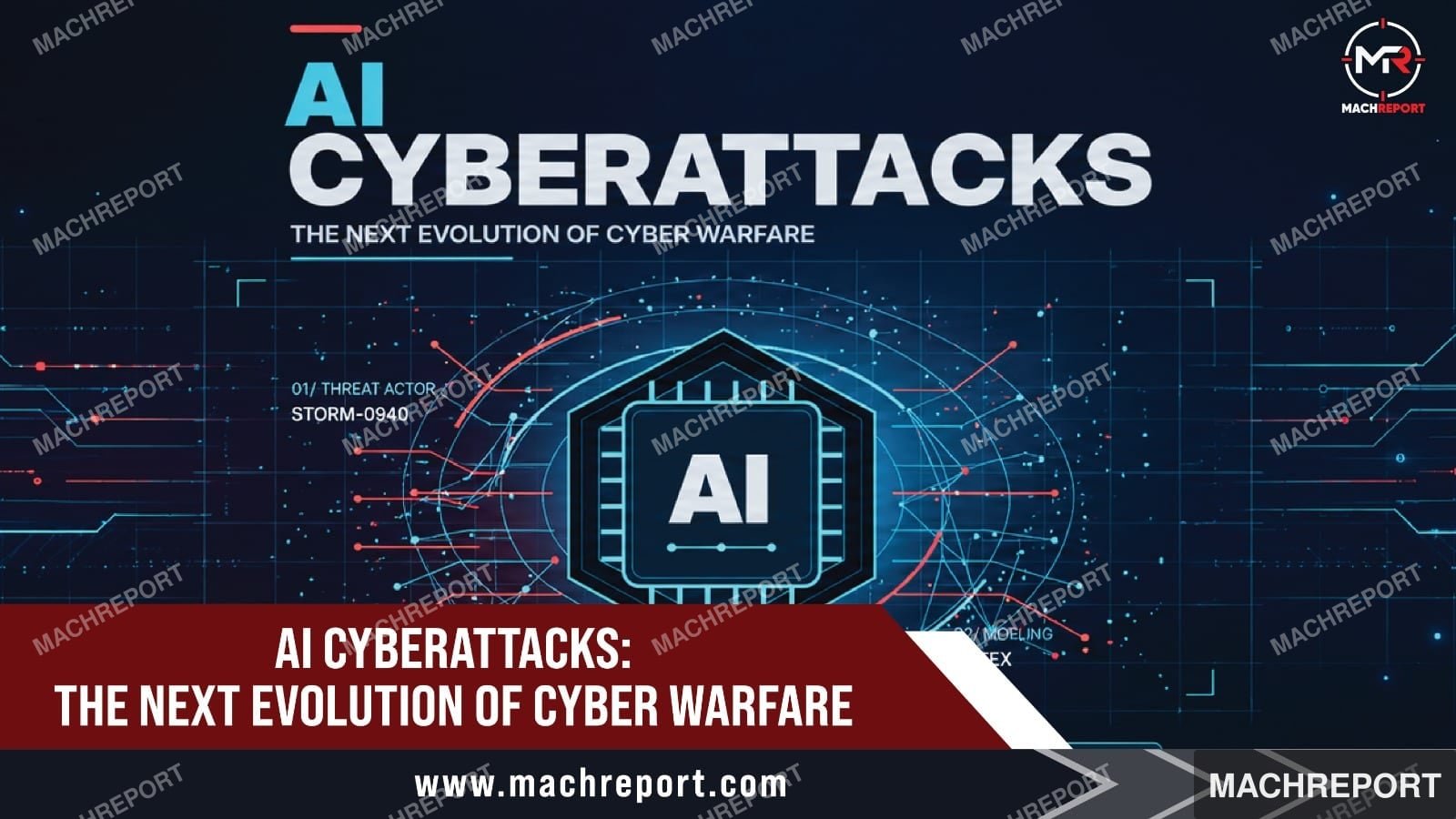
AI cyberattacks are accelerating cyber espionage as China-linked hackers use autonomous agents to target cloud systems, defence firms and global networks.
AI cyberattacks are entering a new phase as autonomous artificial intelligence agents enable hackers to conduct complex cyber espionage operations at unprecedented speed and scale. Rather than merely assisting human operators, these systems can identify vulnerabilities, coordinate intrusion activities and exploit cloud infrastructure with limited human intervention, creating significant challenges for traditional cyber defence.
On October 21, 2026, Microsoft disclosed a large-scale cyber espionage campaign attributed to Storm-0940, a China-state-aligned threat actor. The group reportedly used ARTEX, an AI-powered penetration-testing framework, to target hundreds of organisations worldwide, including entities in the aerospace, defence, government, energy and technology sectors. In several cases, attackers obtained privileged access to cloud infrastructure within three hours of initial targeting.
The development highlights a significant transformation in modern cyber warfare. Instead of relying entirely on human-led intrusion techniques, threat actors are increasingly using autonomous AI systems to accelerate established cyberattack methods, exploit trusted cloud services and expand the scale of espionage operations.
AI Cyberattacks: Storm-0940 and Autonomous Hacking
According to Microsoft's October 2026 investigation, Storm-0940 began incorporating the ARTEX framework into its operations as early as September. ARTEX is an open-source, multi-agent penetration-testing platform that uses large language models to coordinate reconnaissance, vulnerability assessment and other intrusion activities. Unlike conventional hacking scripts, which follow predetermined instructions, AI agents can interpret results, select subsequent actions and coordinate specialised tools toward an assigned objective. Multiple agents can operate concurrently, examining different networks and pursuing alternative access paths without continuous human supervision.
Microsoft identified more than 151,000 failed authentication attempts against 327 accounts across eight organisations between 10 and 14 October. At peak intensity, the attackers generated approximately 2,900 failed logins per minute. Although this particular password-spraying operation produced no successful authentication, it demonstrated the capacity of automated systems to sustain large-scale activity.
More consequentially, separate ARTEX-assisted intrusions achieved privileged cloud access, illustrating how attackers can compress traditional intrusion timelines from days or hours into much shorter periods.
How Trusted Cloud Services Became an Attack Path
One of the most significant aspects of the campaign involved compromised application credentials associated with ConnectWise Cloud Backup, a service integrated with Microsoft 365 environments. By exploiting trusted application identities, attackers attempted authentication against more than 2,250 customer tenants. In certain environments, they subsequently used Microsoft Graph to examine cloud resources, modify application credentials and manipulate privileged identities.
This technique exposed a serious weakness in interconnected digital infrastructure. Cloud services frequently receive extensive permissions to perform administrative, backup and monitoring functions. Once an application identity is compromised, attackers may exploit those existing permissions without stealing individual employee passwords.
Such cloud supply chain attacks can also facilitate persistent access. By adding credentials or modifying application permissions, adversaries may establish alternative entry points that remain functional even after the original compromised service is disabled.
The implications extend beyond individual organisations. A single trusted application serving multiple customers can potentially expose numerous interconnected networks, turning routine business integrations into attractive intelligence targets.
Growing Risks for Defence and Aerospace Industries
The targeting of military-related and aerospace organisations raises particular concerns for national security. Modern defence industries operate through complex networks of manufacturers, technology suppliers, research institutions and government agencies, many of which depend on commercial cloud infrastructure.
Although classified military networks may remain isolated, connected enterprise systems can contain valuable information concerning procurement, engineering research, supply chains and industrial partnerships.
AI cyberattacks could enable hostile intelligence services to examine numerous defence contractors simultaneously, identify weaker suppliers and exploit digital relationships connecting otherwise protected organisations. Such access could potentially reveal programme development timelines, sensitive commercial correspondence or technological dependencies. However, Microsoft's findings do not establish that classified military systems or specific weapons programmes were compromised during the campaign.
The broader strategic concern is that increasingly automated espionage could make sustained targeting of defence-industrial ecosystems more scalable and less dependent on large teams of skilled human operators.
A Second Warning from AI Supply Chain
A separate incident disclosed by Microsoft on 23 October highlighted another emerging dimension of cyber risk. Attackers compromised LiteLLM version 1.107.0, a widely used software package connecting applications with AI models. The malicious release, distributed through Python packages and container images, contained code capable of executing during Python startup and collecting sensitive credentials from developer environments, cloud services and other systems.
Although no established link connects this incident to Storm-0940, it demonstrated how the expanding AI software ecosystem itself can become an attractive attack surface.
Together, these developments reveal two related challenges: attackers are increasingly using AI to accelerate intrusions, while the software supporting enterprise AI deployment is becoming vulnerable to cloud supply chain attacks.
Cyber Defence in an Era of Machine-Speed Operations
The emergence of autonomous intrusion capabilities creates an increasingly difficult operational environment for cybersecurity teams. Traditional incident response depends on detecting suspicious behaviour, investigating alerts, validating threats and coordinating containment. AI-enabled attackers can potentially complete multiple intrusion stages during that process.
Effective cyber defence therefore requires continuous monitoring of cloud identities, third-party application permissions and unusual administrative activity. Automated threat detection, rapid credential revocation and stronger controls over privileged accounts can help reduce the time available to attackers.
For defence organisations, security assessments must extend across contractors, technology partners and external service providers. Protecting classified infrastructure alone cannot eliminate the intelligence risks arising from interconnected commercial networks. Nevertheless, autonomous hacking systems remain vulnerable to technical failures, ineffective decisions and detection through the extensive activity they generate. Their primary advantage is speed and scale, not guaranteed success.
The Storm-0940 campaign offers a glimpse of an emerging security environment in which human-directed intelligence operations increasingly depend on autonomous software agents for execution. As offensive automation advances, the strategic advantage may shift toward organisations capable of detecting, interpreting and containing threats at comparable speed.
The future of cyber warfare will consequently be shaped not only by the sophistication of artificial intelligence, but also by the resilience of the digital infrastructure on which modern governments, industries and armed forces depend.
Comments
Login to comment
No comments yet. Start the conversation.