AI Hallucinations Could Trigger "Strategic Miscalculations," Warns J-20 and J-36 Designer
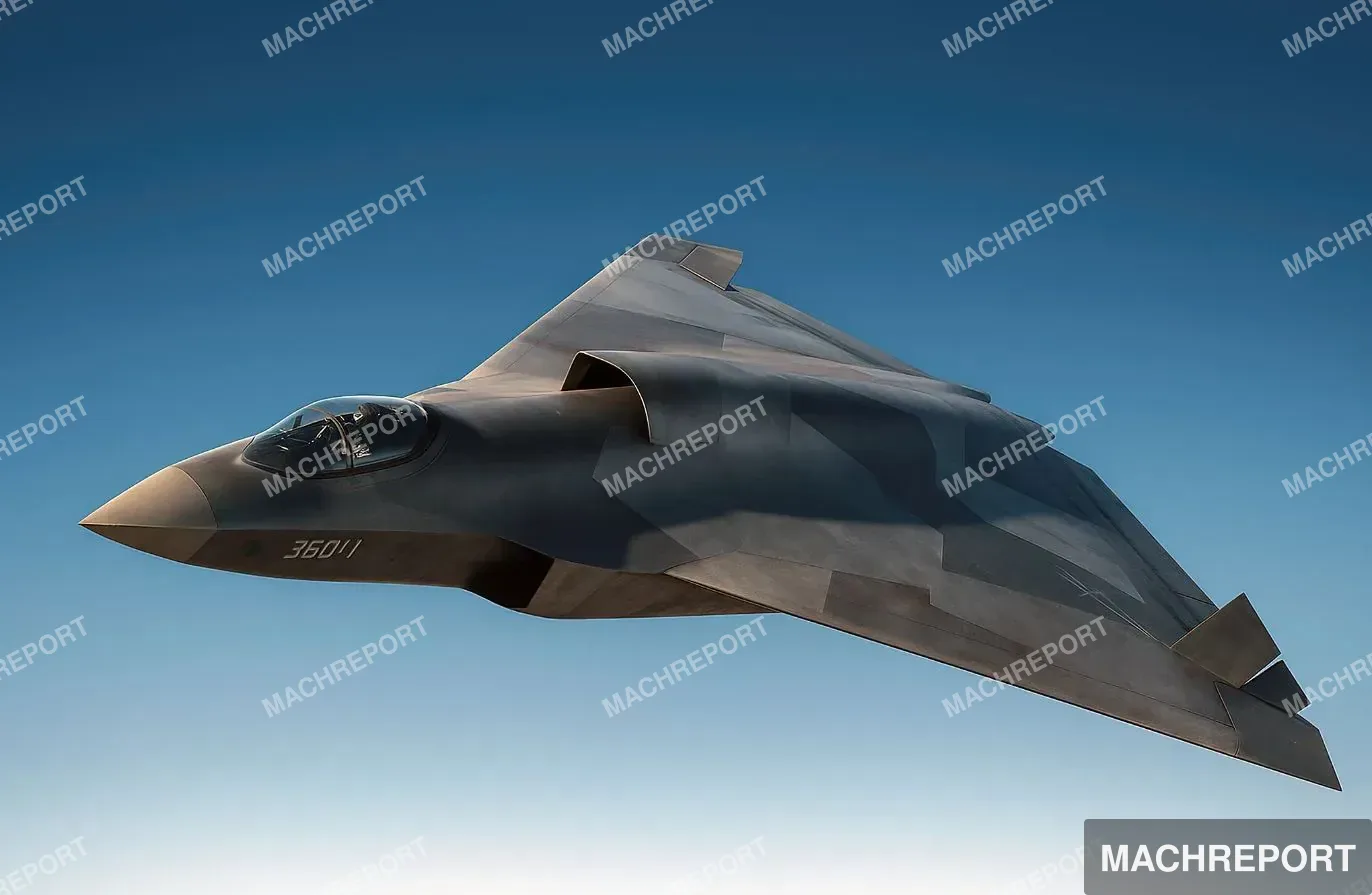
Chinese engineers behind the J-20 and J-36 stealth fighters are warning that AI could seriously distort military intelligence. Large language models can hallucinate aircraft specifications, radar data, and even entire military bases or units, since they're rarely trained on authoritative defense sources. These errors could corrupt fighter design decisions and combat simulations, potentially causing dangerous strategic miscalculations.
Artificial intelligence has transformed how militaries gather and process data, compressing tasks that once took human analysts weeks into a matter of minutes. Yet the very engineers behind China's most advanced stealth fighter programs are now sounding the alarm on the risks this speed carries, warning that AI's tendency to fabricate plausible-sounding but false information could translate into catastrophic miscalculations on the battlefield. Zhang Xianzhe, an engineer at the AVIC Chengdu Aircraft Research and Design Institute, the organization responsible for developing the People's Liberation Army's J-20 stealth fighter and the next-generation J-36, published a paper on June 20 urging restraint in how artificial intelligence is deployed within defense technology intelligence work.
Given that Chengdu's design bureau sits at the heart of China's fighter jet development, Zhang's concerns carry particular weight. His paper appeared in Information Studies: Theory & Application, a journal published by the state-owned arms manufacturer Norinco, signaling that this is not a fringe academic critique but one circulating within China's defense-industrial establishment itself.
The Hallucination Problem
At the core of Zhang's warning is the well-documented phenomenon of AI "hallucination," the tendency of large language models to generate confident, coherent-sounding output that is nonetheless factually wrong. In most consumer applications, a hallucinated fact is a minor inconvenience. In military intelligence, Zhang argues, it can be far more dangerous.
He noted that AI systems can invent basic aircraft specifications, including length, payload capacity, weapons loadout, top speed, and combat radius, while also generating incorrect radar scan ranges and frequency bands. These are not cosmetic errors. They are precisely the data points that shape how a rival aircraft is understood, and, by extension, how a nation's own fighters are designed to counter it.
Zhang described the underlying risk in stark terms: false outputs produced with the appearance of credibility could have severe consequences in an intelligence domain where there is little room for error, potentially leading to strategic miscalculation between nations.
Why Fighter Design Depends on Accurate Intelligence
The paper lays out why this matters so acutely for aircraft development. Before engineers can settle on the defining characteristics of a new fighter, they need a clear picture of the adversary and the battlefield environment. That includes understanding an opponent's radar coverage and the frequencies it operates on, the effective "no-escape zones" of enemy air-to-air missiles, the sophistication of electronic warfare systems, the patrol patterns of airborne early-warning aircraft, and the layout of ground-based air defense networks.
This intelligence directly shapes some of the most consequential decisions in aircraft design, from how much a jet's radar cross-section needs to be minimized, to how powerful its onboard radar must be, to the architecture of its electronic warfare suite, its maneuverability, its range, and its combat radius. If the underlying intelligence is flawed, the resulting design choices are built on a faulty foundation.
Zhang's central concern is that large language models are simply not well suited to this task. Because they are rarely trained on authoritative military sources, he explained, they can produce content that defies basic physics, established design principles, or real-world operational constraints, precisely the kind of nonsense a human military analyst would immediately recognize as implausible.
A Cascade of Possible Errors
The scope of potential AI-driven errors, according to Zhang, extends well past mislabeled specifications. He pointed to examples such as recommending materials that would exceed known fatigue limits, describing flight maneuvers that violate the basic laws of aerodynamics, or generating mission plans that assume an aircraft can fly farther than its actual range allows. On the intelligence side, AI systems could also fabricate details about military bases, invent nonexistent military units, or misrepresent troop and exercise movements that never occurred.
The most consequential danger, Zhang argued, lies in how these errors propagate through analysis and simulation. Once a hallucinated data point enters a modeling or war-gaming exercise, it can quietly distort assessments of an adversary's real combat capability, with analysts and commanders potentially unaware that the foundation of their conclusions is fictional.
A Real-World Precedent
Zhang's paper does not treat this as a purely theoretical risk. It references a strike carried out by the United States against a target in Iran in March 2026, which struck a school and killed more than 175 children. The paper attributes this tragedy in part to outdated targeting data that still classified the building as a military site, compounded by an AI system that flagged it as a high-priority target.
Officials have said that human decision-makers made the final call to strike. But the episode has intensified scrutiny over whether the sheer speed and volume of AI-processed intelligence leaves frontline analysts enough time to meaningfully verify every AI-generated recommendation before it is acted upon, a tension Zhang's paper explicitly invokes as a cautionary example for China's own military-AI ambitions.
Rather than rejecting AI outright, Zhang's paper argues for a more disciplined approach to its integration into defense intelligence. He recommends training models on verified, trustworthy defense data rather than general-purpose datasets, building searchable and authoritative knowledge bases that models can draw from, crafting clear and highly specific prompts to reduce ambiguity, and introducing cross-checking mechanisms, including having multiple AI systems debate or challenge each other's outputs before conclusions are accepted.
He closes by calling for continued development of safer, more efficient, and more reliable applications of large language models specifically tailored to defense technology intelligence.
Zhang's paper captures a tension that extends well beyond China's fighter programs: the same speed and scale that make AI attractive for military intelligence are precisely what make its errors so dangerous when they go unchecked. As militaries around the world race to integrate AI into targeting, analysis, and design decisions, the warning from within one of China's most sensitive defense institutions serves as a reminder that credibility and accuracy, not just speed, must remain the benchmark for any system with life-and-death stakes attached to its output.
Comments
Login to comment
No comments yet. Start the conversation.