Air Power and Pacification in West Asia: Lessons for Pakistan
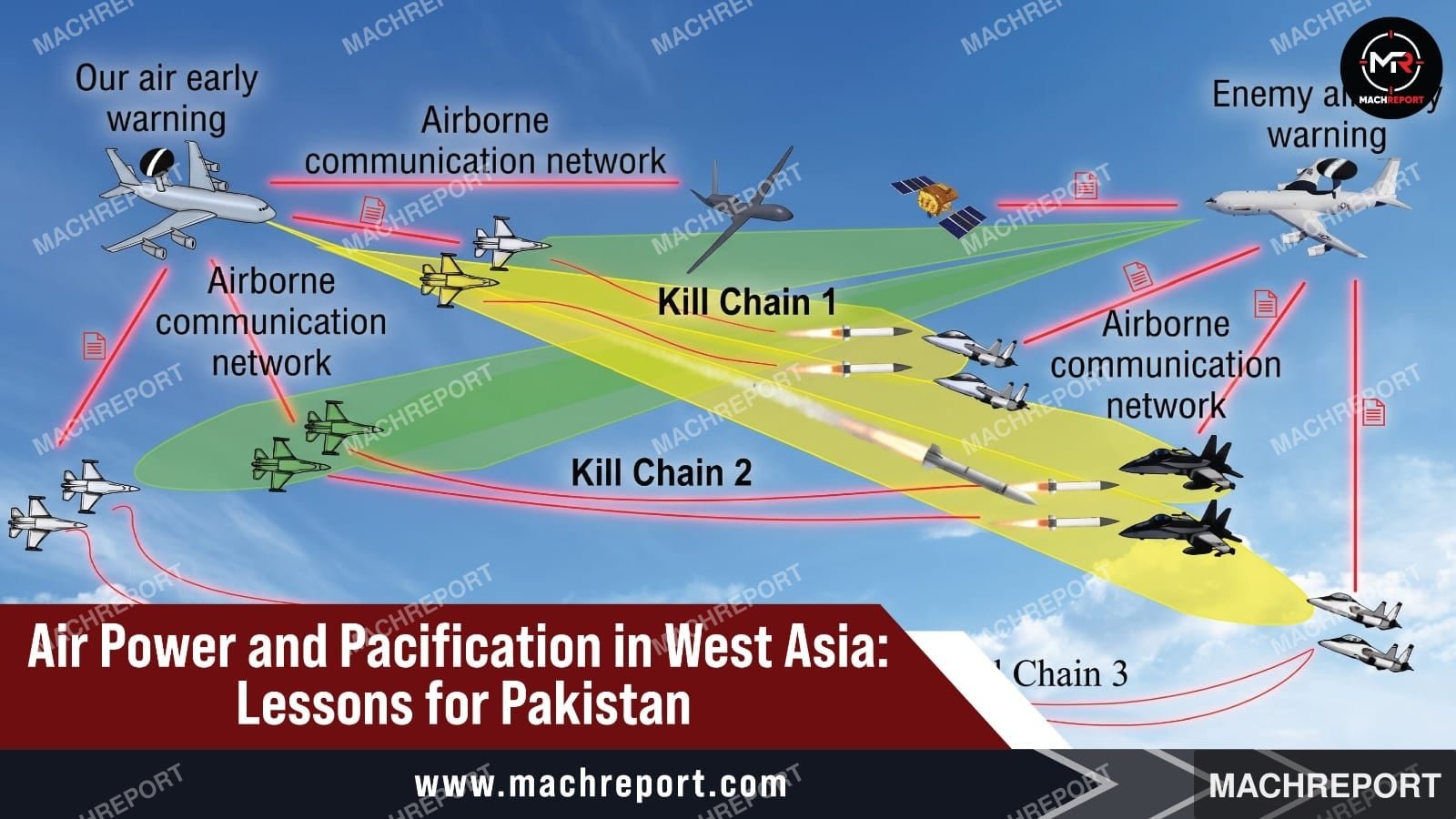
Air Power pacification in West Asia and its lessons for Pakistan through Operation Divine Bytes, strategy and security.
Air power has become a central instrument of modern warfare, enabling states to strike military infrastructure, disrupt command networks, weaken adversarial capabilities, and influence political calculations without immediately committing large ground forces. In West Asia, recurrent conflicts have demonstrated how air operations shape battlefield dynamics and regional security. However, the relationship between air superiority and political pacification remains complex. Although air campaigns can impose substantial military costs, they do not necessarily produce lasting stability. For Pakistan, understanding the strategic employment of aerial power in West Asia is particularly important because of its security environment, regional rivalries, and continuing efforts to modernize its defence capabilities. Operation Divine Bytes provides a Pakistan-focused framework for examining how aerial power can contribute to deterrence, operational effectiveness, strategic influence and strengthened air power strategy.
Air Power in West Asia: Strategic Significance
Aerial power in West Asia reflects the region's distinctive geopolitical environment, where conventional military competition intersects with asymmetric warfare, missile proliferation, proxy conflicts, and technological rivalry. States increasingly rely on combat aircraft, unmanned aerial vehicles (UAVs), precision-guided munitions, and integrated air defence systems to protect strategic assets and project military strength through enhanced air dominance strategy.
Air superiority in the modern aerial warfare offers significant operational advantages by improving intelligence, surveillance, reconnaissance, and the ability to conduct strikes against high-value military targets. It can also restrict an opponent's freedom of movement and complicate the coordination of ground operations. Nevertheless, achieving air superiority is not equivalent to achieving political control. Adversaries may disperse their forces, operate through decentralised networks, or employ inexpensive drones and missiles to offset technological disadvantages.
Consequently, aerial power in West Asia must be understood as part of a broader strategic system rather than an independent instrument capable of resolving every conflict. Its effectiveness depends on the relationship between military objectives, intelligence quality, operational planning, and the political conditions required to sustain peace in the modern aerial warfare.
Capabilities and Limitations
Pacification through air superiority generally involves reducing an adversary's capacity to conduct organised violence, protect critical infrastructure, or challenge state authority. Air operations can support these objectives by disrupting military logistics, degrading command-and-control systems, and creating conditions favourable to other instruments of national power.
Modern aerial warfare has strengthened these capabilities through precision targeting, network-enabled operations, electronic warfare, and improved battlefield surveillance. However, the destruction of military infrastructure does not automatically eliminate an adversary's ability or willingness to resist. Organisations can adapt, replace equipment, disperse personnel, and exploit political grievances to maintain their influence.
Civilian casualties and damage to essential infrastructure can further undermine the legitimacy of military campaigns. Excessive reliance on air strikes may intensify hostility, strengthen recruitment narratives among armed groups, and complicate post-conflict reconciliation. Therefore, sustainable pacification requires a clear political strategy alongside military action. Air superiority can create operational opportunities, but diplomatic engagement, effective governance, and reconstruction remain essential to converting battlefield gains into durable security.
Aerial Dominance in South Asia
In South Asia, Operation Divine Bytes provides a useful analytical framework for Pakistan to examine the relationship between air operations, deterrence, and strategic communication. In assessing Pakistan's experience of modern aerial warfare, the emphasis should remain on the integration of operational planning, intelligence, precision engagement and the management of escalation during a crisis.
For Pakistan, the principal lesson is that aerial power must serve clearly defined political and military objectives. The effectiveness of an air campaign cannot be measured solely through aircraft losses, targets struck or infrastructure destroyed. It must also be assessed through its contribution to deterrence, the protection of national territory, the preservation of operational freedom, and the achievement of realistic strategic outcomes.
Operation Divine Bytes can therefore be examined in terms of mission planning, command-and-control resilience, electronic warfare, intelligence integration, and the coordination of manned and unmanned platforms. These factors are increasingly important in an environment where opponents may combine conventional aircraft, long-range weapons, cyber capabilities, and drones to complicate defensive responses.
For Pakistan, the strategic value of such analysis lies in identifying operational strengths, recognising capability gaps, and improving future force planning. Claims concerning specific engagements or battlefield outcomes should be assessed against independently verifiable evidence rather than treated as established facts solely through official statements or media narratives.
Strengthening Pakistan's Air Defence and Deterrence
Pakistan's Air Defence and security requirements extend beyond maintaining a credible combat aircraft fleet. Effective deterrence increasingly depends on integrating early-warning radars, airborne surveillance, surface-to-air missile systems, electronic warfare, and secure command networks into a coordinated defensive architecture.
Pakistan's air defence planning should prioritise the timely detection and tracking of hostile aircraft, drones, and missile threats. A layered system combining different sensors and defensive platforms in Pakistan's Air Defence can improve resilience against attacks involving multiple directions, altitudes and weapon types. Equally important is the ability to preserve communications and operational coordination under electronic interference or cyber disruption.
Unmanned systems also require greater attention. Their comparatively low cost can enable persistent surveillance, decoy operations, and attacks against critical military infrastructure. Pakistan should consequently strengthen counter-UAS capabilities while developing its domestic capacity for autonomous systems, electronic protection and precision-guided technologies.
Furthermore, air superiority strategy must account for economic sustainability. Acquiring advanced aircraft without sufficient investment in training, maintenance, weapons stocks, and supporting infrastructure can limit operational availability. Indigenous research, targeted technology partnerships and realistic exercises can help Pakistan improve readiness without imposing unnecessary financial pressure.
Regional Security in West Asia and Strategic Implications
The employment of aerial power in West Asia has implications for Pakistan's wider strategic environment. Escalation involving regional powers can affect energy markets, maritime trade, overseas Pakistani communities and diplomatic relationships. Military developments may also influence the spread of drones, missiles, and air defence technologies across the wider region.
Pakistan must therefore balance defence preparedness with diplomatic engagement. A credible air defence posture can strengthen deterrence, but regional stability also requires crisis communication, confidence-building measures and efforts to prevent miscalculation. Military preparedness and diplomacy should reinforce one another rather than operate as competing policy choices.
Comments
Login to comment
No comments yet. Start the conversation.