BrahMos Missile Deal with UAE: Strategic Implications
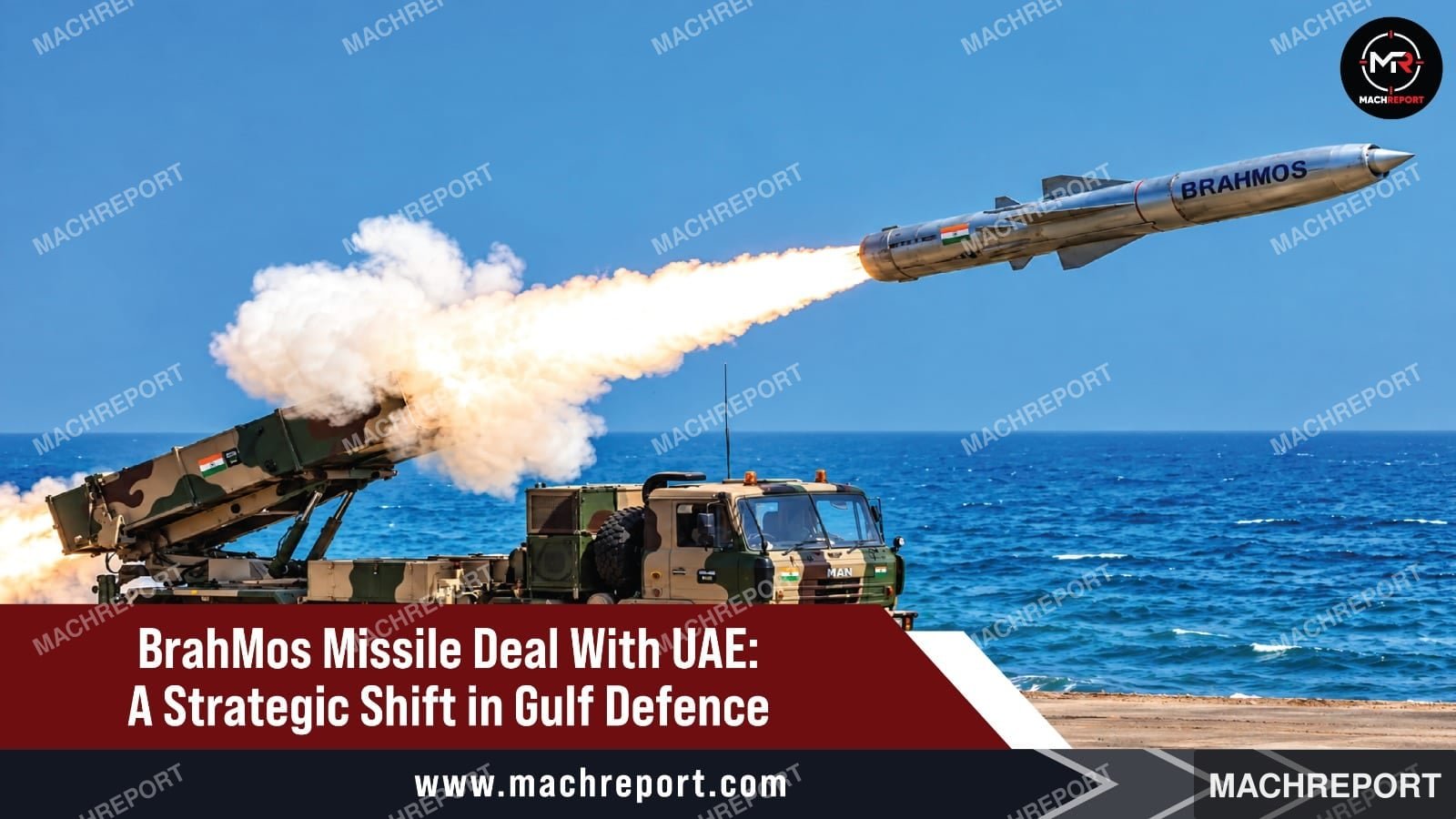
BrahMos missile deal with UAE could reshape Gulf security architecture, strengthen India-UAE defence cooperation and expand India's defence exports.
BrahMos Missile Deal with UAE: A Strategic Shift in Gulf Defence
India's efforts to expand its defence footprint in West Asia could receive a significant boost as the United Arab Emirates (UAE) considers acquiring the BrahMos supersonic cruise missile. The proposed BrahMos missile deal with UAE represents more than a potential arms transaction. It reflects Abu Dhabi's changing security priorities, New Delhi's growing defence export ambitions and the evolving strategic balance in the Gulf.
Developed jointly by India and Russia, BrahMos has attracted international attention for its speed, precision and operational versatility. A successful agreement would make the UAE the first Gulf customer for the missile, potentially opening a lucrative market for Indian defence technology while strengthening bilateral security cooperation.
BrahMos Missile Deal with UAE: Strategic Background
India's defence engagement with West Asia has expanded considerably in recent years. Saudi Arabia has emerged as an important destination for Indian ammunition exports, while Oman maintains extensive defence cooperation with New Delhi. Meanwhile, India-UAE defence cooperation has increasingly moved beyond military exercises and training towards defence manufacturing, technology and advanced weapons systems.
The BrahMos programme represents one of India's most successful defence-industrial collaborations with Russia. Developed by India's Defence Research and Development Organization (DRDO) and Russia's NPO Mashinostroyeniya, the missile travels at approximately Mach 2.8 and can be launched from land, sea and air platforms.
Its export configuration has traditionally featured a range of approximately 290 kilometers, although longer-range variants have since been developed. Its high speed, precision-strike capability and relatively short engagement time make it particularly relevant for maritime deterrence and strikes against high-value targets.
The Philippines became its first international customer in 2022, followed by agreements involving Vietnam and Indonesia in 2026. The UAE's reported interest could now extend BrahMos's international presence into the strategically important Gulf region.
Why Abu Dhabi Wants BrahMos
The UAE's interest in BrahMos reflects growing concerns about regional instability, particularly tensions involving Iran and the vulnerability of critical infrastructure and maritime trade routes.
Located near the Strait of Hormuz, one of the world's most important energy corridors, the UAE faces persistent risks from missile attacks, drones and potential disruptions to commercial shipping. These concerns have intensified amid regional military confrontations.
Abu Dhabi already operates sophisticated American air-defence systems, including Patriot and Terminal High Altitude Area Defence (THAAD). However, these platforms primarily provide defensive capabilities.
The BrahMos supersonic cruise missile would introduce a complementary offensive capability, enabling rapid precision strikes against designated maritime and land targets. Its deployment could strengthen deterrence by increasing the potential costs of hostile military action. Reports also indicate Emirati interest in India's Akashteer air-defence command-and-control system, suggesting a broader effort to diversify defence procurement and improve operational integration.
Nevertheless, acquiring BrahMos would not automatically guarantee strategic superiority. Effective deployment would require reliable intelligence, surveillance, target acquisition and command-and-control integration.
Implications for Indian Defence Exports
For New Delhi, the proposed agreement carries considerable economic and geopolitical significance. According to India's Ministry of Defence, Indian defence exports reached a record ₹38,424 crore in financial year 2025–26, compared with ₹23,622 crore in the preceding year, representing growth of approximately 62.7%. This expansion reflects India's transition from traditional dependence on foreign military equipment towards developing a competitive domestic defence industry. BrahMos has become an important symbol of this transformation. Its reported operational employment during Operation Sindoor in 2025 has further contributed to international interest, although individual battlefield performance claims require independent assessment. A successful UAE agreement would strengthen Indian defence exports in a market traditionally dominated by American and European suppliers. It could also create opportunities for long-term maintenance, training, logistical support and future defence-industrial collaboration. More importantly, India-UAE defence cooperation would acquire an additional strategic dimension, reinforcing India's position as both an economic and security partner in West Asia.
Russia's Role in the Proposed Agreement
Russia remains an indispensable stakeholder in any international BrahMos transaction. BrahMos Aerospace operates as an Indo-Russian joint venture, with India holding 50.5% and Russia 49.5% ownership. Consequently, Russian approval and relevant technology-transfer considerations remain important elements of potential export agreements. Moscow maintains substantial diplomatic and economic relations with Abu Dhabi, suggesting that Russian participation may be manageable. Nevertheless, approval cannot be assumed before formal confirmation. The agreement could also generate commercial benefits for Russian defence industries through joint-venture arrangements and associated technical support. However, Western sanctions against Russia, payment mechanisms and restrictions involving sensitive technologies could complicate negotiations. These considerations demonstrate that the proposed transaction involves not merely two countries but a wider network of strategic and industrial interests.
Regional Security and Geopolitical Implications
A potential BrahMos acquisition could influence the Gulf security architecture by introducing another advanced precision-strike capability into an already heavily militarized region. For Abu Dhabi, diversifying defence partnerships reduces dependence on individual suppliers and potentially increases strategic flexibility. For India, expanding military cooperation with the UAE offers opportunities to deepen regional influence without establishing formal military alliances. However, New Delhi must carefully balance its growing Gulf partnerships with its longstanding relations with Iran and other regional actors. The principal challenge will involve strengthening defence cooperation while avoiding perceptions of direct participation in regional rivalries.
The proposed BrahMos sale represents a potentially significant development in India's emerging role as an international defence supplier. For the UAE, it offers an opportunity to diversify weapons procurement and reinforce deterrence amid growing regional uncertainties. For India, it could unlock new defence markets, consolidate strategic relationships and demonstrate the international competitiveness of its missile technology.
Russia's participation remains an important consideration, while financing, technology protection and regional sensitivities could shape negotiations. Ultimately, the agreement's significance will depend on whether current discussions translate into a binding contract and operational integration. If concluded, it could mark an important milestone in India-UAE defence cooperation and India's expanding strategic presence in West Asia.
Comments
Login to comment
No comments yet. Start the conversation.