CHINA ADAPTS SMOKE SCREENS FOR DRONE ERA
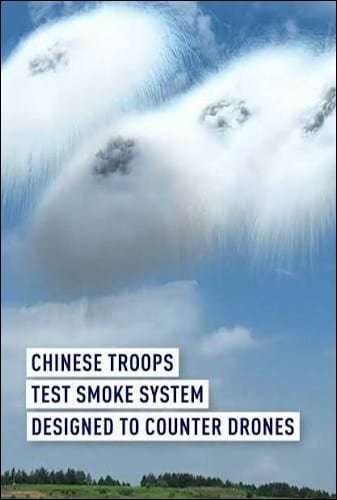
China is testing traditional smoke-screen tactics for an increasingly transparent modern battlefield. Chinese military media released footage of a PLA live-fire exercise testing a mobile smoke-screen capability designed to rapidly create a broad, continuous concealment barrier. While smoke has long been used to obscure positions and movements, its renewed emphasis reflects growing challenge posed by Drones and persistent surveillance. This capability could provide forces with temporary concealment during relocation and other exposed operations, making it a potential layer in battlefield survivability and counter-UAS measures.
China Tests a New Approach to Battlefield Concealment
Battlefield is becoming increasingly difficult to hide on. Small drones can observe positions from above, track movement and provide targeting information to artillery and attack systems. For military forces challenge is no longer simply to camouflage a position, but to prevent an adversary from maintaining a continuous picture of what is happening on the ground.
China's latest PLA training exercise demonstrates how it is adjusting battlefield concealment to an environment that is becoming more and more influenced by ongoing drone warfare. On 25 August 2026, Chinese media showcased a PLA live-fire exercise involving a mobile smoke-screen deployment capability designed to create a broad, continuous smoke barrier. Smoke screens have traditionally been used to hide positions and troop movements, the demonstration is significant because it shows how they have been adapted to modern combat, where battlefield activities can be continuously seen by UAVs and other surveillance devices. PLA's focus on rapid, mobile, and coordinated smoke deployment suggests an attempt to temporarily obscure units during maneuvers, repositioning, and other exposed actions.
Turning Smoke into a Mobile Battlefield Tool
The latest footage released by Chinese media shows multiple smoke-screen rounds being employed together. These rounds create smoke in the air and across a wider area, allowing troops to establish a temporary visual barrier between themselves and adversary. This provides a simple but potentially valuable option for unit to reposition from exposed area.
Military formations cannot always avoid being detected by adversary forces particularly on modern battlefield, where technological advances have made it increasingly difficult for forces operating in open to remain concealed. Armored vehicles have to relocate, artillery has to displace, logistics units have to move and command elements have to reposition. Hence ability to create a concealment at a critical moment can therefore be more useful than attempting to remain invisible continuously. PLA is exploring precisely this type of active concealment.
Drone Threat Changes the Equation
Relevance of this development becomes clearer when analyzed through rapid development of FPV drones and loitering munitions. These systems depend on on cameras or electro-optical sensors to track and identify targets. Once drone has established a visual contact with the target then it is difficult to avoid the attack. However, a dense smoke screen can interfere with this process by temporarily removing target from the sensor’s field of view. The effect is therefore not necessarily destruction of drone. Instead, aim is to break observation and targeting chain. For a target under surveillance, even a short interruption can matter. It may provide enough time to change position, move behind terrain or deploy another defensive measure. For artillery and other high-value systems such a delay could contribute directly to survivability.
This makes latest Chinese demonstration relevant to counter-drone warfare. Although, Chinese reporting presents capability primarily as a smoke-screen and concealment system. Its counter-UAS value comes from its potential to deny or degrade visual observation.
China Is Also Putting Smoke on Drones
In another significant development PLA is not limiting smoke deployment to ground-based systems. Chinese military reporting described a combined-arms exercise in northern China in which smoke-emitting UAVs were deployed to obscure enemy observation posts and fire positions. Exercise involved UAVs carrying obstacle-breaching munitions before a group of smoke-emitting drones deployed a smoke screen, allowing ground forces to advance. The report said PLA personnel had tested different flight patterns and smoke-release methods under varying wind speeds and humidity levels to develop a coordinated procedure for achieving effective coverage.
This is arguably more significant than smoke screen itself.
Using UAVs to deploy obscuration allows PLA to place smoke closer to area that needs to be concealed rather than relying entirely on ground-based launchers. It also links smoke deployment directly with unmanned operations and combined-arms manoeuvre.
The result is a more flexible concept: Drones can be used not only to find enemy, but also to prevent enemy from seeing friendly forces.
From Concealment to Information Denial
This points to a broader change in way concealment method should be assessed. Traditional camouflage prevents detection. The problem is that persistent Drone surveillance can makes complete concealment hard. A UAV can search repeatedly, observe from different angles and wait for target to expose itself.
Active smoke placement offers another approach: if detection cannot be avoided, force can attempt to deny adversary continuous surveillance. This is effectively a form of information denial.
The goal is not to disappear permanently. It is to introduce uncertainty into adversary’s picture that targeting becomes less reliable. In a battlefield even temporary uncertainty can have huge operational value.
A Layer in Counter-UAS Battle
PLA’s smoke-screen capability should therefore be seen as one component of a broader survivability architecture. Smoke is unlikely to defeat every type of sensor and cannot replace dedicated counter-UAS systems. Wind, humidity, terrain and characteristics of obscurant will affect its performance. Its effectiveness will also depend on sensors carried by attacking drone. A conventional electro-optical camera may be heavily degraded by smoke, while other sensing methods may retain some ability to detect or track a target.
Its value comes from combination of methods employed. Camouflage complicates initial detection. Decoys create uncertainty over location of target. EW interferes with drone functions. Smoke interrupts visual observation. Kinetic counter-UAS systems can deal with drones that continue to penetrate defensive layers.
The purpose is to make the enemy detect–identify–track–engage process increasingly difficult and time taking till units relocate.
The Battle to Control Visibility
The deeper importance of this development lies in changing relationship between observation and survivability. Drones have made modern battlefield more transparent. China’s response is not limited to developing systems that shoot drones down. PLA is also exploring ways to make information collected by those drones less useful. Mobile smoke screens, smoke-emitting UAVs, camouflage, deception and EW can all contribute to that objective. They do not necessarily destroy adversary’s sensor; they complicate its ability to turn observation into a reliable target. That may become one of the defining characteristics of future ground warfare.
PLA’s latest smoke-screen demonstrations therefore represent more than a return to an old battlefield technique. They point towards a Chinese approach in which concealment itself becomes mobile, responsive and integrated with unmanned and counter-UAS operations. In an increasingly transparent battlefield, the ability to temporarily deny the enemy a clear view may prove almost as important as the ability to destroy the systems doing the observing.
Comments
Login to comment
No comments yet. Start the conversation.