China Starlink Strategy: Reusable Rockets and Space Dominance
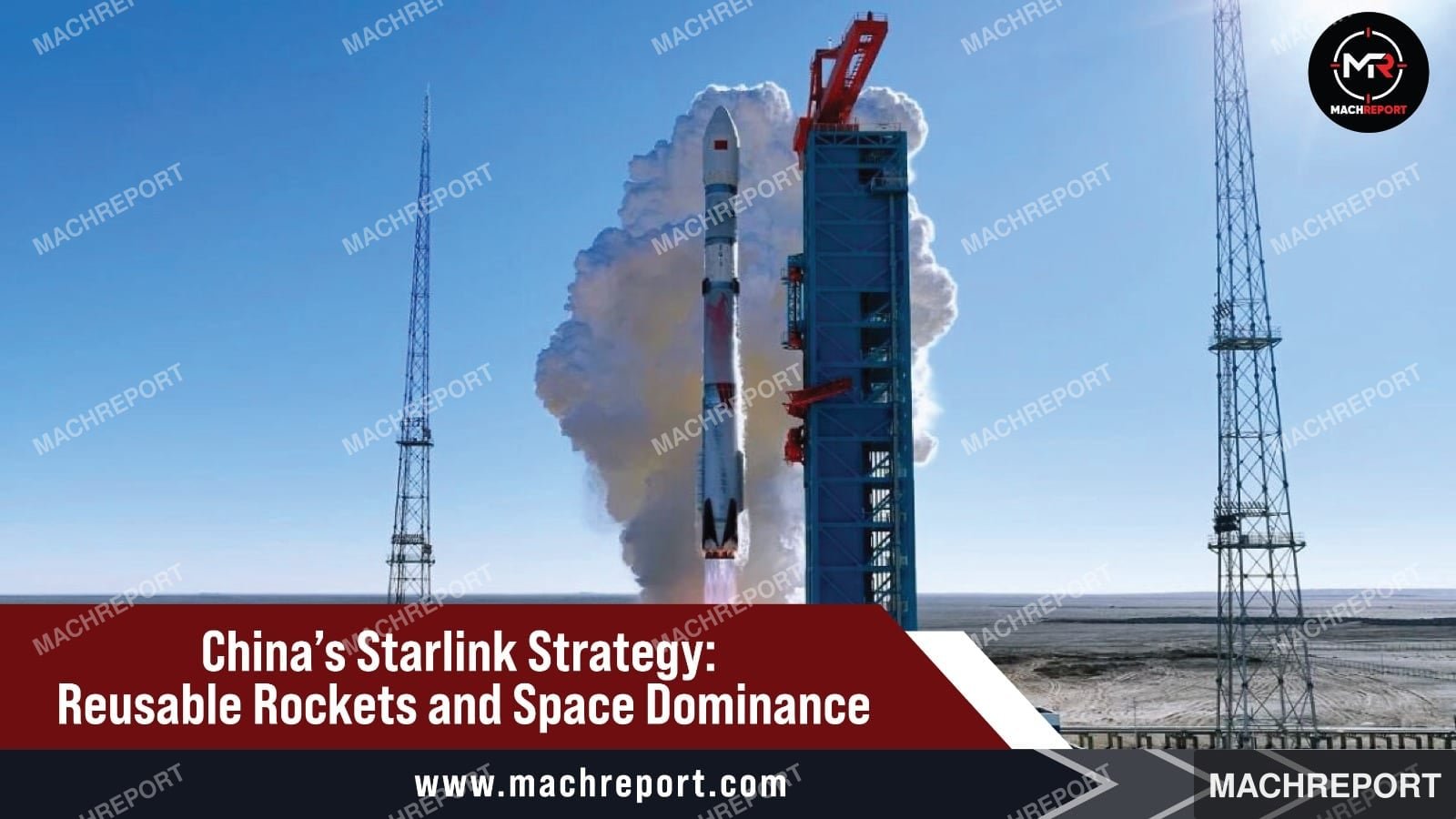
China Starlink strategy combines reusable rockets, satellite constellations and counterspace research as Beijing seeks to challenge SpaceX’s growing orbital advantage.
China’s Starlink Strategy: Reusable Rockets and Space Dominance
China Starlink strategy is increasingly combining reusable rocket technology, large-scale satellite constellations and research into counterspace capabilities. Two recent successful booster recovery tests have brought China’s state-owned and commercial launch sectors closer to a capability that SpaceX has already demonstrated at scale. The developments are significant not only for reducing launch costs but also for China’s ambitions to deploy its own large satellite networks and address the strategic advantages created by SpaceX’s Starlink constellation.
In July, the first stage of the Long March 10B, developed by state-owned China Aerospace Science and Technology Corporation (CASC), successfully slowed its descent and landed inside a netted metal recovery structure positioned on a sea barge. The test represented an important milestone for China’s reusable-launch programme. CASC became the third organisation, after SpaceX and Blue Origin, to demonstrate successful recovery of a rocket booster. The achievement followed a failed recovery attempt by LandSpace’s Zhuque-3 in December, when its reusable first stage crashed into the Gobi Desert. On 18 August, however, Zhuque-3 successfully completed a soft landing on its extended legs, using a recovery approach broadly comparable in concept to SpaceX’s Falcon 9.
The tests do not yet establish reliable commercial reusability. Chinese launch vehicles will require multiple successful flights before their recovery systems can demonstrate consistent operational performance. Additional development will also be necessary before reusable rockets can deliver the launch frequency and cost reductions achieved by SpaceX. Blaine Curcio, founder of Orbital Gateway Consulting and a specialist in China’s space industry, described the Long March 10B test as a “meaningful step forward” while noting that its short-term impact on launch capacity remains limited.
Nevertheless, the successful recovery demonstrations suggest that the gap between China and the United States in reusable launch technology is narrowing. Other Chinese commercial launch companies are also expected to test reusable systems, potentially accelerating competition in a sector that has been transformed by SpaceX.
China’s Reusable Rockets and the Starlink Challenge
The development of reusable rockets is closely connected to China’s ambitions for satellite internet. Starlink, operated by SpaceX, has deployed more than 10,000 satellites and represents roughly 70 percent of satellites in low Earth orbit (LEO), according to figures cited by ChinaTalk. China launched 371 satellites in 2025, compared with 3,169 launched by SpaceX.
Closing that gap would require a dramatic expansion of China’s launch capacity. Reusable rockets could therefore become an important component of Beijing’s long-term plans to build and maintain large satellite constellations. Lower launch costs and faster turnaround times would allow China to place substantially more spacecraft into orbit while supporting the continuous replacement and expansion required by large LEO networks.
China’s approach to Starlink appears to involve two parallel tracks: developing competing satellite-internet networks while examining potential ways to constrain or disrupt Starlink’s strategic advantages.
The military importance of Starlink became particularly visible during Russia’s full-scale invasion of Ukraine, where the network supported communications, military coordination and drone-related operations. Its performance has consequently attracted significant attention from Chinese military researchers examining how commercial satellite networks could influence future conflicts.
PLA Concerns Over China Starlink’s Military Role
The People’s Liberation Army has publicly discussed the potential military significance of Starlink. In May 2022, PLA Daily reported that the constellation could provide high-bandwidth, high-speed military communications and potentially support command-and-control networks connecting US military platforms.
Researchers associated with the PLA and China’s state space sector similarly assessed in 2023 that the growing number of Starlink satellites presented a significant challenge to existing space situational awareness and traditional defence capabilities.
Some Chinese assessments have gone further, suggesting that Starlink could potentially support surveillance and other military missions. However, ChinaTalk has noted that some of these assessments appear to exaggerate the capabilities of individual Starlink satellites, including claims concerning direct reconnaissance of ground targets.
The military relevance of the network nevertheless extends beyond the commercial Starlink service. SpaceX introduced Starshield in December 2022 as a satellite communications and space-based capability developed specifically for US government and military applications.
China and Russia Examine Orbital and Spectrum Constraints
One potential approach examined by Chinese and Russian officials has involved international regulation of orbital positions and radio-frequency spectrum. A November 2023 proposal involving officials associated with CASC and Russian military institutions reportedly considered using existing international satellite regulations to place greater constraints on Starlink's expansion.
The arguments have included concerns over satellite density and collision risks. However, the available material does not establish that China and Russia jointly implemented such measures or submitted a joint filing to the International Telecommunication Union.
China has also filed plans for two proposed megaconstellations that together could involve almost 200,000 satellites. Such filings can help reserve spectrum and orbital positions even if the full number of proposed satellites is never deployed.
In December, China also raised concerns at a United Nations Security Council meeting, accusing Starlink of consuming orbital and frequency resources while increasing risks associated with collisions and space debris. SpaceX has continued expanding its ambitions, including a July application proposing a constellation of up to 100,000 satellites.
Electronic Warfare as a Potential Counter-Starlink Tool
China’s response is not limited to building competing satellite networks. Researchers have also examined electronic warfare and jamming as potential ways to disrupt Starlink.
The scale of the constellation presents a major challenge to such efforts. Because Starlink uses thousands of satellites, disrupting individual satellites or communication links would not necessarily disable the broader network. The system's redundancy could allow traffic to be redirected through other satellites.
A theoretical study by researchers from Zhejiang University and Beijing Institute of Technology examined aerial jamming as one possible approach. The study estimated that aerial jammers operating in a grid at an altitude of 20 kilometres could cover an average area of approximately 38.5 square kilometres per jammer. Applying that theoretical model across Taiwan would require close to 1,000 coordinated aerial jammers.
The figures illustrate the scale of the challenge rather than demonstrating an operational Chinese capability to neutralise Starlink.
GPS Jamming and Starlink
GPS disruption represents another potential vulnerability. Earlier generations of Starlink terminals relied on accurate timing and location information derived from GPS, meaning GPS interference could potentially affect Starlink terminals alongside other systems dependent on satellite navigation.
However, Starlink's newer V5 terminals incorporate the network's own positioning, navigation and timing capabilities. This development could reduce dependence on external GPS signals and increase resilience against conventional GPS jamming.
The evolution highlights an important feature of the China Starlink strategy: as potential vulnerabilities are identified, Starlink can also evolve technically to reduce its exposure to particular countermeasures.
Comments
Login to comment
No comments yet. Start the conversation.