Commercial Satellite Constellations in Armed Conflict
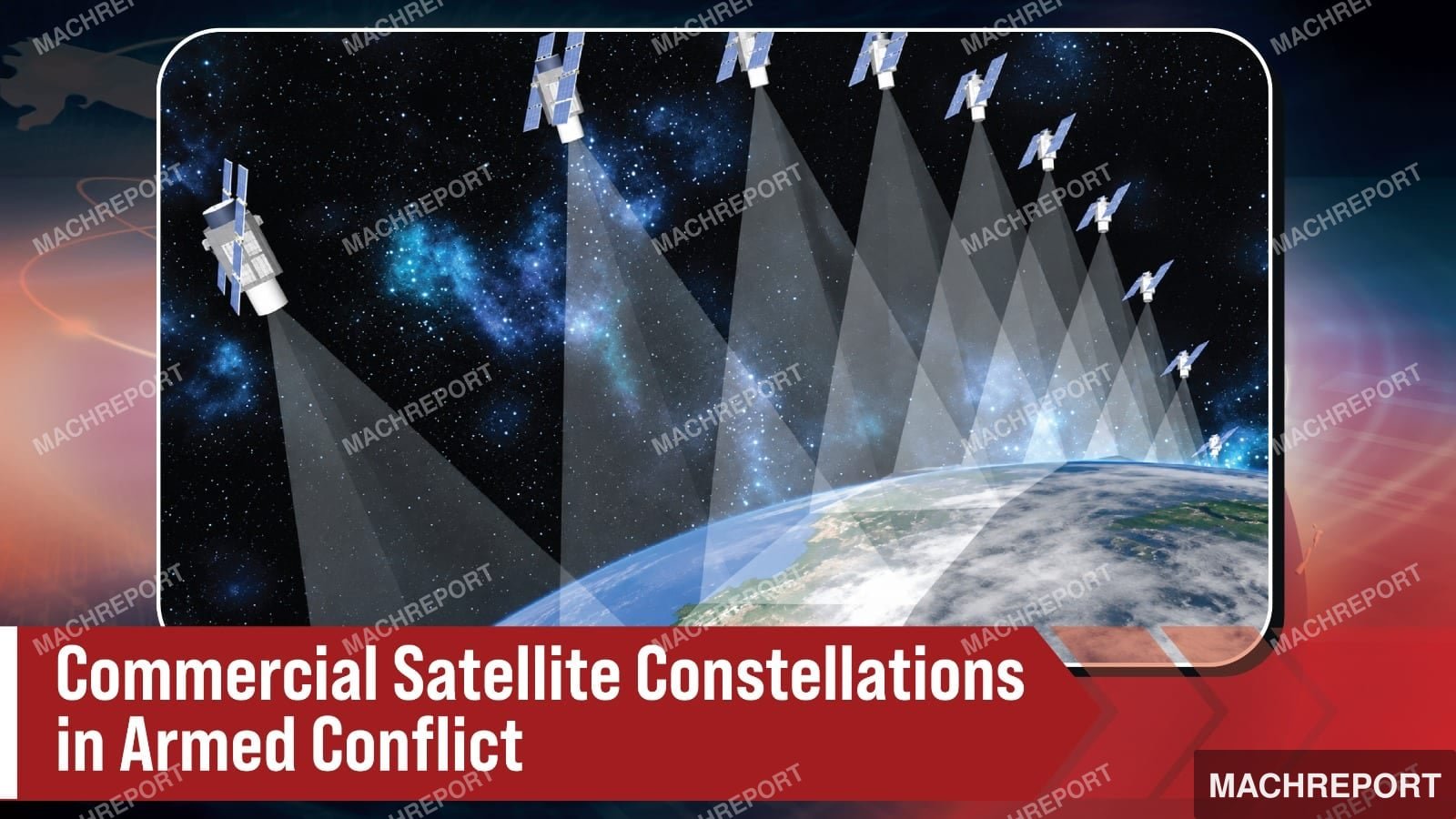
Commercial Satellite Constellations are reshaping warfare, raising legal challenges over targeting, civilian protection and space debris in armed conflict.
The Growing Military Role of Commercial Satellite Constellations
Commercial Satellite Constellations (CSCs) in armed conflicts has blurred the traditional distinction between civilian and military space infrastructure. These satellites increasingly provide connectivity, remote sensing, navigation, and geospatial intelligence that can support both civilian activities and military operations. This dual-use character raises important questions under International Humanitarian Law (IHL), particularly regarding when they may lose their civilian protection and become lawful military objectives.
Commercial Satellite Constellations and Dual-Use Space Infrastructure
Commercial Satellite Constellations are prima facie civilian objects and perform a wide range of civilian functions. They provide broadband connectivity, support weather forecasting, facilitate disaster response, and supply geospatial information for agriculture, infrastructure planning, scientific research, and humanitarian activities.
However, their predominantly civilian character does not necessarily insulate them from the consequences of armed conflict. The Russo-Ukraine War demonstrated how commercial satellite connectivity could become integrated into military operations. Ukrainian forces relied extensively on connectivity provided by the US-based Starlink constellation to support reconnaissance activities, stream drone feeds, and maintain command-and-control capabilities. As a result, commercial satellite infrastructure became increasingly intertwined with battlefield operations.
A similar development emerged during the US-Israel War against Iran in 2026. The US integrated Starlink-supported systems into the deployment of its Low-cost Uncrewed Combat Attack System (LUCAS), a loitering munition platform developed to counter the Iranian Shahed-136 architecture. These systems were reportedly deployed by Task Force Scorpion in a heavily contested electronic-warfare environment against Iranian positions.
These examples illustrate the growing convergence between civilian and military uses of these systems. The resulting dual-use character creates a complex legal dilemma: when does commercial infrastructure remain a civilian object, and when does its military use make it a lawful military objective? International Humanitarian Law and Targeting Commercial Satellites
The legal assessment primarily engages Article 52(2) of Additional Protocol I (AP I) to the Geneva Conventions. Under this provision, an object may constitute a lawful military objective when its “nature, location, purpose, or use makes an effective contribution to military action” and its destruction or neutralization offers a definite military advantage.
The International Committee of the Red Cross (ICRC) commentary further explains that the required “definite military advantage” must be assessed according to the circumstances existing at the time. The anticipated advantage cannot merely be potential or indeterminate.
For Commercial Satellite Constellations, applying this standard creates several practical and legal difficulties.
First, commercial communications satellites are generally not divided neatly into military and civilian components. A single constellation can simultaneously provide services to civilian customers, humanitarian organizations, governments, and military users. Similarly, geospatial intelligence collected by commercial satellites can serve both civilian and military purposes.
For example, US-based Maxar Technology provided imagery concerning a Russian military column near Kyiv while its geospatial capabilities were also used by humanitarian organisations. Such dual-use activity demonstrates the difficulty of separating military functions from civilian services within the same commercial space infrastructure.
The problem becomes even more complicated when a constellation consists of thousands of satellites operating across different orbital paths. Identifying the precise satellite whose destruction would provide a definite military advantage may be extremely difficult. A broad attack against an entire constellation could affect numerous civilian users and raise serious proportionality and distinction concerns.
Legal Challenges in Targeting Commercial Satellite Constellations
The legal framework governing the targeting of these satellite constellations remains incomplete. Space law does not provide a comprehensive set of rules specifically addressing the military targeting of commercial satellite networks.
The 1967 Outer Space Treaty establishes important principles concerning the peaceful use of outer space and prohibits placing nuclear weapons and other weapons of mass destruction in orbit around Earth or on celestial bodies. However, it does not comprehensively establish the circumstances under which conventional Anti-Satellite (ASAT) weapons may lawfully be used against Commercial satellite networks.
The Woomera Manual on the International Law of Military Space Operations attempts to apply existing international legal principles to military activities in space. However, its non-binding nature and criticism from some states limit its ability to provide universally accepted legal guidance.
Consequently, states confronting military threats involving Commercial Satellites must interpret existing IHL and space-law principles in circumstances for which the existing legal framework was not specifically designed.
Space Debris and the Wider Consequences
A further concern is the physical consequence of attacking these systems through kinetic ASAT weapons. A hypervelocity collision can fragment a satellite into thousands of pieces, including debris too small to track effectively. These fragments can remain in orbit for extended periods and create risks for another spacecraft.
The 2019 Indian ASAT test provides an important example of the debris problem. The destruction of the target satellite generated hundreds of trackable debris fragments in low Earth orbit, demonstrating how the effects of an ASAT engagement can extend beyond the immediate military objective.
For Commercial Satellites, the consequences could be even broader because commercial networks often share orbital environments with other civilian, scientific, governmental, and commercial spacecraft. A kinetic attack could therefore create secondary risks for unrelated space infrastructure.
The debris problem also introduces a broader strategic dilemma. Even when a state considers a satellite a legitimate military objective, the wider consequences of destroying it may extend far beyond the immediate conflict. This reinforces the importance of proportionality assessments and consideration of foreseeable effects before conducting an attack against commercial space infrastructure.
Legal Implications for the Future of Commercial Space Infrastructure
The growing military dependence on these dual-use systems is transforming the relationship between civilian infrastructure and modern warfare. Commercial satellites can simultaneously support civilian communications, humanitarian activities, scientific research, and military operations, making the traditional distinction between civilian and military objects increasingly difficult to apply.
Article 52(2) of Additional Protocol provides an important legal framework for determining when civilian objects may become military objectives. However, applying its requirements to these orbital systems presents significant challenges, particularly in determining effective contribution to military action, definite military advantage, distinction, and proportionality.
The legal uncertainty is compounded by the absence of comprehensive space-specific rules governing conventional ASAT operations. Moreover, the creation of long-lasting space debris means that attacks on these space-based assets can produce consequences extending well beyond the intended target. As commercial space infrastructure becomes increasingly integrated into military operations, clearer international legal standards will be necessary to address the protection, use, and targeting of these systems during armed conflict. The future challenge for international law will be to reconcile legitimate military requirements with the protection of civilian space infrastructure and the long-term sustainability of the space environment.
Comments
Login to comment
No comments yet. Start the conversation.