Exercise Veer Guardian 2026: Japan-India Air Cooperation
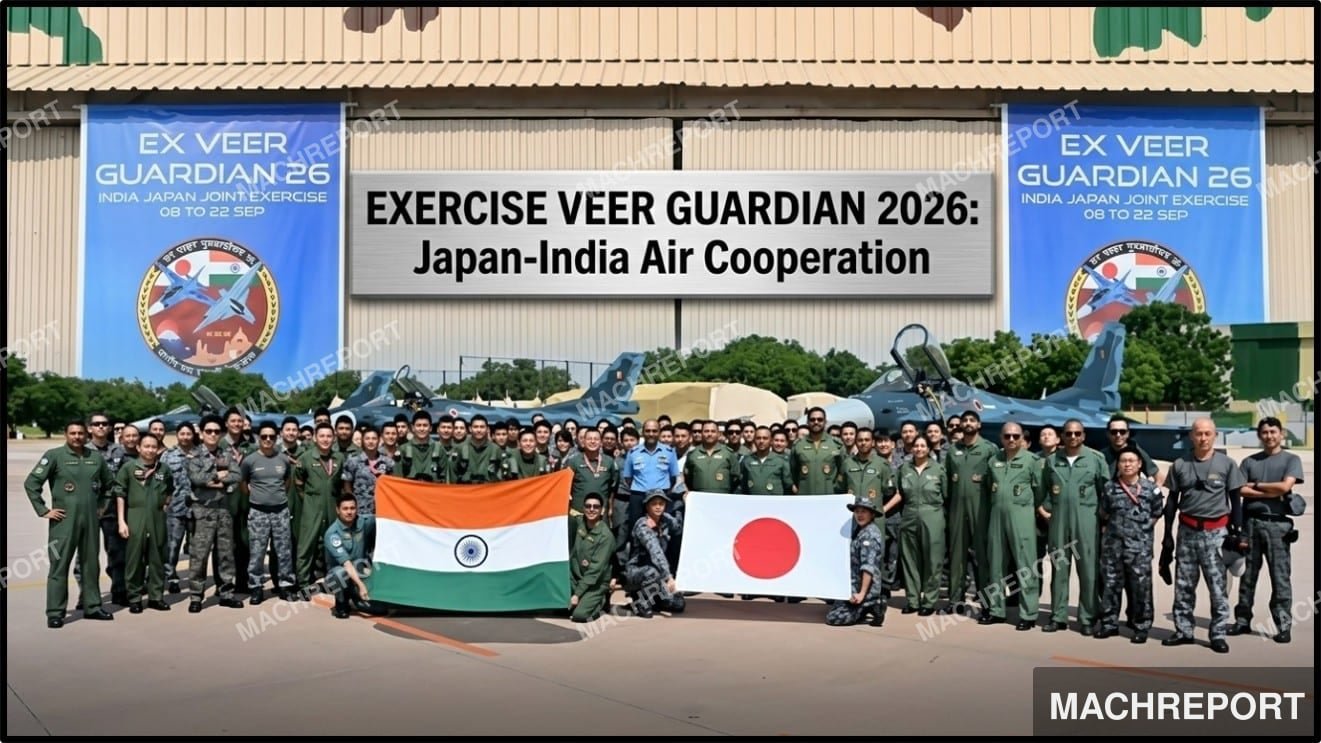
Exercise Veer Guardian 2026 strengthens Japan-India air cooperation, with F-2A fighters adding new tactical and strategic relevance for Pakistan.
Exercise Veer Guardian 2026 from September 9 – September 22, 2026 marks a major defence cooperation between India and Japan, with the first deployment of Japanese F-2A fighters deployed from Indian Air Force Station Jodhpur, Rajasthan. Reports from open-sources regard this as an important step allowing both Japan Air elf-Defence Force (JASDF) and Indian Air Force (IAF) to learn about each other's operational procedures and command-and-control systems. The first edition of this exercise was held in 2023, while the bilateral has entered new phase in this year, with Japanese fighter F-2A deployed and operated from India for the first time.
This core focus of Veer Guardian exercise was to develop operational interoperability in practice between the two air forces and increase deterrence value in the Indo-Pacific region.
Significance of the venue: Jodhpur Air Station
The venue of exercise Jodhpur is not merely a training venue rather the location has strategic value while placing it closer to the Pakistani border. According to open-sources, Jodhpur air-station was used in May stand-off 2025, where Indian aircraft used long-range standoff weapons for deep-striking inside Pakistan without crossing the Line of Control. In parallel, it follows the conduct of JAIMEX (Japan-India Maritime Exercise) aiming to promote deterrence capability in the Indo-Pacific, while reflecting their shared vision of a free, open, and inclusive maritime region. Therefore, the exercise also serves both strategic signalling as well as enhanced operational purposes.
The significance of Veer Guardian exercise hence, underscores both it’s location and the scale of deployment. The IAF is participating with its frontline combat aircraft, including indigenous Rafale, Light Combat Aircraft (LCA), Tejas, Su-30 MKI and, while the JASDF deploys F-2A fighter aircraft.
Exercise Deployment and Aircraft’s
Two Japanese C-2 transport aircraft have already landed at Jodhpur carrying advanced Japanese equipment. They are expected to be followed by three Mitsubishi F-2 fighter aircraft by JASDF from its 8th Wing with 110 personnel from the 8th Air Wing participating in the exercise. The operational intent of the 14-day exercise will be on air combat manoeuvring (ACM), advanced operational missions, tactical coordination, mission planning, and exchange of professional expertise between the two air forces. The Asia Pacific open-sources reported that three F-2As will fly from Tsuiki Air Base to Jodhpur via Naha Air Base in Okinawa and Thailand. The U.S. Air Force shall provide support for deployment, including aerial refuelling. However, JASDF did not disclose any specific base in Thailand where the F-2A Fighters will stop, during which U.S. aerial refuelling support will be provided.
Broader Strategy to Counter Chinese Expansion in Indo-Pacific
As a part of broader defense expansion, it covers all tri-services: maritime security, logistics, defence technology and industrial cooperation. In August 2026, the two countries made a consensus to further strengthen cooperation under the Special Strategic and Global Partnership, with a particular focus on operational coordination on a free and open Indo-Pacific. The wider strategic framework lies in the growing connection between India-Japan incorporating the QUAD. India, Japan, the United States and Australia are rapidly developing mechanisms for maritime security, logistics and regional security to counter China’s rising assertiveness in the Indo-Pacific. Japan and India have also expressed interest in expanding defence cooperation with the third countries, in Southeast Asia. Which suggests that India-Japan defence cooperation is gradually becoming part of a wider security network of Indo-Pacific partnerships rather than remaining strictly bilateral.
India's defence relationship with Japan is reportedly also linked to the fears of China’s wider Indo-Pacific strategy a mix of economic integration and military pressure. Although, QUAD never explicitly mentions China as an adversary in its joint declarations. However, its deterrence frameworks such as Maritime Domain Awareness (IPMDA) actively counters China’s grey-zone tactics, rapid militarisation, and aggressive posturing.
The Strategic Value of Japan’s F-2A in Indo-Japan Air Drills
The Air cooperation between Japan and India carries a critical tactical advantage for both sides. As the Japanese Fighter F-2A shares an airframe lineage with the F-16 Fighter Jets; it is a highly advanced derivative developed jointly by Japan and Lockheed Martin. It has similar basic aerodynamic design, single-engine layout, fly-by-wire flight control, and cockpit ergonomics as standard F-16 Fighter which also remains the backbone of Pakistan Air Force (PAF). This would enable IAF pilots to test how the radars and electronic warfare pods handle the sophisticated jamming and tracking frequencies. Whereas for Japan, training with Su-30MKI provides tactical exposure to Russian-origin fighter design this is significant, as China also operates several Sukhoi-derived fighters, including the J-11 family.
Implications for Pakistan
For Pakistan, any improvement in India's ability to cooperate with technologically superior foreign partners can indirectly affect regional security calculations. This is specifically relevant when such level of exercise takes place at air bases in India's western theatre, such as Jodhpur. The timing is critical, when India-China relations have shown signs of improvement after recent military disengagement process at LAC after BRICS held in September 2026, with both sides seeking to restore diplomatic and economic ties. The key assessment for Pakistan shall therefore focus on broader network of partnerships that could influence India's future air-power, logistics and operational capabilities.
Comments
Login to comment
No comments yet. Start the conversation.