Fa'az Missile: Pakistan Tests Indigenous Air-to-Air Weapon
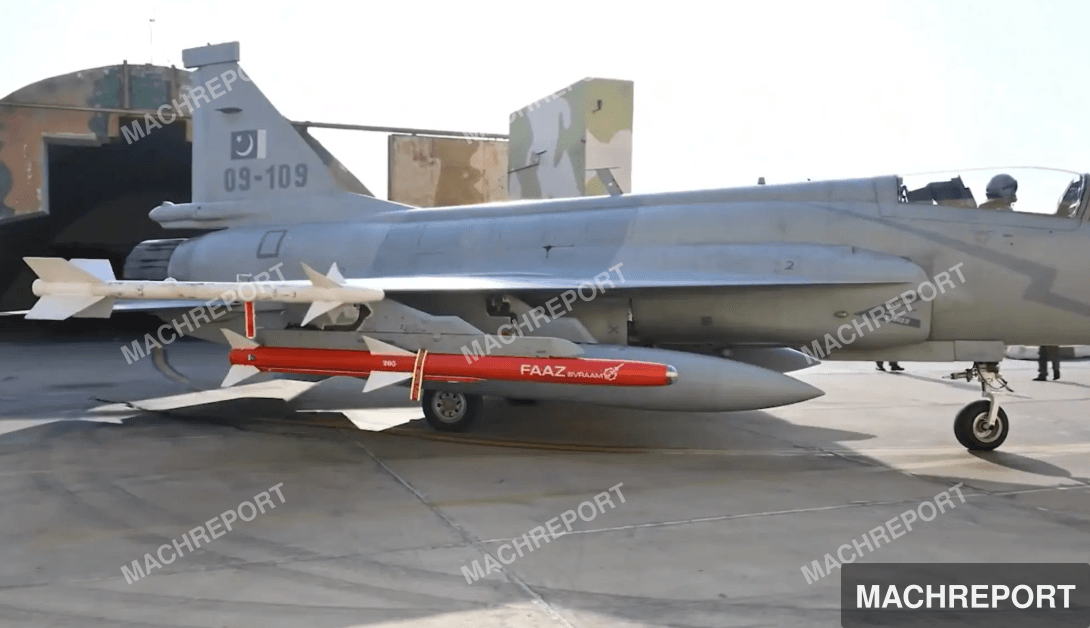
Fa'az missile test marks a milestone for Pakistan's defence industry, with advanced guidance and JF-17 integration supporting future air combat capabilities.
Pakistan has successfully flight-tested its first indigenously developed Fa'az missile, marking a significant step towards strengthening domestic aerospace capabilities and reducing dependence on foreign air-to-air weapons. Conducted on November 3, 2026, the test involved a JF-17 Thunder fighter aircraft launching the new weapon, which features an advanced terminal guidance system designed to engage aerial targets at extended ranges.
The Pakistan Air Force described the achievement as an important milestone in national defence technology, highlighting the country's growing ability to develop sophisticated aviation weapons. While the successful launch demonstrates progress in indigenous missile development, questions remain regarding its actual engagement range, technical configuration and the extent of locally developed components.
Fa'az Missile Test Marks a New Defence Milestone
According to Inter-Services Public Relations (ISPR), the successful flight test demonstrated progress in developing a domestically produced air-to-air weapon equipped with advanced terminal guidance technology. Senior military officers, scientists and engineers associated with the programme witnessed the event.
The military stated that the new weapon would enhance the operational flexibility of the Pakistan Air Force and strengthen the country's overall defence capabilities. President Asif Ali Zardari, Prime Minister Shehbaz Sharif and senior military leadership congratulated the scientists and engineers responsible for the development.
Footage released by the military showed the weapon being launched from a JF-17 Thunder fighter, an aircraft jointly developed by Pakistan and China that forms an important component of the PAF's combat fleet. The demonstration represents a transition from publicly displayed missile prototypes towards actual flight testing. However, details regarding the test's engagement distance, target characteristics and complete performance results have not been publicly released.
Technical Capabilities and Guidance Systems
Pakistan's Global Industrial & Defence Solutions (GIDS) previously displayed two versions of the weapon at the 2023 International Defence Industry Fair in Türkiye. These included the Fa'az-RF, equipped with active radar guidance, and the Fa'az-IIR, incorporating an imaging infrared seeker. Both variants were advertised as medium-range weapons with ranges exceeding 100 kilometres and maximum speeds of approximately Mach 3.5.
Defence analysts examining the latest test footage identified the launched weapon as the infrared-guided version. Unlike conventional radar-guided missiles, imaging infrared seekers detect thermal characteristics of aerial targets during the terminal phase of engagement. This provides an alternative guidance mechanism that could complement radar-guided weapons already employed by the PAF.
For extended-range engagements, infrared-guided missiles may require initial targeting information and midcourse navigation before their seekers acquire the target. However, the precise guidance architecture and availability of in-flight data updates for the tested Pakistani weapon have not been publicly confirmed. The reported range and speed figures remain manufacturer specifications rather than independently verified operational performance.
Integration with the JF-17 Thunder
The missile's integration with the JF-17 Thunder is one of the most significant aspects of the programme.
The fighter already operates with imported air-to-air weapons, including Chinese-origin missiles designed for beyond-visual-range engagements. The Block III variant, equipped with modern avionics and an active electronically scanned array radar, represents an important component of Pakistan's evolving air-combat capabilities. A domestically developed weapon could provide additional flexibility in aircraft integration, maintenance, upgrades and long-term inventory management.
The infrared-guided variant could also complement existing radar-guided weapons by offering another engagement option against aerial targets. Combining different guidance technologies may complicate an adversary's defensive response, although the actual effectiveness of such tactics would depend on sensors, target acquisition, networking and operational conditions.
The integration process is equally important from an engineering perspective. A modern air-to-air weapon must function reliably with the aircraft's avionics, weapons-management system, targeting architecture and operational procedures.
A successful flight test demonstrates progress, but additional testing and certification would be necessary before routine operational deployment.
Indigenous Development and Chinese Technology Questions
The programme has also attracted attention because of questions surrounding the extent of its domestic development.
Pakistan has described the weapon as indigenous, reflecting its broader ambitions to strengthen national defence manufacturing. However, analysts have observed similarities between the missile's external design and existing Chinese air-to-air weapons, particularly the SD-10 and PL-12 family.
Such similarities have led to speculation about possible foreign technological influence, especially given Pakistan's longstanding aerospace partnership with China. Douglas Barrie, a senior fellow for military aerospace at the International Institute for Strategic Studies, has suggested that Chinese-origin seeker technology could be involved. However, this remains an assessment rather than confirmed information. GIDS has maintained that its systems are developed locally and that it holds the associated intellectual property rights.
The distinction between indigenous production, local design and foreign technological assistance is important. A missile assembled domestically may still depend on imported components, while a system developed using foreign technological experience can nevertheless contribute to domestic engineering capability.
Without detailed information about its propulsion system, seeker, guidance electronics and manufacturing supply chain, the precise level of technological independence cannot be independently established.
Implications for Pakistan's Air Combat Capability
The successful flight test comes as air-to-air missile development becomes increasingly important to the military balance in South Asia. Pakistan currently operates a combination of Chinese and American air-to-air weapons, including the PL-15E and AIM-120 AMRAAM. These systems provide beyond-visual-range engagement capabilities but also create long-term dependence on foreign suppliers for maintenance, upgrades and replenishment.
An indigenous missile programme could gradually reduce some of these constraints by providing greater national control over weapon integration, production planning and future improvements. For Pakistan, the strategic significance therefore extends beyond the performance of a single missile. Developing domestic expertise in guidance systems, propulsion, electronics and weapons integration could strengthen the wider aerospace industry. This is particularly relevant to the JF-17 programme, where increasing local control over aircraft weapons could support future upgrades and potentially improve the competitiveness of export configurations. However, developing a prototype and establishing sustained production are separate challenges. Reliable manufacturing, quality assurance, operational testing and long-term technical support will determine whether the programme delivers lasting advantages.
Future Development and Longer-Range Variants
Pakistan's missile-development efforts are not limited to the initial version. Defence reporting indicates that a longer-range Fa'az-2 variant is also under development, suggesting an ambition to expand beyond the capabilities advertised for the earlier missile family. Additional range could provide new operational options, but greater distance alone does not guarantee superior combat performance. Beyond-visual-range effectiveness depends on the missile's energy management, seeker performance, guidance reliability and access to accurate targeting information.
Future testing will therefore be important in establishing the weapon's capabilities under realistic operational conditions. Pakistan has not announced a confirmed date for operational induction of the tested version or disclosed a detailed development schedule for the longer-range system.
A Step Towards Defence Self-Reliance
The successful flight test represents an important stage in Pakistan's effort to develop indigenous airborne weapons. Moving from exhibition models to an actual aircraft launch demonstrates tangible progress in missile engineering and integration with a frontline fighter platform. Nevertheless, several questions remain unresolved, particularly concerning the missile's operational performance, domestic component content and readiness for service.
For the Pakistan Air Force, the long-term value of the programme will depend on whether these developments can be translated into reliable production, sustainable inventories and effective integration with existing combat aircraft. The significance of the Fa'az programme therefore lies not simply in adding another missile to Pakistan's arsenal, but in building the industrial and technological capacity required to develop, maintain and improve advanced air-combat weapons domestically.
If successfully matured and operationally validated, the programme could contribute to greater strategic autonomy while strengthening Pakistan's position as a developing aerospace and defence technology producer.
Comments
Login to comment
No comments yet. Start the conversation.