Ferozepur Border Firing: India-Pakistan Diplomatic Tensions
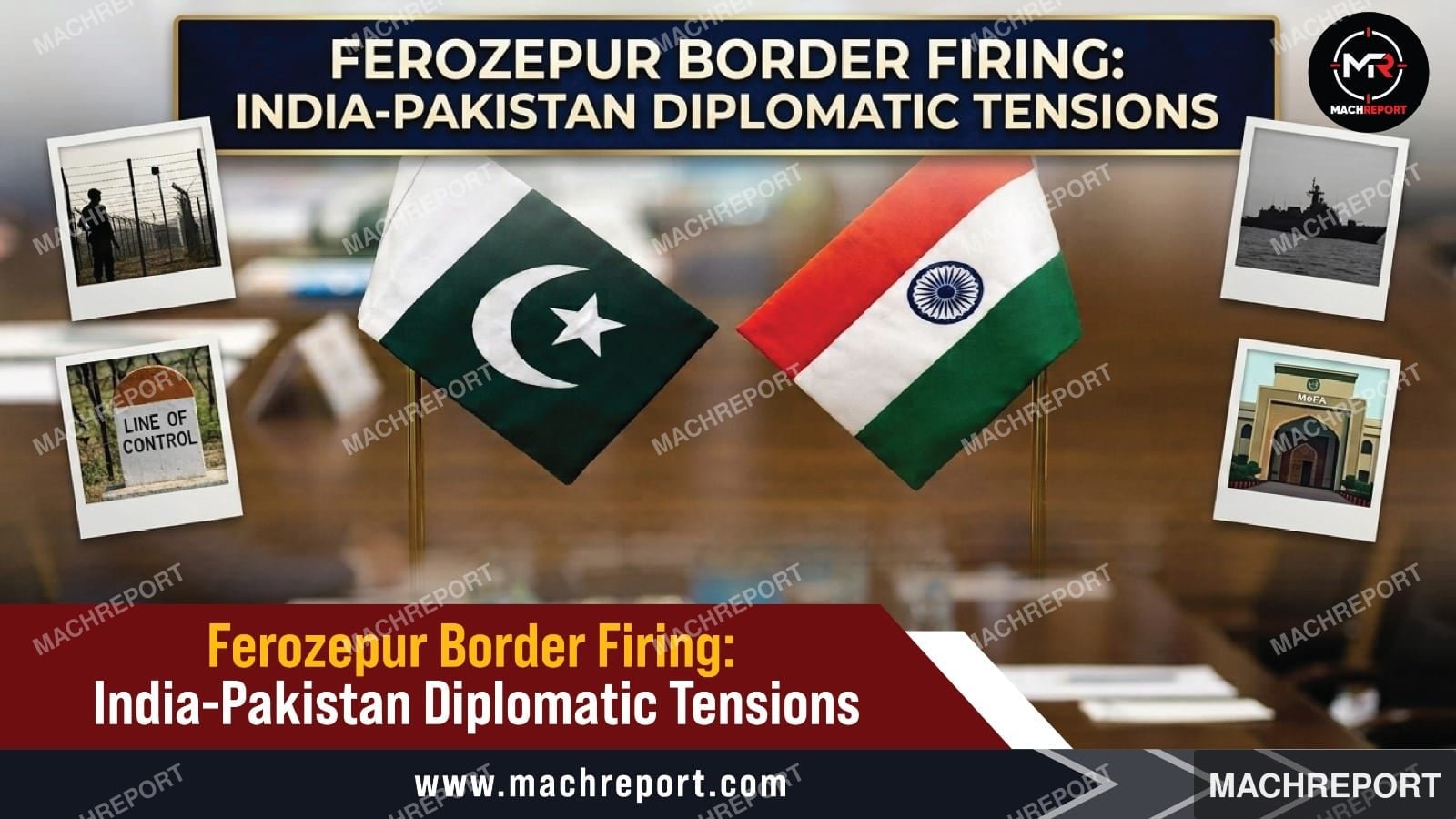
Ferozepur Border Firing escalates India-Pakistan diplomatic tensions, highlights an escalation mechanism with competing narratives and multi-domain warfare risks.
Are India-Pakistan tensions on the rise?
Amid ongoing India–Pakistan tensions along the International Border, on 02 October 2026, in the Bedian sector along the International Border in Ferozepur, India, the Indian Border Security Force (BSF) opened fire on two unarmed civilians who were accused of attempting cross-border infiltration. The Ferozepur border firing was followed by reciprocal diplomatic action by Pakistan. The very next day, on 03 October, the Pakistani Ministry of Foreign Affairs (MOFA) summoned the Indian Chargé d’Affaires over the reported violation of fundamental human rights, citing concerns that the incident failed to distinguish between “infiltrators” and “civilians.”
As per open-sources this is the second occasion in September causing Diplomatic friction between the two South-Asian rival states India and Pakistan. Reportedly, India has also summoned Pakistan’s Chargé d’Affaires, rejecting Pakistan’s concerns over what it labelled as continued facilitation of ‘cross-border terrorism’. The recent diplomatic exchange marks a shift in the incidental context from a local border-security orchestration into a formal India-Pakistan diplomatic tension.
According to the recent statements issued by MOFA, "The BSF personnel resorted to unprovoked lethal force against unarmed civilians. Such use of force was wholly unjustified and grossly disproportionate, resulting in the tragic loss of two precious lives. Pakistan categorically rejects any attempt to mischaracterize the deceased as 'infiltrators,". MOFA implied that the Indian side must be called to conduct a transparent investigation with credible evidence against those found responsible for the ‘terrorism’ accusations and formally communicate its findings to the Government of Pakistan.
Previously, in the last month on 16 September 2026, an incident involving a naval collision occurred when Indian vessels reportedly carried out aggressive maneuvers in close proximity to Pakistani ships conducting the biennial SEASPARK-26 exercise. It was disclosed that the collision breached a 1991 bilateral agreement that mandates at least three nautical miles distance from each other to avoid any accident in the international waters. Reports claim that this was the first overt military tension between India and Pakistan, after May 2025 conflict that carried fears of wider escalation.
Emerging Patterns: Recurring Escalation Mechanism
The emerging pattern signals that India-Pakistan tensions are increasingly shaped across multiple operational domains. Maritime encounters, border incidents and diplomatic tensions are dependent on one another, particularly when either side interprets its account of actions with the ‘perceived threat’ to establish a ‘threat perception’.
Pakistan’s principal concern remains the probability that routine border-security incidents could become a recurring source of diplomatic and military tension. Whereas India describes preventing cross-border infiltration and addressing perceived terrorism is the core objective to maintain border-security.
The recent International border incident follows a similar sequence. An incident involving security forces first generated competing narratives from India and Pakistan. Each government subsequently attributed responsibility of action to the other side and framed the incident as per its own security narrative.
Taken together, these developments indicate a recurring escalation mechanism in which a localized incident creates competing narratives, followed by reciprocal allegations and diplomatic summoning, eventually contributing to heightened strategic concerns and reinforcing existing security perceptions.
Parallel Pattern: The May 2025 Crisis
The widely discussed similar escalation mechanism was witnessed in the May 2025 conflict, previous year, which was followed by the Pahalgham incident, where both countries adopted a series of reciprocal diplomatic and economic measures. India suspended aspects of the Indus Waters Treaty and downgraded several bilateral mechanisms, while Pakistan's MOFA expelled Indian High Commission staff in Islamabad during an intense diplomatic standoff. The crisis subsequently developed into direct military escalation involving kinetic measures with missiles, drones and artillery before ceasefire was reached on 10 May 2025.
The 2026 incidents have not reached up to that threshold of escalation. However, they demonstrate the same structural characteristics: competing narratives, reciprocal diplomatic actions and military escalation. The comparison therefore should not be interpreted as evidence that another major conflict is predictable. Rather, it demonstrates the importance of recognizing the escalation mechanism that has repeatedly appeared in Pakistan and India bilateral conflicts.
Moreover, the recurring conversion from a competing narrative into combined kinetic and non-kinetic confrontation underscores how multi-domain operations have been intensified in India-Pakistan competition. The recent episodes demonstrate how localized incidents act as catalysts for parallel diplomatic, informational and military actions, creating grounds for escalation across multiple domains. This pattern suggests that the conventional model of fifth-generation warfare, is majorly centered around information and psychological operations through framing, narrative shaping and gatekeeping, with a limited utility when employed in isolation. In May 2025, Operation Divine Bytes demonstrated that information dominance requires greater synchronization with concrete strategies across multiple domains. A coordinated multi-domain strategy can amplify the effects of information operations by their integration with kinetic operations, thereby generating effects across both the real-time and informational ecosystems.
For both India and Pakistan, the central challenge on a strategic level is therefore not only managing individual events but restraining their cumulative effects from developing into a broader multi-domain confrontation. The trajectory of recent events indicates that future crises will increasingly be shaped by how escalation management is done by both sides across the intersecting kinetic action, information warfare, diplomacy and strategic signalling.
Comments
Login to comment
No comments yet. Start the conversation.