From Independence to Air Dominance, How PAF Defended Pakistan Skies and Guarded Its Freedom
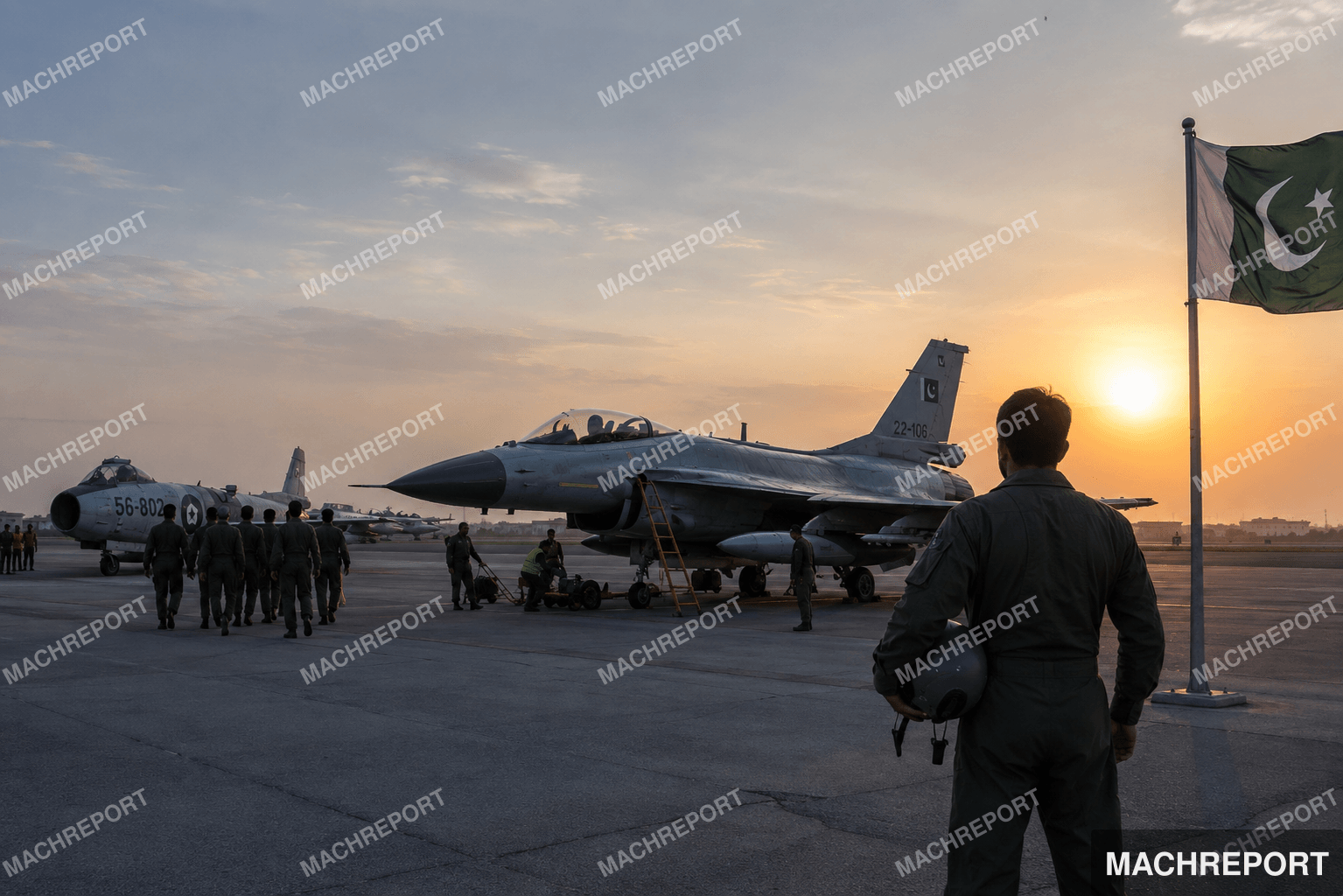
From the early days of 1947 to the modern JF-17 and J-10CE era, Pakistan Air Force has evolved through decades of conflict, innovation, sacrifice and adaptation.
Before dawn, when Pakistan is still wrapped in silence, the sound of a fighter taking off carries a meaning that goes far beyond aviation.
For the pilot, it is a mission.
For people on the airbase, it is a responsibility.
For the country, it is a reminder that someone is watching the sky.
Since 1947, Pakistan has lived with a strategic reality that left little room for complacency. The country began its journey with limited resources, a small industrial base and an air arm that had to develop under difficult circumstances. It could not simply depend on numbers. It had to learn to compensate through training, professionalism, technology, operational readiness and above all determination to adapt.
That determination became part of identity of Pakistan Air Force. And over decades, the aircraft changed. The pilots changed. The weapons changed. The technology changed. But responsibility remained the same: Pakistan must be able to defend its skies. That is why the story of PAF is ultimately not only a story of air power. It is a story of Pakistan itself.
A Nation That Learned to Defend Its Sky.
PAF's journey began in an environment in which survival demanded more than ambition.The young state needed an air force capable of doing something that seemed disproportionately difficult for its circumstances: protecting a country with limited resources against a much larger regional power. The response was not to accept that imbalance as destiny. It was to build professionalism.
The wars of 1965 and 1971 became defining chapters in that process. The 1965 war established a generation of PAF pilots and airmen whose courage and professionalism became embedded in Pakistan's national memory. The experience of 1971, meanwhile, reinforced another lesson that air power exists within a larger strategic environment and that military success depends on much more than individual bravery. From those experiences emerged a philosophy that would shape PAF for decades: Train harder. Prepare better. Adapt faster.
The history of the PAF can almost be read through the aircraft that have served it. Sabres and Starfighters. Mirages. F-16s. And eventually JF-17 Thunder and J-10CE. Each represented a different chapter in Pakistan's search for credible air power. F-16 gave Pakistan access to one of the world's most capable fighter platforms of its generation. The Mirage fleet provided decades of service and became deeply embedded in PAF operational culture. But JF-17 represented something particularly important. It was not simply another fighter entering Pakistani service. It represented an attempt to build combat-aircraft capability with Pakistan playing a direct role in the programme's development and production. For a country seeking greater strategic autonomy, that mattered.
The JF-17 became evidence that Pakistan did not have to remain merely a customer in the global defence market. It could become a participant. J-10CE represented another step, bringing a modern Chinese fighter into PAF with advanced sensors, weapons and networked combat capability. Together, these aircraft became part of a much broader transformation. And eventually, they would have to prove themselves under most unforgiving test of all: combat.
2019: The Fighter Becomes Part of a System
Operation Swift Retort in 2019 was an important milestone in PAF's evolution. It demonstrated that modern air combat was no longer simply about which pilot was better or which aircraft was faster. Sensors mattered. Command-and-control mattered. Electronic warfare mattered. Weapons mattered. Information mattered. And the ability to bring all of them together mattered most of all. The fighter remained at centre of the operation but it was increasingly becoming part of a larger combat system. That transformation would become even more visible during Marka-e-Haq.
Marka-e-Haq: When Technology Met Combat
May 2025 confrontation became one of the most consequential episodes in modern history of South Asian air power. For Pakistan, it was not simply another confrontation. It was moment when years of investment in fighters, weapons, sensors, electronic warfare, command-and-control and operational training were tested against a sophisticated adversary in an intensely contested environment. Reuters reported that US officials assessed that Pakistani J-10 fighters had shot down at least two Indian military aircraft, including at least one French-made Rafale. PAF, however, stated that seven Indian Air Force aircraft had been shot down during confrontation, a figure later endorsed by US President Donald Trump in his public remarks. The episode placed J-10CE and Rafale representing newer generations of Pakistani and Indian air power respectively at centre of an intensely scrutinised real-world air-combat encounter.
It was being discussed internationally as a real-world test of advanced air-combat capabilities. The message Pakistan's air campaign sought to demonstrate was unmistakable: advanced technology does not guarantee dominance. What matters is how that technology is used. The significance went beyond aircraft themselves. The point is fundamental to modern air warfare: technological sophistication alone does not guarantee dominance. A Rafale is a formidable combat aircraft, as is the J-10CE, but neither operates in isolation. When JF-17 entered combat, it represented more than another fighter in Pakistan’s inventory. It became S400 killer, known as one of world’s most capable integrated air-defence systems. JF-17 was no longer just a development programme; it was a Pakistani-built platform being tested in war. The moment carried a larger significance: Pakistan had moved from operating with limited sources to developing and fielding indigenous technology capable of challenging some of the world’s most advanced defence systems
But Behind Every Aircraft Is an Airman This is where the story must return to the human being. Because aircraft can be replaced. Airmen cannot. Every generation of PAF aircraft has eventually become old. The Sabre became history. Starfighter became history. Mirage will one day become history. Today's JF-17 and J-10CE will eventually be replaced by something newer. But people who flew them, maintained them, remain part of permanent history of the institution. That is why names of Sarfaraz Ahmed Rafique and M.M. Alam continue to mean something. Their aircraft belong to another era. Their courage does not.
Marka-e-Haq also reminded Pakistan of the price paid by those who defend the country from the ground as well as from the cockpit. Squadron Leader Usman Yousuf at PAF Base Bholari, and four other PAF personnel were martyred in a missile strike shortly before ceasefire. Pakistan later identified the other fallen personnel as Chief Technician Aurangzeb, Senior Technician Najeeb, Corporal Technician Farooq and Senior Technician Mubashir. Their names deserve to be remembered alongside the aircraft that dominated headlines during the conflict. Because while world watched fighters in the sky, men were working on the ground. They were maintaining aircraft. Preparing systems. Keeping machines of air power operational. Doing work that rarely appears in photographs or television broadcasts. And then, in a matter of seconds, they gave their lives. That is the part of air warfare that aircraft specifications cannot explain. A fighter can be measured in speed, range and weapons. A missile can be measured in kilometres. A radar can be measured in detection range.
But sacrifice has no specification sheet. The country sees an aircraft take off. A family waits for its airman to come home. Sometimes, he does not. This is why the PAF's history is not simply a record of victories.It is a chain of generations. The pilots of 1965 could not have imagined JF-17. But they served the same flag. They defended the same country. And they accepted same responsibility. That is what makes the PAF's evolution so meaningful. The technology is passed forward. So are lessons. So is courage. And so is memory of those who paid the highest price.
Perhaps that is what makes sound of a PAF fighter different on 14 August. For someone unfamiliar with military affairs, it may simply be the roar of an aircraft. For a defence professional, it is a weapon system. For a pilot, it is a responsibility. But for Pakistan, it can represent something much larger. It carries the memory of those who flew before us. Of M.M. Alam. Of Sarfaraz Ahmed Rafique. Of generations of pilots whose names became part of our national memory. And of men at Bholari who never returned home.
So, when the sound of a PAF fighter passes overhead this Independence Day, listen beyond the engine. Hear history. Hear the sacrifice. Hear determination of a country that began with limited means and refused to remain limited by them. We inherited a Pakistan. Others gave their lives defending it. We inherit their skies.
Pakistan Zindabad.
Comments
Login to comment
No comments yet. Start the conversation.