Full-Spectrum Multi-Domain Warfare in Pakistan
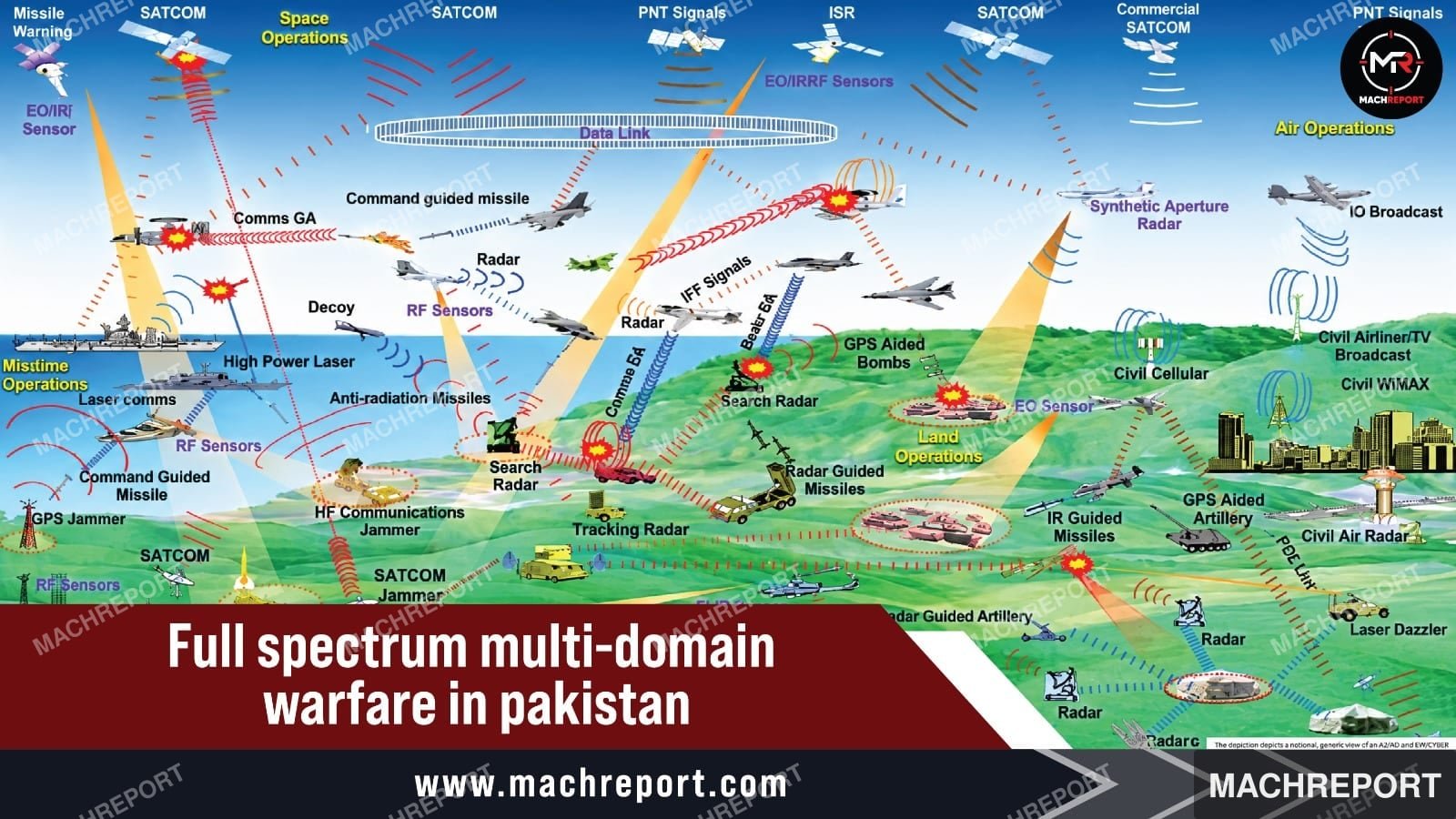
Discover how Full-Spectrum Multi-Domain Warfare is shaping the Pakistan Air Force through advanced airpower, cyber warfare and modern military technology.
Full-Spectrum Multi-Domain Warfare and the Changing Battlefield
Full-Spectrum Multi-Domain Warfare is reshaping modern military strategy by integrating airpower, land and maritime capabilities, cyber operations, electronic warfare, artificial intelligence (AI) and unmanned aerial systems. The May 2025 India-Pakistan conflict brought renewed attention to these evolving dimensions of warfare and the role of technology in contemporary military operations.
The Catalyst: India’s Aerial Aggression
It was the night between 6 and 7 May 2025 when India launched air strikes targeting civilian populations at multiple locations in Pakistan and Muzafarabad, the capital of the autonomous state of Azad Jammu and Kashmir. India named this military adventure ‘Operation Sindoor’. New Delhi attempted to justify the aggression by blaming Pakistan for the alleged ‘Pahalgam false flag operation’, an accusation for which India has failed to present any evidence before an international forum to this day.
What unfolded over the next 100 hours transformed the history of modern warfare. In response, Pakistan launched ‘Operation Bunyan-un-Marsoos’, a counter-offensive formally termed the ‘Battle of Truth’ (Marka-e-Haq).
Redefining the Skies: The 52-Minute Air Battle
On the night of 7 May, Indian Air Force (IAF) scrambled 72 fighter jets into the skies. This fleet included 14 French-made Rafale EH aircraft, widely regarded globally as the peak of modern aviation. Prior to this battle, the Rafale was considered the absolute, invincible monarch of the skies. However, the Pakistan Air Force (PAF) rewrote aviation history that day.
In a fierce engagement lasting approximately 52 minutes, 42 Pakistani fighter jets took on 72 Indian aircraft. During this clash, the world first became familiar with the capabilities of the Chinese-built J-10C fighter jet. The encounter was defined by short-duration, highly unique Beyond-Visual-Range (BVR) missile engagements.
By the end of the Marka-e-Haq , Pakistan had shot down:
• Four Rafale jets
• One Su-30MKI
• One MiG-29UPG
• One Mirage 2000H
• One Heron MK2 drone
To this day, Indian military strategists remain baffled, desperately trying to deduce exactly how the PAF executed this sweep.
This historic clash laid the groundwork for what experts call Full-Spectrum Multi-Domain Warfare. In simple terms, this means that rather than fighting a traditional isolated air battle, the military seamlessly integrated conventional land, sea, and air capabilities with sophisticated electronic and cyber warfare. By synchronising these domains, Pakistan effectively neutralised the enemy's operational capacity while operating strictly within its own sovereign borders.
Today, the PAF is globally recognised as an invisible, full-spectrum multi-domain force.
Operation Divine Bytes: The Cyber Strike and Path to Ceasefire
A crucial milestone of the counter-offensive was the PAF’s ‘Operation Divine Bytes’, which utterly stunned the Modi administration and the Indian military and civil apparatus.
During a live broadcast from the 92 News studios, we broke the news that Pakistan had successfully breached the Indian National Power Grid. Simultaneously, reports emerged that the Punjab Police (India) website had been compromised, and that the highly sensitive surveillance cameras monitoring the Pathankot-Jammu transport route were no longer controlled by New Delhi, but by Pakistan.
On 10 May, the Pakistan Cyber Force dismantled over 100 Indian government websites and e-governance platforms. Among the 67 high-profile entities targeted, 4,411 Information and Communications Technology (ICT) linked elements were successfully wiped out. The compromised list included:
• The BJP Madhya Pradesh official website
• Medha Solar and Associated Power Plant
• Jammu Power Distribution Corporation Limited
• Indraprastha Gas Limited, Delhi
• Hindustan Petroleum Corporation Limited
• Bihar Water Resources Department
• Bharat Software Solutions
• Directorate of Treasuries and Accounts, Telangana
• Bihar Weight and Measure Division
• Forbes India Content Management System
• Odisha Forest Department
It took India's top IT and tech experts up to four weeks to fully restore most of these systems. Interestingly, Pakistan voluntarily restored a few of the websites shortly after the strike on purely humanitarian grounds.
As international media outlets picked up the story, panic spread among the Indian public, sparking widespread public anger against their own government and military and IAF. While Operation Divine Bytes firmly contributed to bring Pakistan on victory stage, it also exposed India’s structural vulnerabilities. The operation proved to the world that India’s vaunted $200-billion IT export industry is largely built on customer service call centres and low-end retail operations; when faced with high-tech cyber security challenges, India proved entirely incompetent.
The anonymous, invisible soldiers of the Pakistan Cyber Force executed Operation Divine Bytes with such surgical precision that the Modi government was brought to its knees within hours. Using international mediators, New Delhi urgently dispatched a ceasefire proposal to Pakistani Prime Minister Shehbaz Sharif, Deputy Prime Minister Ishaq Dar and the Chief of Army Staff, Field Marshal Asim Munir. The subsequent diplomatic outcome secured a lasting triumph for Pakistan.
A Contrast with the Past: 2019 vs. Today
This victory stands in stark contrast to the events of 2019. Back then, the Modi government staged the Pulwama false flag drama and launched an air strike on Balakot, Pakistan, succeeding only in hitting a single tree and killing two crows. In response, PAF launched ‘Operation Swift Retort’, famously downing Indian fighter jets and capturing the Indian pilot, Wing Commander Abhinandan Varthaman.
Notably, there were no traces of cyber tools being deployed during Operation Swift Retort in 2019. The overwhelming success of the recent Operation Divine Bytes is credited heavily to the creative vision, operational brilliance and real-time, out-of-the-box strategic planning of Air Commodore Attaullah Zeb, the Director General of the PAF Cyber Force.
Strategic Evolution Under Air Chief Marshal Sidhu
Under the leadership of Air Chief Marshal Zaheer Ahmad Babar Sidhu since 2021, the Pakistan Air Force has undergone a strategic institutional evolution focused on modern, non-linear warfare. The force has integrated high-fidelity training simulations and advanced capabilities across cyber warfare, electronic warfare, aerospace operations, artificial intelligence and unmanned aerial systems to proactively counter adversarial strategies. This is his Vision that PAF is Recognised as Full Spectrum, multi domain force.
Comments
Login to comment
No comments yet. Start the conversation.