Hybrid Warfare Is Moving Beyond the Battlefield
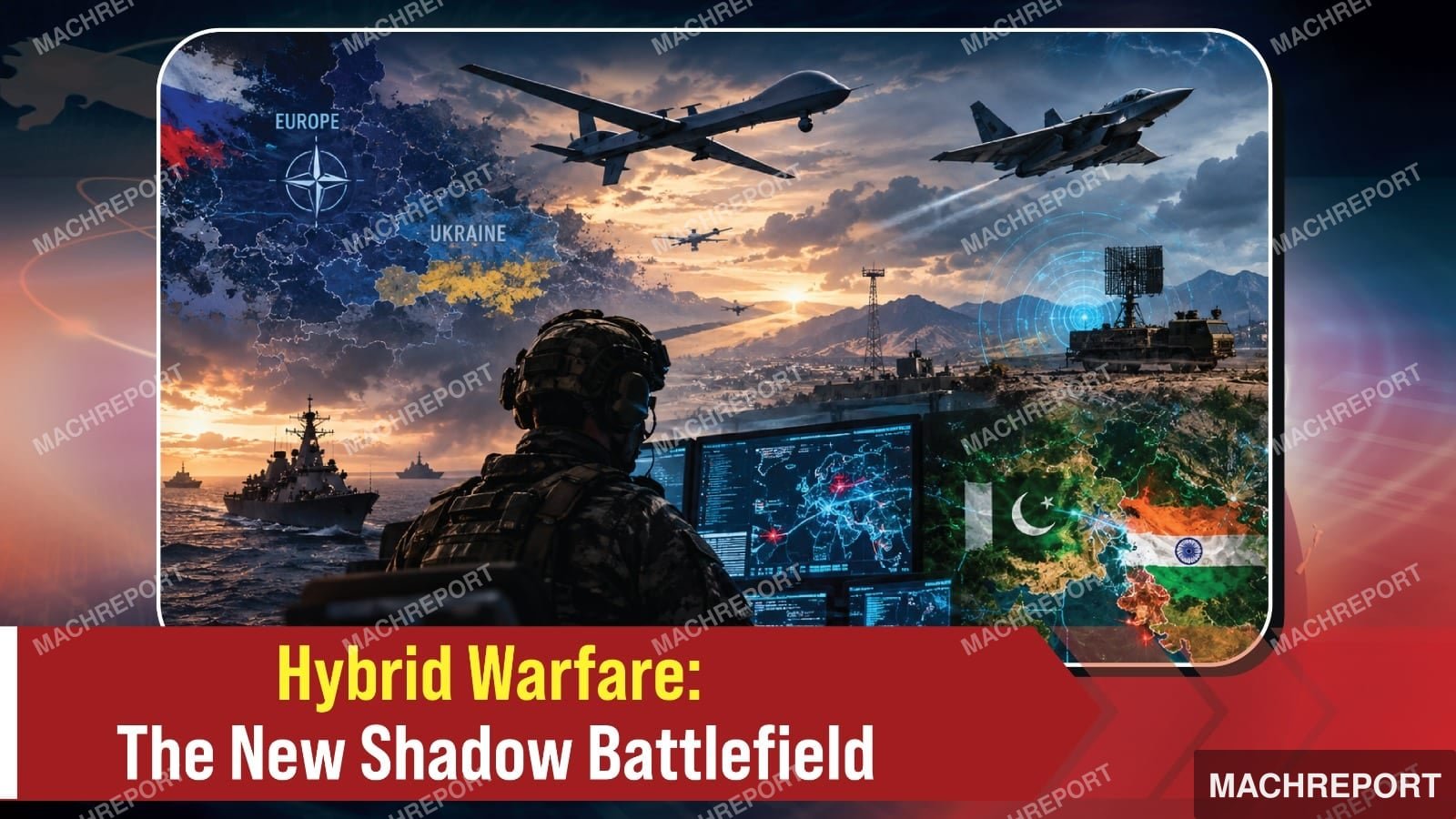
Hybrid warfare is reshaping conflict as cyberattacks, drones, AI and electronic warfare transform military operations from Europe and Ukraine to South Asia.
As geopolitical tensions rise across Europe, Middle East and Asia, hybrid warfare is becoming an increasingly important element of state competition. Modern conflicts are no longer defined only by aircraft, missiles, tanks and naval forces. Cyberattacks, drones, electronic warfare, sabotage, information operations and space-based capabilities are increasingly being integrated with conventional military power.
Reuters reported on 23 September 2026 that European officials were warning of increased Russian sabotage, cyberattacks, drone incursions and other covert activities. Denmark's defense intelligence service subsequently warned that Russia could intensify hybrid attacks against Western and NATO countries. The significance is that military competition is increasingly occurring below the threshold of open war.
Drones and Electronic Warfare Are Changing the Battlefield
Ukraine conflict has demonstrated how rapidly drones and electronic warfare can transform military operations. Russia's increasing use of faster jet-powered Shahed-type drones has placed additional pressure on Ukrainian air defenses. This development illustrates a broader shift. Drones are no longer limited to reconnaissance or low-cost one-way attacks. They are increasingly being employed for surveillance, targeting, electronic warfare, deception and precision strike missions.
At the same time, electronic warfare is becoming essential to both attack and defense. Jamming communications, disrupting navigation and interfering with radar and other sensors can degrade an adversary's ability to detect targets and coordinate weapons. This creates a battlefield in which the side that controls electromagnetic spectrum can potentially influence what the opponent sees, communicates and engages.
Cyber Warfare Creates a Hybrid Warfare
Cyber operations have become an increasingly integrated element of modern military competition, targeting digital infrastructure that underpins command and control, intelligence, communications, logistics and critical national services. Unlike conventional strikes, cyber operations can disrupt these functions without immediately producing a visible physical signature, potentially degrading an adversary's ability to detect threats, communicate orders and sustain military operations. The Russia-NATO confrontation illustrates the growing importance of this domain. European governments have increasingly attributed a range of suspected sabotage and cyber incidents to hostile state activity, prompting NATO to strengthen intelligence-sharing, cyber resilience and protection of critical infrastructure. The challenge, however, extends beyond defense. Cyber operations often operate in an environment of deliberate ambiguity, where identifying a network intrusion does not necessarily establish the perpetrator, the extent of access achieved or the precise operational effect. This ambiguity gives cyber warfare a distinctive strategic value: an adversary can seek to disrupt military and national infrastructure while maintaining uncertainty over attribution and the threshold at which a response should be triggered. As cyber capabilities become increasingly integrated with electronic warfare, intelligence and conventional operations, cyberspace is no longer a supporting domain but an increasingly important component of the wider battlespace.
Operation Divine Bytes: Pakistan’s Digital Front
South Asia's May 2025 India-Pakistan confrontation demonstrated how cyber warfare is becoming integrated with conventional military operations. Alongside air strikes, electronic warfare and unmanned systems, cyberspace emerged as another operational domain. Pakistan's Operation Divine Bytes, conducted by PAF Cyber Force, was reported as part of this multi-domain campaign. The Nation, reported that operation targeted elements of India's digital infrastructure, including communication networks, power infrastructure and logistical systems. The operation demonstrated growing integration of cyber capabilities with wider multi-domain kill chain. Rather than operating independently, cyber activity can support air operations by disrupting communications, degrading information flows and creating uncertainty within an adversary's command-and-control network. PAF has subsequently described its approach as integrating cyber, electronic warfare, space, unmanned systems and conventional air power. This reflects a broader shift in modern warfare, where operational advantage increasingly depends on the ability to connect sensors, intelligence, networks and weapons across multiple domains. Operation Divine Bytes therefore illustrates how the battlefield is moving beyond physical targets. Cyber operations can influence the information environment, electronic warfare can disrupt sensors and communications, while drones and aircraft exploit the resulting operational advantage.
The Shadow Battlefield Before Next War
The same pattern is emerging across major strategic theatres. In Europe, Russia-NATO competition increasingly involves cyber activity, sabotage, electronic interference and drones alongside conventional deterrence. In Ukraine, mass drone employment is forcing rapid changes in air-defense architecture. In US-China strategic competition, AI, advanced computing and cyber capabilities are becoming increasingly important. South Asia is moving in the same direction. The significance of Operation Divine Bytes therefore extends beyond individual claims of cyberattacks. The broader lesson from 2025 confrontation is growing convergence of air power, cyber operations, electronic warfare, unmanned systems and information networks. The future battlefield will not be neatly divided into air, land, sea, cyber and space. These domains increasingly interact. A cyber operation can disrupt communications. Electronic warfare can blind sensors. Drones can identify targets. Satellites can provide surveillance and connectivity. AI can process large volumes of information. Aircraft and missiles can then exploit the resulting information advantage.
The central competition is increasingly about who can sense, connect, decide and act faster across multiple domains.
For modern militaries, air power can therefore no longer be measured only through fighter numbers, missile ranges or aircraft performance. Resilient networks, cyber defence, electronic warfare, unmanned systems, space support and rapid data processing are becoming equally important elements of combat power. The next major conflict may not begin when the first aircraft crosses a border. Its opening phase could already be underway inside communications networks, electromagnetic-spectrum activity, satellite systems and drone operations. That is the emerging shadow battlefield before the next war.
Comments
Login to comment
No comments yet. Start the conversation.