India-Pakistan Airspace Tensions: NOTAMs and Escalation Risks
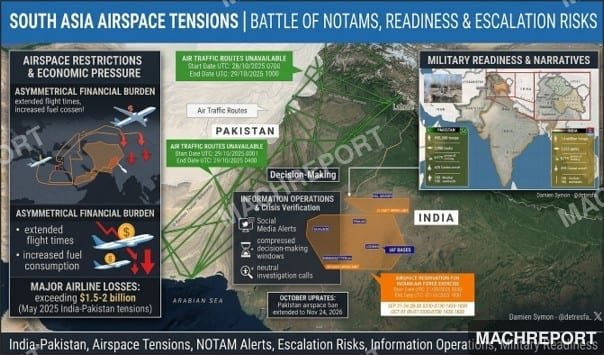
India-Pakistan airspace tensions intensify as NOTAM restrictions, military exercises and aviation bans raise economic and regional security concerns.
India-Pakistan airspace tensions remain a significant regional security concern as both countries continue aviation restrictions amid military competition and strained diplomatic relations. On October 17, 2026, Pakistan extended its airspace ban on Indian aircraft until November 24 through an official Notice to Airmen (NOTAM) issued by the Pakistan Airports Authority (PAA). The restrictions, originally imposed following the April 2025 Pahalgam attack and subsequent bilateral confrontation, continue to affect regional aviation and commercial flight operations.
Beyond commercial aviation, the increasing attention given to NOTAM alerts for military exercises, missile tests and restricted airspace has introduced another dimension to regional security assessments. Observers have described this development as a "Battle of NOTAMs," where aviation notices are interpreted as potential indicators of military readiness, operational signalling and strategic competition.
However, an official airspace restriction does not independently establish preparations for military action. In a nuclear-armed region where reaction times are short and military activities are closely monitored, misinterpreting routine aviation notices could contribute to unnecessary escalation risks. Distinguishing verified operational developments from speculation and information operations has therefore become increasingly important.
Airspace Restrictions and Economic Pressure
The region of South Asia is situated at the crossroads of major global aviation corridors linking Europe and Southeast Asia. Shutting down airspace acts as a catalyst for economic pressure. The bilateral airspace restrictions following the Pahalgam incident have caused an asymmetrical financial burden, heavily weighted against commercial aviation. During the May 2025 airspace tensions, major Indian airlines like Air India, IndiGo and SpiceJet reportedly faced massive losses exceeding $1.5–2 billion since the airspace closure in April 2025.
While both countries maintain airspace restrictions, flight times are extended, resulting in increased fuel consumption and regular losses of millions of dollars. Historically, these restrictions disproportionately strain operators in the target country by limiting their global reach and restricting flight paths to Europe, North America and Central Asia, thereby increasing operational risks.
India-Pakistan Airspace Tensions and Military Readiness
It is noticeable that, from August to October 2026, the frequency of NOTAM alerts has intensified, followed by updates from defence agencies highlighting successful weapons tests and developments. Following an August airspace warning spanning a 750-kilometre corridor, Pakistan’s Ministry of Defence (MOD) laid the groundwork for testing its advanced Fatah-series rocket and cruise missile systems. In particular, Pakistan’s military advanced its regional reach by validating the extended-range Fatah-IV (or Fatah-4) ground-launched cruise missile, a platform capable of evading detection, and the Fatah-2 ER (Extended Range) guided missile, which incorporates advanced avionics and high-speed manoeuvrability to challenge opposing air-defence systems.
On the other hand, the Indian MOD issued NOTAM alerts over the Bay of Bengal and the Indian Ocean. Subsequently, India reportedly conducted a trial of the Khagantak-243, an indigenously designed Long-Range Glide Bomb (LRGB) with precision-guidance systems intended for use as a stand-off weapon. Furthermore, these restricted airspaces align with preparations for carriage trials of India’s new 500-kg bunker-buster bomb, alongside strategic indicators over the Indian Ocean associated with the testing of medium-range ballistic missiles (MRBMs) managed by India’s Defence Research and Development Organisation (DRDO).
Social Media Alerts and Escalating Narratives
It has been assessed that airspace restrictions coincide with heightened military tensions; however, the correlation between the two does not necessarily validate a ‘conflict alert’. A NOTAM provides evidence of an officially declared aviation restriction, but it does not verify fighter readiness, deployments or command-and-control activity. Rather, it may form part of information operations.
The central concern remains the potential interaction between social-media NOTAM alerts and compressed decision-making windows for commanders operating in a tri-service environment grounded in multi-domain operations. Since both sides anticipate possible aviation encounters, suspicious activity might be interpreted as hostile, particularly when diplomatic communication between the two governments is strained. A clear instance is the recent naval collision between India and Pakistan during exercise SEASPARK-26, which led to an intense diplomatic exchange between both countries.
Social media has become a distributing channel for Information operations concerning NOTAMs, airspace restrictions, aircraft movements, military exercises and possible security incidents, particularly through X accounts. During the May 2025 India–Pakistan tensions, similar alerts circulated before official confirmation became available. The escalation followed the issuance of NOTAMs by both countries between 24 April and 10 May 2025.
NOTAM Intelligence and the Challenge of Crisis Verification.
The main challenge remains distinguishing verified aviation notices from unconfirmed claims and speculation regarding military posturing. A NOTAM should be cross-verified against its issuing authority, publication time, validity period, geographical coordinates and stated restrictions. Claims regarding aircraft activity should therefore be assessed using reliable flight-tracking data, official releases and other independent evidence. Flight-tracking gaps alone do not prove military readiness, while social-media reports should not be treated as confirmation without corroboration.
Therefore, operating in a volatile nuclear-armed region, any miscalculation can amplify the risk of unintended escalation. However, this does not mean that every aviation restriction signals an imminent confrontation; rather, it highlights the importance of distinguishing routine safety measures from developments independently associated with a deteriorating security environment.
India–Pakistan airspace tensions highlight the economic and strategic implications of aviation bans. While NOTAMs confirm declared airspace limitations, they do not independently validate military readiness or imminent conflict amid orchestrated information operations. However, assessing escalation risks requires a careful examination of broader military and diplomatic context to avoid misinterpreting routine activities as indicators of escalating conflict.
Comments
Login to comment
No comments yet. Start the conversation.