India-Pakistan Naval Collision Raises Maritime Tensions
Competing Accounts
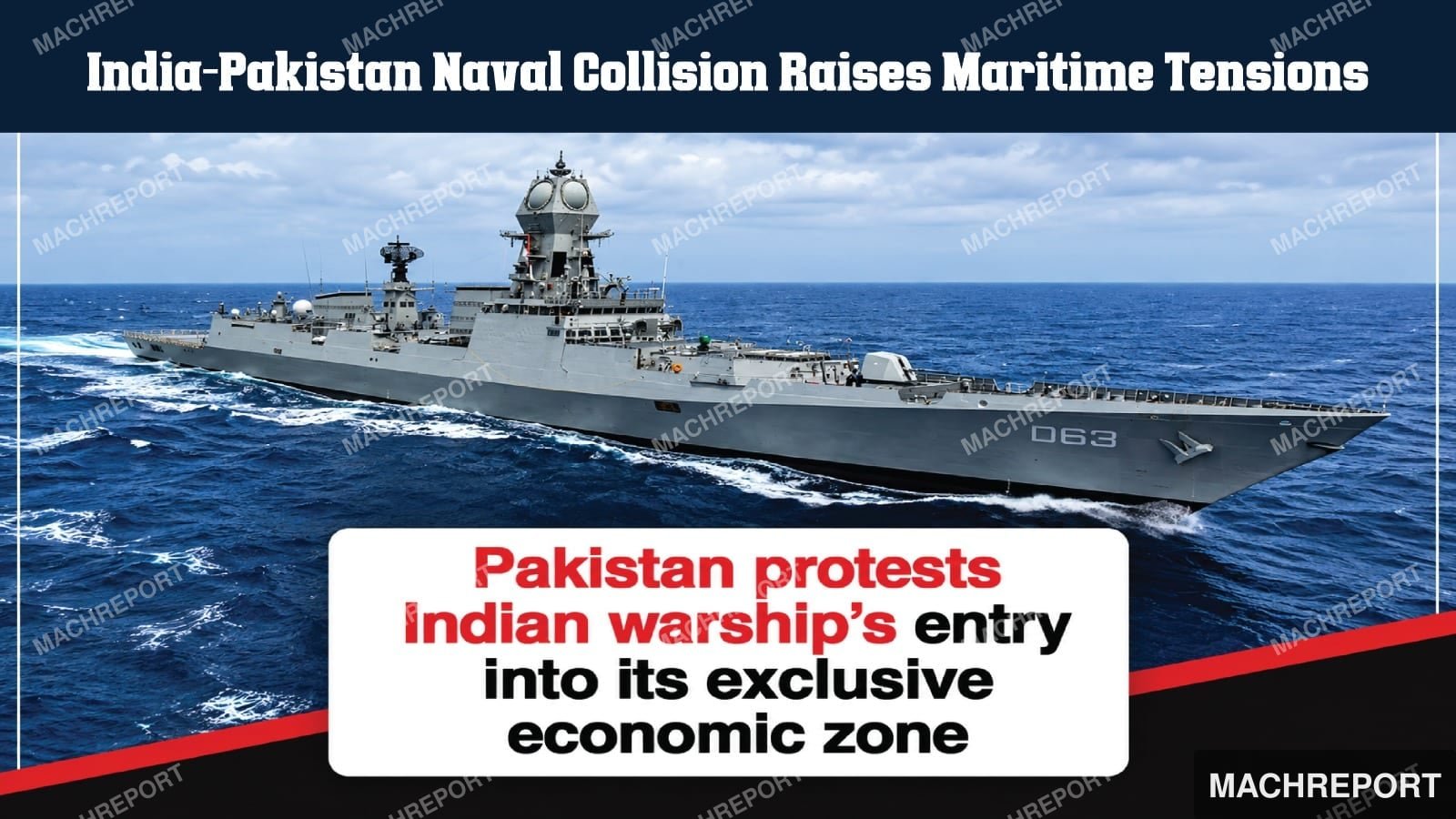
The collision between Pakistani and Indian naval vessels in North Arabian Sea has triggered competing accounts from Islamabad and New Delhi, with both sides lodging diplomatic protests over the encounter. The incident involved Pakistan Navy’s PNS Hunain and an Indian Navy warship during Pakistan Navy’s SEASPARK-26 maritime exercise. While two governments agree that vessels came into contact, they sharply differ over location of encounter and manoeuvres that preceded it.
Pakistan’s Foreign Office said Indian vessel conducted what it described as aggressive man oeuvres in close proximity to PNS Hunain while Pakistani ship was operating within Pakistan’s Exclusive Economic Zone (EEZ). Islamabad said Indian vessel’s actions resulted in collision and subsequently summoned India’s chargé d’affaires to lodge a formal protest. New Delhi has rejected that account. India said encounter occurred in international waters, alleging that PNS Hunain approached Indian warship at high speed and subsequently manoeuvred unsafely, resulting in the collision. India also summoned Pakistan’s chargé d’affaires and lodged a diplomatic protest.
The disagreement therefore extends beyond collision itself. The key unresolved issues are the exact location of encounter, relative positions and movements of vessels, and sequence of manoeuvres immediately before contact. Neither side has publicly released sufficient independent evidence to conclusively establish responsibility.
What Is Known About Incident
Indian reporting identifies Pakistani vessel as PNS Hunain, with Indian officials describing encounter as a minor collision. The Indian warship reportedly suffered no major damage, while PNS Hunain sustained damage and returned towards harbour. The Indian side said the incident occurred approximately 120 nautical miles from the Gulf of Oman.
Pakistan's account differs. Its Foreign Office identified the Indian vessel as INS Kolkata and said it had operated close to Pakistani naval units during SEASPARK-26 despite warnings. Pakistan maintains that the Indian vessel's manoeuvring resulted in contact with the Pakistani ship. These details remain allegations from the respective governments rather than independently established findings. Neither side has publicly released sufficient navigational or sensor data to independently reconstruct the final moments before the collision. Consequently, assigning responsibility on the basis of the currently available public information would be premature.
The EEZ Dispute
The disagreement over incident's location has particular importance. Pakistan says the collision occurred inside its Exclusive Economic Zone, while India says it occurred in international waters. Under the UN Convention on the Law of the Sea, an EEZ can extend up to 200 nautical miles and gives the coastal state specific sovereign rights over natural resources and certain areas of jurisdiction. It does not, however, give the coastal state the same sovereignty over navigation that it possesses in its territorial sea. Other states retain specified navigation freedoms in an EEZ. The location therefore matters, but the EEZ issue alone does not determine whether a naval vessel was entitled to be present. The conduct of the vessels, applicable bilateral commitments and the precise circumstances of the encounter remain separate questions.
The 1991 Agreement
Both sides have referred to 1991 Agreement on Advance Notice of Military Exercises, Manoeuvres and Troop Movements, a bilateral confidence-building measure designed to reduce the risk of military activity being misinterpreted. Its Article 10 specifically states that naval ships and submarines of the two countries should not approach within three nautical miles of one another while operating in international waters, with the stated purpose of preventing accidents.
India says Pakistani vessel's conduct breached this provision. Pakistan, meanwhile, argues that the Indian vessel's actions represented a violation of international law and the bilateral framework. The article's application will depend on establishing the actual location and sequence of events. The agreement is particularly relevant because it was designed precisely to reduce the possibility that military movements could be misread as hostile intent. Its re-emergence in the present dispute illustrates the continuing importance of maritime confidence-building mechanisms between the two countries.
Why the Incident Matters
The collision comes at a sensitive time for India-Pakistan relations. Both countries have maintained substantial military activity since their most recent confrontation, while naval forces are also operating more actively across the Arabian Sea because of wider regional instability.
The North Arabian Sea is strategically important to Pakistan because of its maritime trade, energy supplies and access to Karachi and Port Qasim. India also maintains regular naval surveillance and patrol activity across the Arabian Sea. Recent Indian reporting indicates that Indian naval ships have maintained a sustained presence in the region amid the wider West Asian conflict and disruptions around the Strait of Hormuz.
This creates greater potential for encounters between naval units conducting surveillance, exercises, maritime security operations and other missions. When relations are already strained, even an accident can quickly acquire a diplomatic and strategic dimension.
Diplomatic Response
Both governments responded through diplomatic rather than military channels. Pakistan summoned India's chargé d'affaires and issued a strong protest, while India summoned Pakistan's chargé d'affaires and issued its own protest. Neither side has announced military retaliation or indicated that the collision itself led to further hostile action at sea.
This restraint is significant. The immediate dispute remains centred on attribution and compliance with agreed procedures rather than military escalation.
For Islamabad, the episode reinforces concerns about the safety of Pakistani naval forces operating during exercises in waters it considers within its EEZ. For New Delhi, the priority is maintaining what it regards as lawful navigation and operational activity in international waters while avoiding unsafe encounters with Pakistani units.
A Warning for Maritime Deconfliction
The September 15 collision is unlikely to be resolved simply through competing diplomatic statements. Establishing responsibility would require more detailed evidence, potentially including navigational records, communications, radar tracks, imagery and the vessels' respective accounts of their manoeuvres.
For both navies, however, immediate lesson is clearer. Increased naval activity in a politically sensitive maritime environment requires robust communication, predictable operating procedures and strict separation between military units.
The incident also demonstrates why the 1991 India-Pakistan agreement remains relevant more than three decades after it was signed. Its purpose was to prevent military activity from generating a crisis through miscalculation. The latest collision shows how quickly that risk can re-emerge when naval forces operate in close proximity.
At present, available evidence establishes a collision and a subsequent diplomatic dispute, but not a definitive account of responsibility. The most consequential issue may therefore be whether Islamabad and New Delhi use the incident to reinforce existing maritime safety mechanisms—or allow competing narratives to deepen an already fragile security environment.
Comments
Login to comment
No comments yet. Start the conversation.