INDIA EXPANDING IAF-CENTRIC MEDIA CAMPAIGN
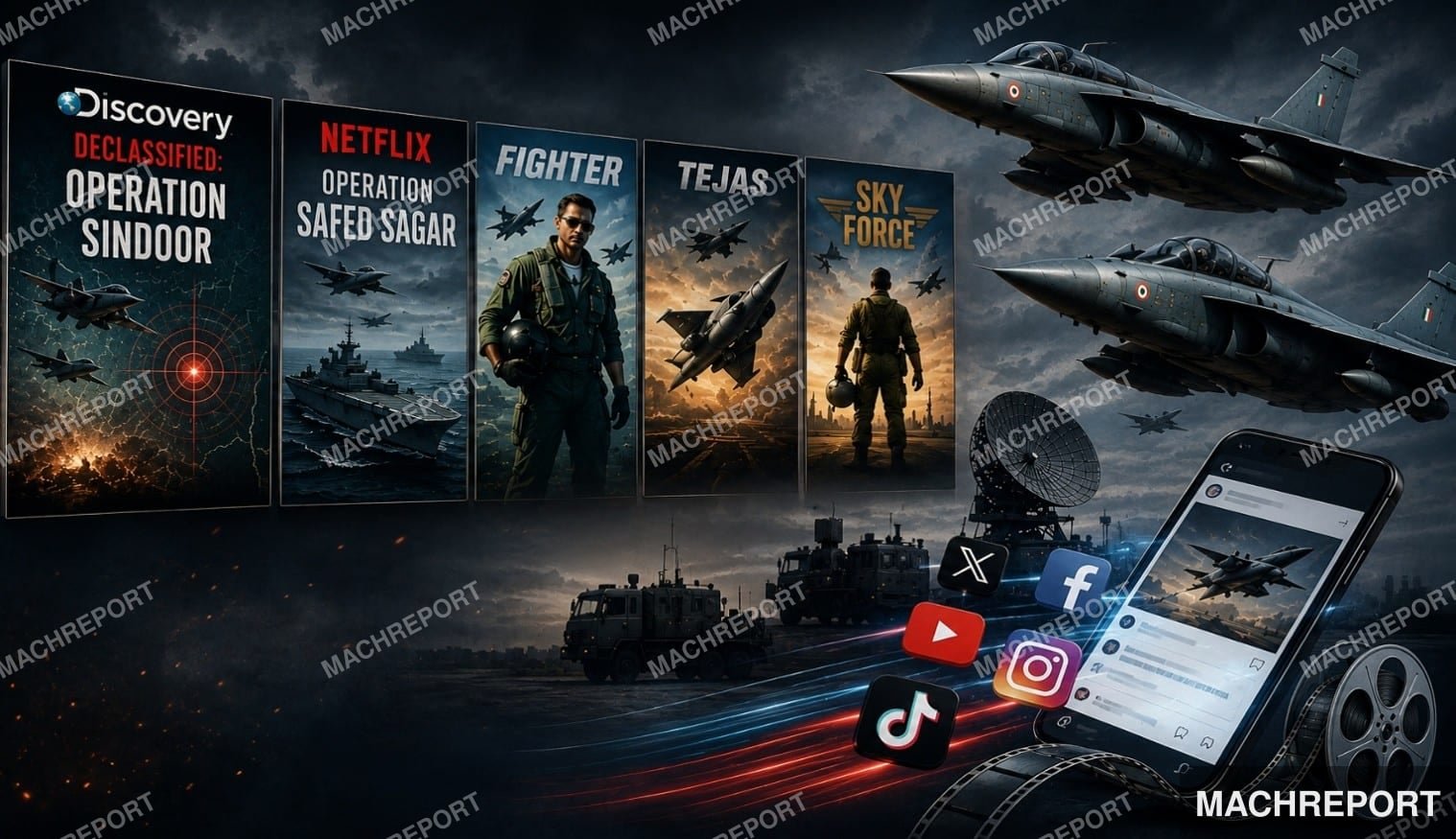
The most consequential battle surrounding Operation Sindoor may ultimately not be fought over what happened in the air, but over which version of what happened survives in public memory. More than a year after the May 2025 confrontation, India is investing considerable effort in ensuring that its interpretation of the conflict is not merely heard but repeatedly reproduced through documentaries, streaming platforms, military-themed entertainment, official disclosures and social media.
The emergence of Declassified: Operation Sindoor on Discovery Channel India on 15 August 2026 is particularly revealing. Its release on Independence Day was not simply a convenient broadcasting date. It placed a contemporary military operation inside a broader national narrative of sacrifice, retaliation and military achievement. The production was promoted as an account revealing the story behind the operation and was scheduled across Discovery Channel India and discovery+.
This is where India’s post-Sindoor media strategy becomes analytically significant. New Delhi is not only communicating its version of the war; it is packaging that version for repeated consumption.
From Battlefield Claims to Narrative Construction
During a conflict, competing sides naturally attempt to control the information environment. What is different in the post-conflict phase is the opportunity to convert temporary wartime messaging into a lasting historical narrative.
India appears to be doing precisely this.
The emerging narrative places the IAF at the centre of Operation Sindoor and presents Indian airpower as technologically sophisticated, operationally effective and capable of conducting complex operations against Pakistan. Aircraft, precision weapons, surveillance platforms, electronic warfare, unmanned systems, air defence and command-and-control are woven into a single picture of an integrated and increasingly modernised force.
The objective is therefore larger than proving the success of one operation. It is to make Operation Sindoor a demonstration of Indian airpower itself.
That distinction matters. A military operation can be contested, its individual claims disputed and its tactical outcomes debated. But if operation is repeatedly embedded within documentaries, films, television coverage and social-media content, its broader political meaning can gradually become detached from the original evidence. The conflict begins to function as a case study in Indian military superiority regardless of which individual battlefield claims remain unresolved.
Discovery Changes the Nature of the Message
The use of an international entertainment platform is arguably the most important element of this campaign.
Official Indian military statements are understood by audiences as official statements. A documentary distributed through a globally recognised media brand operates differently. It possesses visual language of investigative television: maps, satellite imagery, interviews, graphics, operational footage and dramatic reconstruction. That format can give a contested account a stronger sense of authority and coherence.
A claim repeated by a government spokesperson can be dismissed by foreign audiences as national messaging. The same claim embedded within a professionally produced documentary, supported by imagery and accompanied by references to foreign analysts, can appear considerably more authoritative. The platform consequently becomes a narrative multiplier.
The effectiveness of this approach lies not necessarily in presenting fabricated evidence, but in controlling relationship between evidence and interpretation. A satellite image may establish damage without independently establishing who caused it. A radar display may demonstrate detection without proving entire operational sequence described around it. An official account may reveal how Indian commanders understood an engagement without independently resolving what happened on the opposing side.
The power of the documentary format is that these different categories can be placed together into a seamless story.
The Real Target: Perception of Indian Airpower
The wider media campaign also appears to be serving a second purpose: reframing India’s airpower story after the conflict. IAF has long been associated with individual platforms—Rafale, Su-30MKI, Mirage 2000, Tejas and others. The post-Sindoor narrative goes further by portraying these aircraft as components of a larger technological ecosystem. This is strategically useful for India.
The debate following Operation Sindoor became heavily focused on aircraft losses, air-defence effectiveness, beyond-visual-range engagements and the performance of individual platforms. Such debates are difficult to control because they invite direct comparison between Indian and Pakistani claims.
A broader airpower narrative provides an alternative. Instead of asking only which aircraft achieved what, the audience is encouraged to focus on the sophistication of overall Indian system: sensors, intelligence, targeting, electronic warfare, long-range weapons, unmanned systems and networked command structures. In other words, the narrative moves from platform performance to system superiority. That is a far more durable message.
From Documentary to Social Media: The Amplification Machine
The real strength of the campaign emerges when international media and social media are considered as a single ecosystem.
The documentary provides the master narrative. Television promotes it. Streaming makes it accessible. Social-media accounts extract dramatic statements, images and clips. Commentators then reinterpret those fragments, while media outlets report on the documentary itself. The resulting coverage feeds back into social media.
The cycle becomes:
official disclosure → documentary → international platform → social-media clips → commentary → news coverage → renewed amplification.
At that point, original documentary is no longer the only source of the narrative. Thousands of secondary posts begin repeating its themes. This is how perception is built. A disputed claim does not necessarily become convincing because stronger evidence emerges. It can become familiar because it is repeated across different platforms and presented in different formats. Familiarity can then be mistaken for corroboration. The inclusion of foreign analysts is particularly useful within this cycle. Even when an analyst is commenting on only one specific aspect of the conflict, excerpts can be circulated as if they constitute broader international confirmation of India's narrative.
The Larger Media Ecosystem
The development is also not confined to Operation Sindoor. Netflix's Operation Safed Sagar, centred on the IAF's role during the 1999 Kargil War, has appeared alongside a wider resurgence of Indian military aviation content. Netflix describes the six-episode series as a drama based on the Golden Arrows squadron during the Kargil conflict. Indian media has explicitly connected the series' release with renewed public appreciation of the IAF and described the broader trend as a "renaissance" of Indian airpower.
That is significant because Sindoor is being placed within an already established historical continuum. Safed Sagar represents the IAF's past battlefield experience. Sindoor represents its contemporary operational capability. Films such as Tejas and Sky Force contribute the popular-cultural dimension. Documentaries provide the supposedly factual dimension. Social media supplies constant repetition. Together, these formats create something more powerful than any individual production: a persistent cultural narrative of Indian airpower.
The Objective Is Bigger Than Sindoor
The ultimate objective may therefore be less about winning an argument over individual events and more about establishing a durable perception of India's military transformation. The media campaign therefore functions on two levels: domestically, it reinforces national confidence in the armed forces; internationally, it helps construct an image of India as a technologically sophisticated military power. That makes the information campaign a strategic instrument rather than merely public relations.
But Narrative Is Not Evidence
The danger for analysts is obvious. A professionally produced documentary can establish a narrative far more effectively than it can establish the historical truth of every event it depicts. The presence of satellite imagery does not automatically validate the interpretation attached to it. The presence of senior commanders does not remove the institutional perspective from their testimony. The presence of foreign commentators does not transform the entire production into an independent investigation. India's narrative should therefore neither be automatically accepted nor dismissed.
Its claims should be tested against Pakistani accounts, independent satellite imagery, geolocation, weapons analysis, flight-tracking data, photographic evidence and assessments from genuinely independent sources.
That standard is particularly important because Pakistan is simultaneously attempting to establish its own interpretation of the conflict. The result is not a simple contest between truth and propaganda. It is a competition between two information ecosystems, each attempting to select evidence that strengthens its preferred interpretation.
The central contest after Sindoor is consequently no longer only over who struck what, which aircraft performed better or which weapons achieved particular effects. It is over which interpretation becomes embedded in public consciousness before the historical record is fully settled. India is investing heavily in that contest. And in the information age, the side that tells its story most effectively can influence historical memory of a conflict almost as profoundly as the side that claims to have won it.
Comments
Login to comment
No comments yet. Start the conversation.