India’s Rafale F4 Plus Deal: A Risky Bet After May 2025?
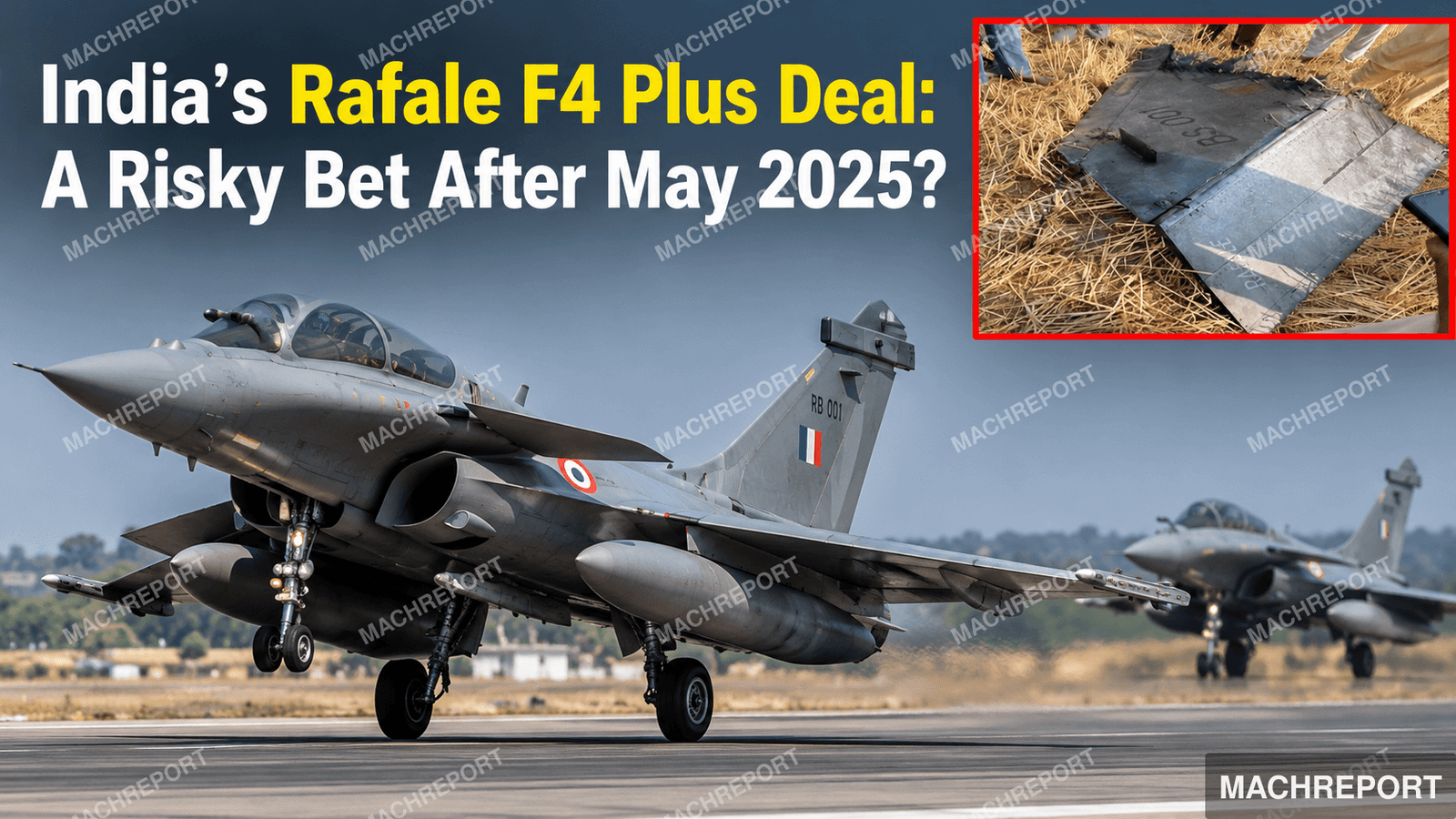
India's Rafale F4 Plus deal raises fresh questions after the May 2025 losses against Pakistan. Is investing in more Rafales a sound military strategy?
India's proposed Rafale F4 Plus Deal is raising important questions about the future of the Indian Air Force (IAF), particularly after the aircraft losses reported during the May 2025 military confrontation with Pakistan. New Delhi is pursuing the acquisition of 114 additional Rafale fighters, with plans for domestic manufacturing and integration of Indian weapons. However, the decision to expand its reliance on the French-built platform, despite its reported combat losses against Pakistani fighter jets, raises a critical strategic question: Is India addressing the operational weaknesses exposed in May 2025, or simply investing more heavily in an aircraft that has already faced a significant battlefield test?
Rafale F4 Plus Deal: India's Expanding Dependence on French Fighters
India's Defence Acquisition Council granted preliminary approval in February 2026 for the procurement of additional Rafale multirole fighters under the IAF's modernization programme. The proposed acquisition of 114 aircraft represents one of India's most ambitious fighter procurement initiatives.
According to defence reporting, approximately 90 aircraft could be manufactured in India through cooperation between Dassault Aviation and Indian industrial partners. The planned arrangement is intended to strengthen domestic aerospace production and reduce dependence on imported components.
The proposed F4 Plus configuration is expected to incorporate improvements in electronic warfare, connectivity, sensors and weapons integration. Reports also indicate that Dassault has agreed in principle to integrate Indian-developed weapons, including Astra Mk1 and Mk2 beyond-visual-range missiles, onto the Rafale platform. However, the exact aircraft configuration, technology-transfer arrangements and final weapons package remain subject to contractual confirmation.
May 2025: The Battlefield Test That Changed the Rafale Narrative
The Rafale Losses May 2025 became a defining development in South Asian air warfare when India and Pakistan engaged in intense aerial combat during Operation Sindoor.
Pakistan claimed that its air force had successfully engaged several Indian fighters, including Rafales, using Chinese-origin J-10C aircraft and long-range air-to-air missiles. Importantly, the incident attracted international attention beyond the competing claims of Islamabad and New Delhi.
On May 8, 2025, Reuters reported that two American officials assessed that Pakistani J-10 fighters had shot down at least two Indian aircraft, including one Rafale. Later, India's Chief of Defence Staff, General Anil Chauhan, acknowledged that Indian aircraft had been lost during the confrontation, although he disputed Pakistan's higher loss figures.
French Air Force Chief General Jérôme Bellanger subsequently indicated that available evidence pointed to the loss of three Indian fighters, including a Rafale. The incident challenged assumptions about the survivability of advanced Western fighter aircraft when confronting modern Chinese-origin weapons and integrated air-combat capabilities.
Nevertheless, an aircraft's loss does not independently establish technological inferiority. Combat outcomes depend on multiple factors, including situational awareness, electronic warfare, intelligence, tactics and command-and-control effectiveness. The more significant question is whether India has identified and adequately addressed the operational deficiencies that contributed to those losses.
Pakistan J-10C and the Changing Dynamics of Air Superiority
The May 2025 confrontation highlighted the growing relevance of the Pakistan J-10C within South Asia's evolving aerial balance. Pakistan's combination of Chinese-manufactured fighter aircraft, long-range missiles and networked surveillance capabilities demonstrated how integrated air-combat systems can challenge technologically sophisticated adversaries.
The confrontation also illustrated the increasing importance of beyond-visual-range engagement, where detecting, tracking and engaging an opponent before being detected can determine the outcome.
For India, the experience should raise questions about whether additional Rafales alone can overcome the challenges posed by Pakistan's modernizing aerial capabilities. Advanced aircraft remain important, but numerical expansion without improvements in airborne early warning, intelligence sharing, electronic warfare and integrated operational planning may offer diminishing returns.
India's future air-combat effectiveness will depend not merely on the sophistication of its individual aircraft but on the performance of the wider network supporting them.
India Rafale Acquisition: Strategic Investment or Repeated Vulnerability?
The proposed India Rafale Acquisition presents New Delhi with a complex military and financial decision.
From India's perspective, expanding the Rafale fleet offers several practical advantages. The IAF already operates the aircraft, reducing some training, maintenance and logistical challenges associated with introducing an entirely new fighter type. Domestic production could also improve industrial capabilities and create a more sustainable supply chain. Nevertheless, concentrating a substantial portion of future fighter modernization around one foreign-designed platform introduces strategic risks.
If weaknesses in doctrine, intelligence coordination or missile employment contributed to the May 2025 losses, purchasing additional aircraft will not automatically eliminate those vulnerabilities. Furthermore, the proposed introduction of new missiles and advanced electronic warfare systems must be evaluated against the capabilities of contemporary Chinese and Pakistani air-combat networks.
Greater dependence on a single aircraft family could also expose India to common technological limitations, upgrade delays and supply-chain constraints. This does not necessarily make the Rafale an unsuitable aircraft. Rather, it highlights the difference between purchasing a capable fighter and developing an effective air-superiority system. The central concern is whether New Delhi is investing proportionately in the supporting infrastructure, operational doctrine and technological capabilities required to maximize its fighter fleet's effectiveness.
Indian Air Force Modernization: Can Local Manufacturing Deliver Independence?
Indian Air Force Modernization is increasingly linked to India's broader objective of achieving defence-industrial self-reliance.
Manufacturing Rafales domestically could contribute to this objective, particularly if Indian companies gain meaningful access to production technologies, maintenance capabilities and weapons integration.However, local assembly does not automatically translate into technological independence. The degree of autonomy will depend on how much control Indian manufacturers obtain over critical components, software, avionics, radar systems and future upgrades. Integrating Astra missiles could reduce some dependence on imported air-to-air weapons, but the wider issue of proprietary aircraft systems would remain.
Therefore, the success of the manufacturing programme should be measured not only by the percentage of Indian-made components but also by the country's ability to independently maintain, modify and upgrade the aircraft. Without meaningful technology transfer, the programme risks reinforcing long-term dependence on foreign suppliers while being presented as a major indigenous manufacturing achievement.
Is India Learning the Right Lessons?
India's continued investment in Rafale fighters following the May 2025 confrontation presents a strategic dilemma. The aircraft remains a capable multirole fighter, and expanding an existing fleet offers understandable logistical and operational benefits.
However, the reported loss of a Rafale during combat with Pakistan raises legitimate questions about India's assumptions regarding technological superiority and its broader approach to air warfare. The central lesson of May 2025 is not necessarily that the Rafale is an ineffective fighter. It is that modern air combat cannot be won through platform quality alone.
If New Delhi responds to those losses primarily by purchasing additional Rafales, without sufficiently strengthening its intelligence networks, electronic warfare capabilities, operational coordination and indigenous defence technologies, the investment could reproduce rather than resolve existing vulnerabilities. Ultimately, the question is not whether India can afford more Rafales, but whether it can afford to place increasing strategic reliance on the same platform without demonstrating how the lessons of May 2025 have been incorporated into its future air-combat strategy.
Comments
Login to comment
No comments yet. Start the conversation.