India–UAE Relations: A Multidimensional Partnership
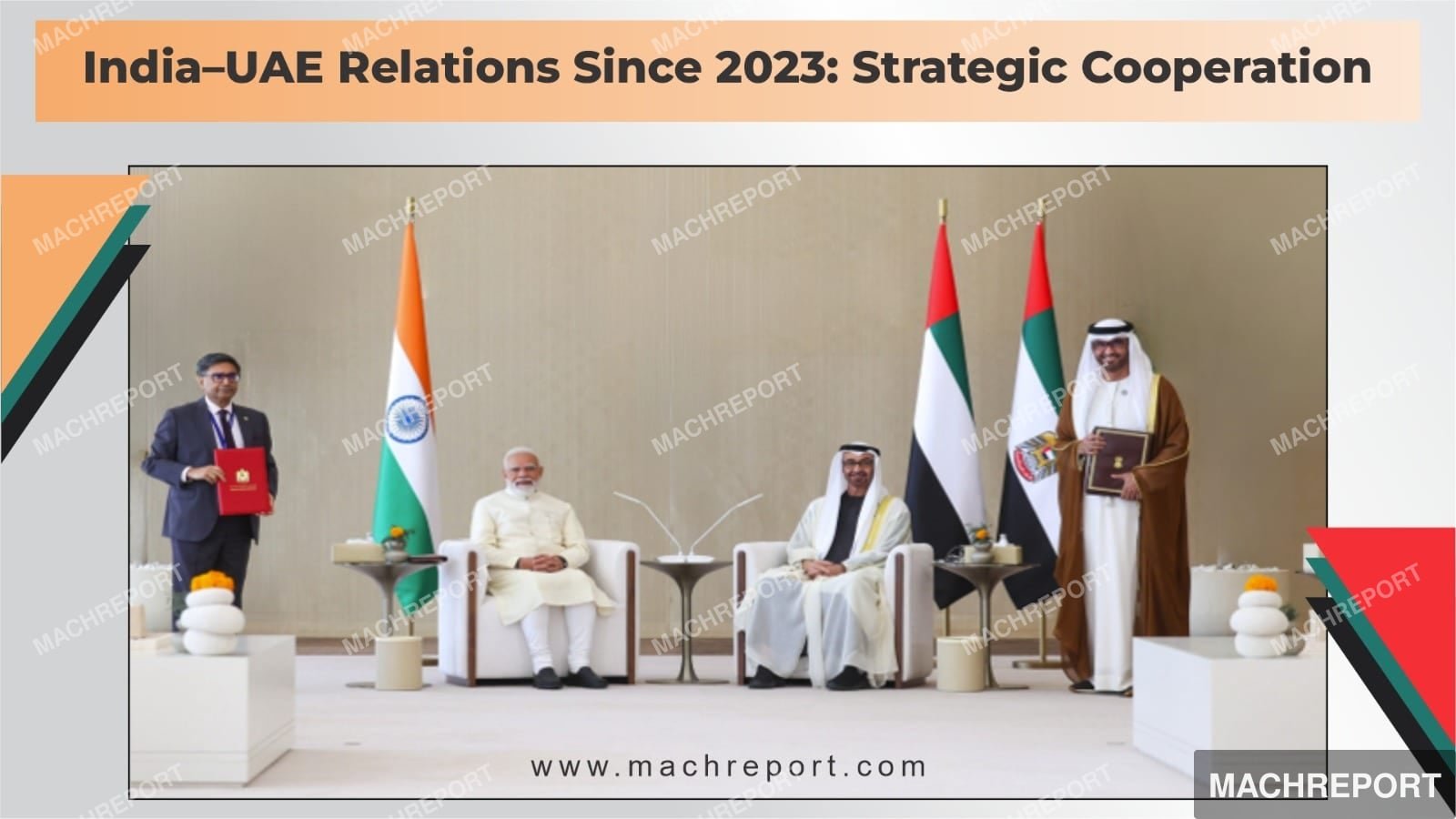
India-UAE Relations evolved from energy and trade ties into a broader strategic partnership covering defence, security, technology, investment and trade.
Expanding Horizons: The Modern Trajectory of India-UAE Relations
India and the United Arab Emirates have a long-standing relationship that has significantly diversified in recent years. The India-UAE Strategic Partnership has become a cornerstone of this bond. Since 2023, the two countries have expanded their cooperation from traditional energy trade and human resource exchange which laid the groundwork for modern India-UAE Economic and Trade Relations to artificial intelligence infrastructure development, technology transfer, and intelligence sharing. Defense collaboration, often formalized through robust India-UAE Defence Cooperation agreements, has also deepened. Furthermore, regional connectivity ambitions and a joint focus on India-UAE Maritime Security have emerged as new areas of shared interest between the two states. Intense diplomacy, resulting in back-to-back official visits, indicates their bilateral approach to seeing each other as important partners. The reciprocal official visits of Indian Prime Minister Narendra Modi and UAE President Sheikh Mohamed bin Zayed Al Nahyan have intensified this India-UAE Strategic Partnership in all spheres. The consistent exchange between both countries makes the relationship reciprocal rather than one-sided.
Political and Diplomatic Relations
India-UAE Relations were established formally in 1972. This relationship has since transformed into deep political and diplomatic ties through continuous high-level visits and cooperation. Since 2023, various agreements have been signed, including visits from the Indian Prime Minister, the UAE President and Crown Prince, foreign ministers, and trade and energy ministers. The UAE has invested in several projects in India, further strengthening bilateral ties through various initiatives. Politically, both countries have increasingly linked their relationship with wider regional and international issues, including developments in the Gulf, West Asia, counter-terrorism, connectivity, and multilateral cooperation. Both nations prioritize safeguarding vital sea lanes, making India-UAE Maritime Security a crucial diplomatic talking point. The UAE’s role as an important Gulf partner and India’s expanding engagement with the wider Middle East have provided additional relevance to their relationship. Overall, the political relationship has evolved from formal diplomatic ties into a structured India-UAE Strategic Partnership based on regular leadership-level engagement across multiple policy areas.
Economic and Trade Relations
The impressive trajectory of India-UAE Economic and Trade Relations shows that both nations have multiplied their economic partnership over the years. Bilateral trade surpassed USD 100 billion in 2024–25, driven heavily by the Comprehensive Economic Partnership Agreement (CEPA), a major milestone in India-UAE Economic and Trade Relations. Although this has created an easy way to access the market and lower tariffs, growth in trade cannot be equaled naturally, as India remains dependent on Gulf investment and energy imports while the UAE reaps benefits from India’s large market. Bilateral goods trade reached approximately USD 100.06 billion. India’s export volume to the UAE stands at USD 36.63 billion while it imports goods worth USD 63.42 billion, resulting in a shortfall of about USD 26.79 billion for India. The Bilateral Investment Treaty, signed in 2024, transformed infrastructure, renewable energy, technology, and logistics. The Emirate’s investments provided a large amount of capital to India while increasing its dependence on foreign investment. The financial interlinking supported by UPI-AANI and RuPay-JAYAWAN helped the private sector expand exponentially. Both countries are committed to doubling their trade volume by 2032, a testament to the strength of India-UAE Economic and Trade Relations.
Defence and Security Cooperation
India-UAE Defence Cooperation has notably expanded since 2023. The relationship is not limited to military visits or joint meetings. Rather, the two countries are working to build a long-term security framework which includes military cooperation, robust India-UAE Maritime Security, counter-terrorism, defence industries, artificial intelligence, cyber security, and advanced defence technology. These efforts allow them to respond to shared security challenges more effectively. The foundation of India-UAE Defence Cooperation is supported by joint exercises, as shown in the table below:
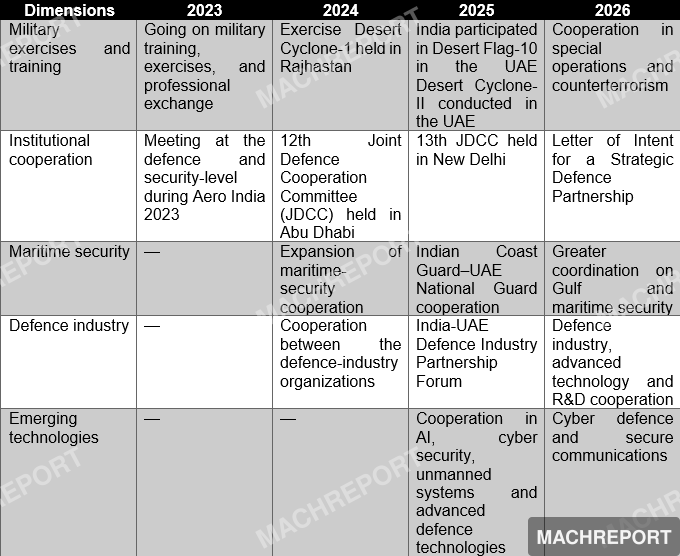
The UAE is important for India’s strategic stretching and economic ambitions because of its energy reserves, location in the Gulf and Arabian Sea, and regional footprints. Safe transit through these waters relies heavily on effective India-UAE Maritime Security. The ongoing negotiations between the two countries over the possible deal for BrahMos missiles and the Akashteer air defense system can be seen as the extension of New Delhi’s defence diplomacy. This potential deal is a testament to deepening India-UAE Relations, which could boost India’s defence exports and market BrahMos beyond its traditional foothold.
Conclusion
Over the past three years, the India-UAE relationship has undergone a significant transformation, evolving from a primarily energy-driven economic partnership into a broader and more multidimensional India-UAE Strategic Partnership. The two countries expanded their cooperation in defence, security, energy, trade, infrastructure, and technology, reflecting the growing convergence of the countries' strategic and economic interests. This expanding relationship has been shaped by a range of bilateral agreements and institutional mechanisms rather than relying on a single initiative. The period from 2023 to 2026 can be regarded as a transformative phase, shifting toward a more comprehensive alliance. Continuous India-UAE Defence Cooperation and a shared commitment to maritime stability highlight their overlapping regional goals. For the UAE, this transformation is part of its quest for security and economic diversification aimed at multi-aligning ties. For India, it is part of New Delhi’s efforts to further stretch its footprints in the Gulf region, secure energy resources, and attract more investments.
Comments
Login to comment
No comments yet. Start the conversation.