Innovation Continues to Make S-400 Air Defence System Vulnerable
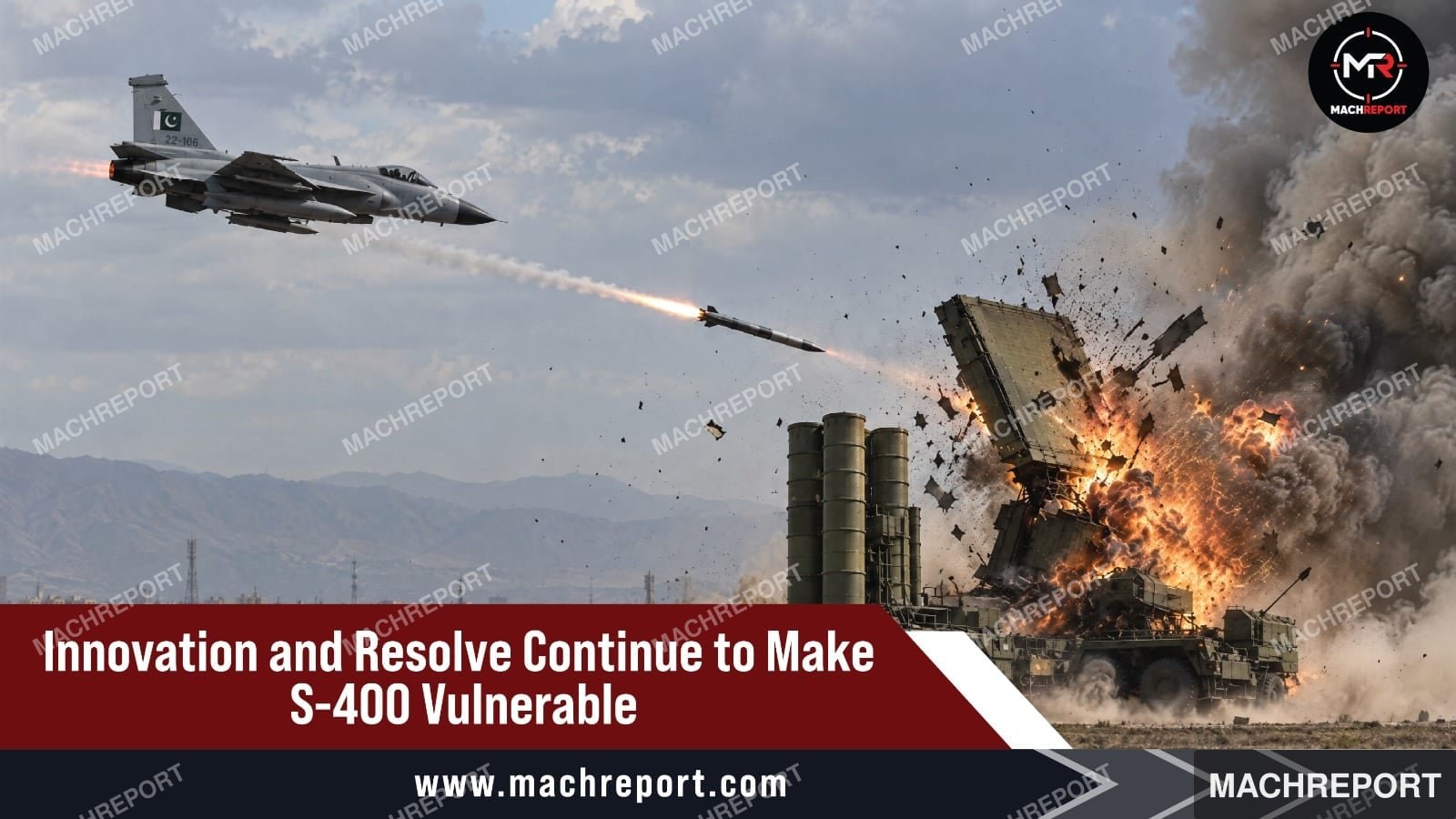
Explore S-400 air defence system vulnerabilities, lessons from the Russia-Ukraine war, and reported PAF operations involving the JF-17 and CM-400AKG missile.
Few defence systems in the world have been marketed with as much awe as Russia’s S-400 Triumf. Heralded as a near‑impenetrable shield, the S-400 air defence system is meant to deter adversaries through sheer technological sophistication, based on its marketed radar performance, and design featuring beam-steering technologies and frequency hopping. Yet, Russia-Ukraine war and Marka-e-Haq have shown that the S‑400 is not invincible. The destruction of S-400 in both wars demonstrated that ingenuity, resolve, and innovation can level the playing field against even the most formidable air defence networks.
How the S-400 Air Defence System Works
The S‑400 is an integrated air defence system with surveillance radars, command post, engagement radars and mobile launchers. The 91N6E radar detects targets, the 55K6E Command Post prioritises threats, and the 92N6E engagement radar tracks and guides interceptors. Missiles include the 40N6E for long range, 48N6DM for ballistic missiles, 9M96E2 for manoeuvrable aircraft, and 9M96E for short range cruise defence. The S‑400’s advertised 400‑kilometre range represents an idealised maximum under perfect conditions. Terrain masking, electronic warfare, interception geometry, and target manoeuvrability all erode its effective reach. Ukraine has exploited these limitations with drone swarms, cruise missiles, and precision strikes, overwhelming the system’s radar capacity. Ultimately, the operators have been forced into the impossible options of either expending costly interceptors on cheap drones or risk damage to launch assets and radar. This paradox of choice reveals that the S‑400, despite its sophistication, can be saturated and degraded by coordinated, multi‑vector attacks.
Lessons from Ukraine’s Attacks on the S-400
Ukraine relied heavily on long-range drones, R-360 Neptune cruise missile, M142 HIMARS and M39/M39A1 ATACMS ballistic missiles to reportedly destroy or damage approximately eighteen S-400 system’s major operating components.
Pakistan Air Force and the S-400
On the other hand, PAF employed the JF‑17 integrated with the CM‑400AKG missile. This hypersonic missile has an operational range of 250 kilometres, which varies based on factors such as aircraft speed and launch altitude. The PAF took down two Indian S-400 batteries at Adampur and Bhuj by precisely engaging 92N6E with CM-400.
Targeting the S-400’s Critical Components
PAF used manned aircraft and stand-off weapons, making the mission more hazardous than Ukraine’s missile and unmanned approach. This choice of deploying
crewed aircraft reflected PAF’s confidence in its multidomain capability, which spans over space, EW and cyber. The PAF also exploited the logistical footprint of the S-400, for its mobility and relocation time. Thus, the 92N6E Grave Stone fire-control radar was struck as it was recognised to be the system’s eyes and brain and it was realised that its destruction was as effective as destroying the S-400’s system. By targeting the system’s critical nodes, which was left unprotected due to the lack of IAF’s MDO support, Pakistan demonstrated that degradation of critical elements such as detection and tracking components can neutralise the S-400’s deterrent effect.
HQ-9BE and Multi-Domain Operations
In stark contrast to India’s neutralised two S-400 systems, Pakistan’s HQ-9BE was backed by MDOs, which protected it against any Indian attacks, leaving our system unscathed. Moreover, the effectiveness of the HQ-9BE was seen through its downing of the multi-million-dollar Heron drone as opposed to zero kills by Indian S-400. Additionally, our Air Defence System proved itself resilient against drones, whilst the S-400 systems deployed in Russia were seen to be vulnerable against drones and missiles.
Multi-Domain Warfare and S-400 Vulnerabilities
Both Pakistan and Ukraine have signalled through their respective devastation of the S-400 that they are not cowed by the acquisition of advanced systems across the border. This resolve is itself a weapon. The PAF brought in its MDO magic, effectively contesting the S-400’s aura of invulnerability and its mobility advantage challenge posed to the PAF. Here it is important to understand that most of the attacks executed by Ukrainian forces were on static S-400 sites. The bravery of PAF pilots and leadership to achieve the destruction of S-400 was very professional. It utilised its multi domain expertise in the electromagnetic spectrum, cyber and space to achieve its kills accurately. It reassured the nation that its Air Force and its aerial assets can meet the challenges head-on, whilst warning the adversary that sole reliance on an Air Defence System is not enough.
The Future of S-400 Vulnerabilities
As EW, drones, and precision missiles become central to modern aerial combat, the S-400’s vulnerabilities will only grow more apparent. Pakistan’s continued investment in indigenous platforms, coupled with its operational creativity, ensures that it will remain capable of exploiting these weaknesses. The combination of JF-17 and CM-400AKG is not the end of the story but a symbol of a broader trajectory, which is a commitment to innovation, autonomy, and resilience displayed under the leadership of Air Chief Marshal Zaheer Ahmed Baber Sidhu.
What the S-400’s Vulnerabilities Mean for Modern Warfare
In the end, the lesson is clear. No air defence system can remain completely impregnable when faced with an attacking force that has the determination and resolve to penetrate it and succeed. Similarly, the S-400 is not invulnerable to an attacking force’s innovative tactics, and gumption to neutralise the system. Pakistan and others have shown that with resolve, ingenuity, and the courage to innovate, even the most formidable shields can be pierced. The PAF demonstrated mental ascendency to destroy the S-400 and it can also draw lessons from the Russia-Ukrainian war to further discern the S-400 weaknesses as India is purchasing additional S-400 systems within its approved defence purchases worth 25 billion USD. The destruction of the S-400 systems has made it clear that technology alone does not guarantee dominance. It is innovation and resolve that truly determine survivability in the modern battlespace.
Comments
Login to comment
No comments yet. Start the conversation.