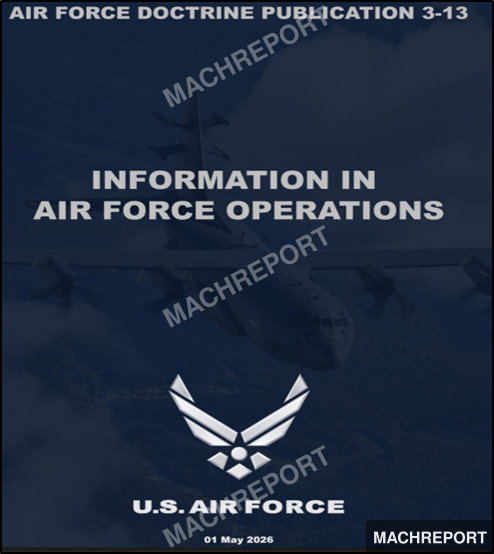
On 1 May 2026, the United States Air Force released AFDP 3-13, Information in Air Force Operations, a doctrine publication that formalises how the service plans, organises, and employs information as an instrument of military power. The document is notable less for introducing new capabilities than for the conceptual shift it codifies: information is no longer treated as a supporting function bolted onto combat operations, but as a distinct instrument of power in its own right, standing alongside not beneath traditional combat power.
This reframing matter. Militaries have long used propaganda, deception, and signals intelligence, but folding these disparate tools under a single doctrinal umbrella called Operations in the Information Environment (OIE) signals an institutional judgment: that shaping how people, organisations, and even automated systems perceive, decide, and act is now core business for an air force, not an afterthought to it.
What OIE Actually Covers
The doctrine organises information activity around four broad purposes:
• Informing and engaging relevant groups and individuals
• Influencing foreign actors
• Attacking, disrupting, or denying an adversary's information and information systems
• Protecting the Air Force's own information and systems
Crucially, the doctrine states these activities are not confined to wartime. They apply across the full spectrum of what US doctrine calls "competition" — from peacetime cooperation, through grey-zone rivalry short of armed conflict, to open war. This is a doctrine built for an era in which information contests are treated as continuous rather than episodic, running in the background of everyday great-power competition rather than switching on only once shooting starts.
The Toolkit: Seven Capabilities Under One Roof
AFDP 3-13 brings together seven distinct capability areas under the OIE banner:
1. Military Deception (MILDEC) actions designed to mislead an adversary's decision-makers
2. Operations Security (OPSEC) protecting friendly information from adversary collection
3. Public Affairs (PA) truthful communication with public and media audiences
4. Information Support Operations activities aimed at influencing foreign audiences
5. Cyberspace Operations and Electromagnetic Spectrum Operations (EMSO) creating effects in cyberspace and across the electromagnetic spectrum
6. Civil-Military Operations (CMO) engagement with local populations, often in humanitarian or stability contexts
7. Intelligence and Space Support collection, analysis, and communications support underpinning the rest
What stands out is the doctrine's insistence on a firm internal boundary: capabilities built on deception are explicitly separated from those built on truth. Military Deception exists to mislead an adversary's decision-makers; Public Affairs exists to inform the public honestly. The doctrine draws a further, pointed line here MILDEC is not to be used to intentionally mislead the American public. In an environment where deception and legitimate strategic communication increasingly sit side by side within the same organisational structure, this internal firewall is one of the doctrine's more consequential and more scrutinisable provisions.
Command and Control: Who Actually Runs This
The doctrine lays out a layered command architecture rather than a single information "commander." A Combatant Commander may attach information forces to Service components as operations demand. Beneath that, the Air Component Commander typically exercises authorities delegated from above, while a Joint Force Air Component Commander (JFACC) may be handed responsibility for specific information capabilities. A Joint Force Information Officer can be designated to coordinate OIE activity at the joint force level, and four standard support relationships General, Mutual, Direct, and Close Support govern how information elements coordinate with the units they serve, reinforced where needed by Direct Liaison Authorization.
16th Air Force (16 AF) emerges as the doctrine's centre of gravity for force provision the principal organisation supplying information forces, spanning ISR, cyberspace operations, electronic warfare, and related capabilities, though other USAF organisations can contribute as operations require.
Organisationally, information planners are not sequestered in a separate cell. They sit inside the Air Operations Center, embedded either within the Strategy Division or as a cross-functional team placed deliberately alongside intelligence, targeting, and operations staff rather than off to one side. This is reinforced by perhaps the doctrine's clearest structural statement: there is no standalone OIE plan or annex. Information requirements are to be woven into existing operational planning from the outset, carried through execution, and revisited in assessment not treated as a parallel process that gets reconciled with the "real" plan later.
Why This Matters Beyond US Air Force?
For outside observers allied planners, competitor militaries, and analysts alike, AFDP 3-13 offers a useful reference point for comparative doctrinal study. Several features are worth watching:
• Integration over specialisation. By refusing a separate OIE annex, the USAF is betting that information effects are best achieved when planned concurrently with kinetic and non-kinetic operations, not sequenced afterward.
• Persistent competition framing. Treating OIE as active across peacetime, competition, and conflict reflects a broader doctrinal trend of preparing for continuous information contests rather than discrete wartime information campaigns.
• Institutionalised ethical boundaries. The explicit prohibition on using deception against the domestic public even as deception remains sanctioned against adversaries is a doctrinal statement with legal and reputational stakes, and a natural point of comparison against how other forces draw (or fail to draw) the same line.
• 16th Air Force's centrality. The doctrine's reliance on a single principal force provider for information capabilities offers a clear organisational marker for tracking how the USAF resources and prioritises this mission area going forward.
The Bottom Line
AFDP 3-13 does not claim to invent new information warfare tools. Its significance lies in consolidation: taking capabilities that have existed separately for decades deception, cyber effects, public affairs, civil engagement, intelligence support and binding them into a single doctrinal framework with defined command relationships, embedded planning integration, and explicit ethical guardrails. Whether that integration translates into genuine operational advantage, or simply better paperwork, will depend on how faithfully the Air Operations Center actually folds information planning into every operation from day one, as the doctrine insists it must.
Comments
Login to comment
No comments yet. Start the conversation.