Iran Accelerates Construction at Deeply Buried Pickaxe Mountain Site as US Explores New Bunker-Busting Capabilities
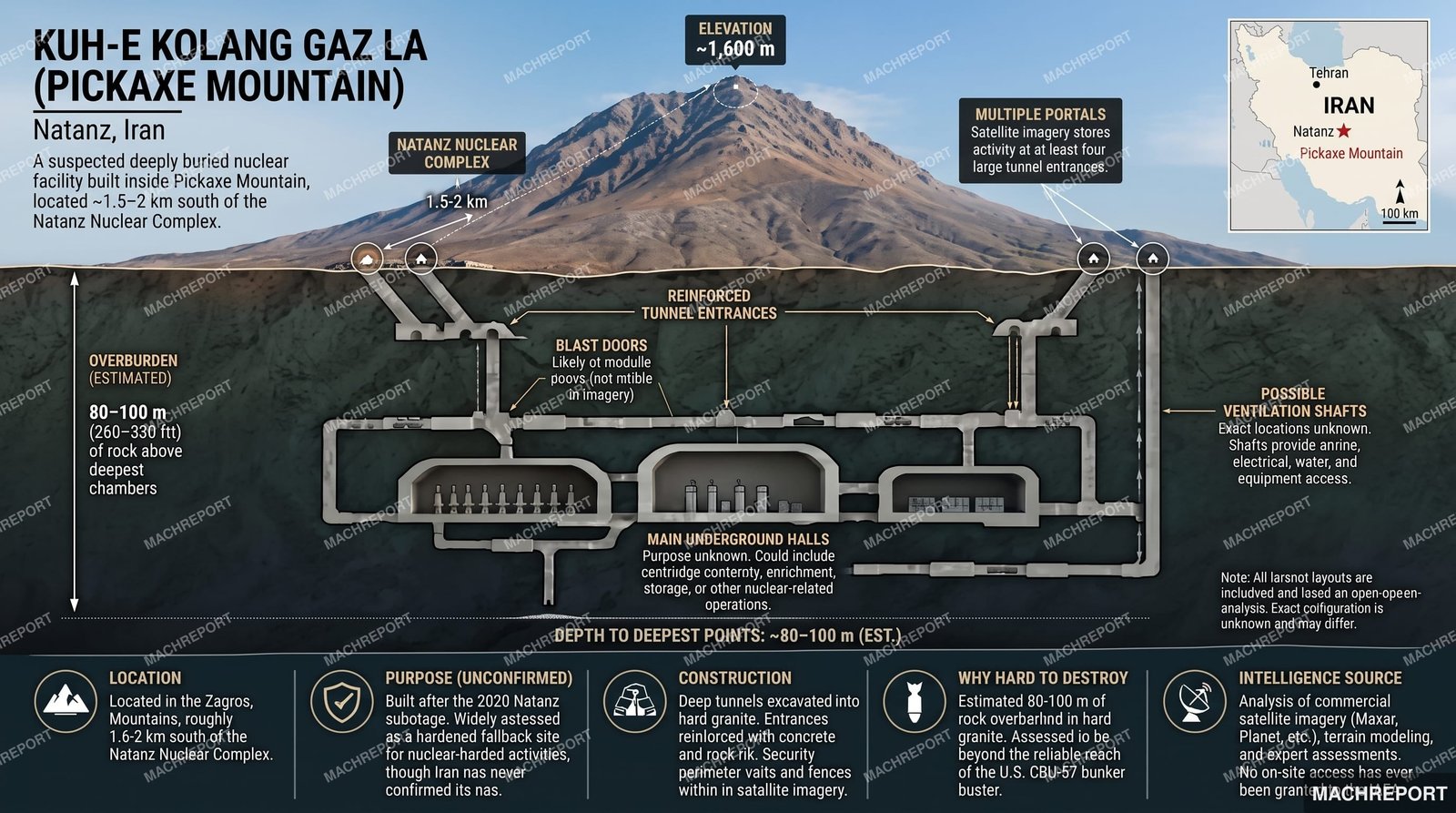
Iran accelerates construction at the deeply buried Pickaxe Mountain site, raising concerns over uranium enrichment and prompting new US bunker-buster efforts.
Iran has significantly accelerated construction at a deeply buried underground facility near its Natanz nuclear complex, raising fresh concerns in Washington and among nuclear analysts that the site could eventually become a hardened center for uranium enrichment or other sensitive nuclear activities.
The development at the site, known as **Pickaxe Mountain**, was identified through an analysis of six years of satellite imagery by the Center for Strategic and International Studies (CSIS), which shared its findings with CNN. Analysts observed a clear surge in construction activity during 2026, including work on tunnel entrances, roads and reinforced access areas.
Pickaxe Mountain, also known locally as Kuh-e Kolang Gaz La, is located roughly 225 kilometers south of Tehran and only a few kilometers from the Natanz nuclear complex. The facility is buried beneath a mountain of extremely hard granite, making it substantially more difficult to attack than many conventional military targets. Some estimates place parts of the complex more than 100 meters underground, with some assessments suggesting depths approaching 170 meters.
Why the site is attracting concern
The precise purpose of Pickaxe Mountain remains uncertain. However, CSIS analysts believe the facility was likely designed as a protected “safe haven” for Iran's nuclear program. Three potential uses have been identified: an underground uranium-enrichment hall, a facility for assembling centrifuges, or a location for other nuclear-weapons-related activities.
Israeli intelligence has previously suggested that Iran could move centrifuges to the site as part of an effort to protect its enrichment capabilities. However, analysts have cautioned that the available satellite evidence does not establish that uranium enrichment is currently taking place there. In fact, the CSIS assessment indicates that if enrichment is the intended purpose, the facility may not yet be operational for that activity.
The construction pattern itself is significant. Earlier activity concentrated on excavating the mountain, while more recent work appears to have shifted toward reinforcing tunnel entrances, paving internal roads, strengthening access points and carrying out interior construction. This suggests that Iran may be moving from the excavation phase toward making the underground complex more functional and resilient.
A major challenge for US weapons
The location presents a serious problem for US military planners. The United States possesses the Massive Ordnance Penetrator (MOP), a massive bunker-busting weapon designed to attack deeply buried hardened facilities. But the combination of extreme depth and granite surrounding Pickaxe Mountain could place the site beyond the effective reach of existing conventional weapons.
CNN reported that the Pentagon is exploring ways to develop a weapon capable of reaching targets buried deeper underground. The US Air Force has already begun work on a 'next-generation penetrator' intended to eventually succeed the current MOP. Prototype work began under a contract awarded in September 2025, while the Air Force sought additional industry input in June 2026.
US military planners have also reportedly conducted a recent “planning sprint” focused on options for attacking deeply buried facilities. Pickaxe Mountain was reportedly included in a potential target package considered earlier this year, although it remains unclear whether existing American bombs could penetrate far enough to destroy the facility itself.
Secretive testing in New Mexico
Perhaps the most revealing development is evidence that the United States has been preparing to test capabilities against deeply buried targets.
Four days before the launch of Operation Epic Fury, a Pentagon agency responsible for countering weapons of mass destruction approved an emergency '$1.2 million contract' to repair a specialized underground testing facility at White Sands Missile Range in New Mexico.
The contract described preparations for a “live-fire test” intended to validate classified capabilities against emerging threats. Three sources told CNN that the test was connected to the Iran conflict and efforts to develop methods for attacking Iran's deepest underground facilities. Satellite imagery also showed excavation activity at the remote test location beginning in February and continuing into March.
The White Sands facility is itself carved into granite, making its geological characteristics comparable to those surrounding Pickaxe Mountain. CNN, however, said it could not independently confirm whether the planned weapons test actually took place or precisely what capability was being evaluated.
A growing nuclear standoff
The developments come amid an escalating confrontation between Washington and Tehran. US President Donald Trump has repeatedly threatened to strike Pickaxe Mountain, most recently warning that the United States could attack the site “very soon.” Reuters reported that US intelligence has been closely monitoring activity there.
For Washington, the central concern is that Iran could use the mountain to rebuild or protect nuclear capabilities that have already been damaged elsewhere. For Tehran, moving sensitive infrastructure underground offers protection against airstrikes and potentially gives its nuclear program greater resilience. The situation therefore presents the United States with a difficult choice: strike a facility whose contents and operational status remain uncertain, or allow Iran additional time to complete a heavily fortified underground complex.
With construction accelerating and Washington simultaneously exploring new deep-penetration weapons, Pickaxe Mountain is emerging as one of the most difficult and strategically important points in the escalating US-Iran confrontation.
Comments
Login to comment
No comments yet. Start the conversation.