Jet-Powered Drones: The New Air Defense Challenge
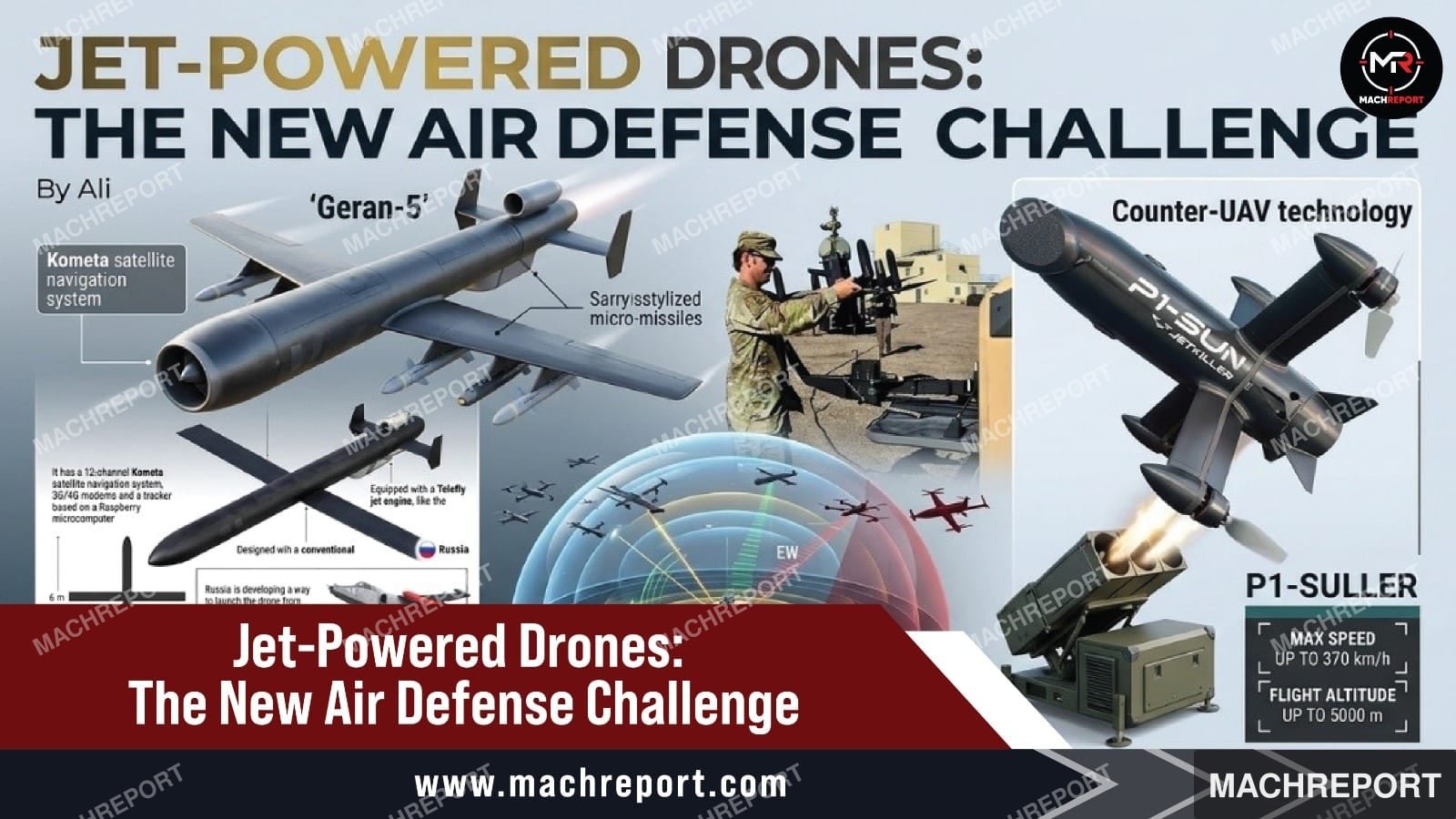
Jet-powered drones are challenging conventional air defense with high speeds and shorter interception windows.
The present militaries are transforming to jet-powered drones since battlefield dynamics had adapted previously to slow propeller drones at large, that have proved ineffective against adversary elements. The new air defense challenge is defined by rapid upscaling of these drones for-instance Iranian-designed Shahed-238 and Russia's latest Geran-4 and Geran-5 variants. As witnessed in the battle contestations, latest variants have introduced a modern air defense challenge by blurring lines between cheaper loitering munitions and cruise missiles.
Flying at speeds between 300 to 700 km/h and altitudes up to 7-8 kms, these turbojet systems have compressed the interception time window for air defenses and introduced a new challenge for existing Counter-UAV capability. This emerging security threat has prompted an evolving interest among States to pursue AI-assisted layered air defense architecture with EW and improved detection strengths.
From Propeller-Driven Swarms to Jet-Powered Drones: Why Militaries Are Shifting Strategies
The early phases of conflicts in Ukraine and between US-Iran were highly dependent on propeller-driven "kamikaze" drones (e.g. Shahed-136), till they reached their tactical limitations. Afterwards the drone threat advanced into integrated swarms overwhelming the air defense architecture with saturation attacks. However, defenders like Ukraine somehow managed to counter aerial threats by enhancing its Counter-UAV capability; upgrading a comprehensive counter-UAV ecosystem, through its indigenous firms such as Phantom.
Nonetheless, an issue of economic anti-air interception was highlighted by several defense experts in context of US-Iran confrontation in March-May 2026 where $4 million THAAD interceptors took on cheaper swarm drones depleting stockpiles of air defense systems.
The transition from integrated swarm drones to jet-powered systems is assessed as a direct response driven by the following possible driving factors:
Counter-Drone Défense’s Are Improving
In light of recent conflict theatre, it has been assessed that militaries are developing better defense tech solutions to detect, disrupt and neutralize drones. The expanding deployment of aircraft guns, acoustic sensors, thermal tracking, automated aircraft guns, and localized electronic warfare improved the ability to detect and engage some swarm threats. Shifting to a jet propulsion is a direct counter-response to penetrate these newly hardened defenses.
In its recent operational drills, China has recently tested its soft-kill mechanism that can handle massive drone attacks through its high-power microwave weapons (including the "Uragan-3000" or Hurricane-3000 system) to disrupt and break up swarm formations. The cost-effectiveness of such systems is defined by their multi-layered operational mechanisms where low-cost electronic, laser, and microwave systems disable mass drone swarms, in case any drones successfully penetrate, they are engaged by kinetic defense assets such as Type 625 gun and PG99 35mm anti-aircraft guns.
Cost-Effectiveness Factor
The aim is not simplified to building high-speed undetectable drones. Rather it is directed towards maintaining a cost-effective strike potential while placing greater economic costs on the defender. Cheaper drone tactics can therefore, force the defenders to launch costly missiles or deploy air defense interceptors. Jet propulsion solution offers a method to improve operational performance, although it introduces additional engine requirements and production costs.
Bypassing the Electronic Warfare Barrier
Slow drone swarms rely heavily on interconnected networks and GPS guidance to maintain coordination and formation, making them highly vulnerable to electronic jamming and spoofing. Jet-powered systems in contrary prioritize raw speed, autonomous internal navigation over seamless network connectivity are capable of disrupting traditional jamming.
Exploiting Altitudes
Low-altitude swarm drones are vulnerable to cost-effective ground-based solutions, including mobile systems with heavy machine guns. However, Jet drones cruising at medium altitudes (up to 8 kilometers), reduce the effectiveness of short-range defences.
The Market competition between attack drones and Interceptors
The market contest between jet-powered systems and latest interceptors is a competition of economic attrition rather than high-speed. As the jet-powered systems evolve, demand is likely to increase for overhauling counter-UAS technologies, including AI-assisted detection, interceptor drones, EW and layered air defense solutions. While jet propulsion allows drones to penetrate deeper and compress defense reaction times, it introduces an infrared signature that makes it increasingly vulnerable to heat-seeking weapons. To survive this threat, modern militaries are depending on layered air defence architecture, an AI-assisted threat detection that automates tracking, while high-speed interceptor drones and micro-missiles provide low-cost, kinetic solution.
The ongoing conflict between Russia-Ukraine has revealed that Russia expanded its local production capacity for the powered drones producing 3,000 Geran-4 and Geran-5 variants per month in 2026, following its domestic facility upgrades. Open-sources unveil that this year, Russia’s jet-powered attack drones have emerged as toughest setbacks faced by Ukraine’s air defenses, flying faster and higher with less interception probability. The fastest Ukrainian drone interceptors typically detect up to 300 to 400 kph not faster enough to intercept latest jet-powered variants Geran-4 and Geran-5 produced in Alabuga. It is noticeable that earlier versions of Geran family such as Geran-2 depended highly on Chinese Telefly Turbojet engines whereas Geran-4 and Geran-5 have indigenous jet-engines.
In its recent operational drills, China has recently tested its soft-kill mechanism that can handle massive drone attacks through its high-power microwave weapons (including the "Uragan-3000" or Hurricane-3000 system) to disrupt and break up swarm formations. The cost-effectiveness of such systems is defined by their multi-layered operational mechanisms where low-cost electronic, laser, and microwave systems disable mass drone swarms, in case any drones successfully penetrate, they are engaged by kinetic defense assets such as Type 625 gun and PG99 35mm anti-aircraft guns. In parallel, India has also set eyes on the development and is developing solutions with private sector partnerships to manufacture domestic turbojet engines like Gas Turbine Research Establishment (GTRE) for its speed, range, and penetration capabilities as seen in recent jet-driven kamikaze platforms.
The new air defense challenge is therefore, reshaping the present conflicts has placed great pressure on detection costs, interception time windows and defense expenditures. As a result, future air defence shall be increasingly dependant on multi-layered air defenses featured by EW, AI-assisted detection and cost-effective threat elimination factor. The competition is also likely to reshape countries priorities accelerating investment in both modern attack drones and counter-drone solutions.
Comments
Login to comment
No comments yet. Start the conversation.