Mecca Pact: Strategic Opportunities and Risks for Pakistan
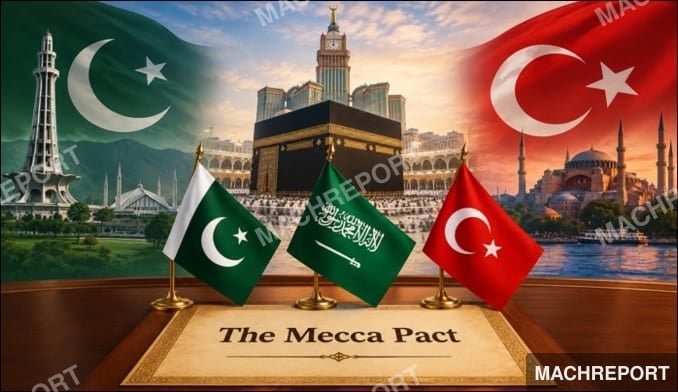
Mecca Pact strengthens Pakistan's defence ties with Saudi Arabia and Türkiye, creating military opportunities while raising regional security risks.
The Mecca Pact, formally known as the Makkah Joint Defence Agreement, marks a significant development in Pakistan's defence strategy and the evolving security architecture of the Middle East. Signed on 7 August 2026 by Pakistan, Saudi Arabia and Türkiye, the agreement establishes a collective defence framework under which an external armed attack against one member is regarded as an attack against all three.
Ministry of Foreign Affairs Pakistan
For Pakistan, the trilateral arrangement offers opportunities to expand its regional influence, strengthen military cooperation, attract defence-industrial investment and deepen strategic partnerships with Riyadh and Ankara. However, these potential benefits are accompanied by significant challenges, including military overstretch, relations with Iran and the complexities of regional security commitments.
The central question is whether Islamabad can translate this new defence partnership into sustainable strategic advantages while maintaining its foreign-policy independence and avoiding involvement in regional confrontations that could undermine its national interests.
Mecca Pact: Background and Strategic Significance
The Makkah Joint Defence Agreement builds upon decades of military cooperation between Pakistan, Saudi Arabia and Türkiye in order to strengthen Saudi Arabia-Pakistan-Türkiye alliance. Its immediate foundations include the bilateral Saudi-Pakistan Strategic Mutual Defence Agreement signed in September 2025.
The new arrangement brings together three countries with complementary strategic strengths: Pakistan's nuclear deterrent and experienced armed forces, Saudi Arabia's financial resources and geopolitical influence, and Türkiye's advanced defence industry and NATO experience.
Beyond its collective defence commitment, the agreement provides for joint military exercises, intelligence sharing, defence production, technology development and logistical cooperation. Importantly, the pact establishes a Strategic Political and Defence Committee and a Saudi-based secretariat, initially led by a Pakistani representative. Pakistan and Saudi Arabia announced completion of their respective ratification processes in October 2026, while Türkiye initiated parliamentary ratification procedures. Nevertheless, the agreement's operational effectiveness will depend on how its members implement their commitments during actual crises.
Strategic Opportunities for Pakistan; Greater Regional Influence
The agreement could substantially elevate Pakistan's diplomatic standing by positioning it as an important security partner in the Middle East. Through the Saudi Arabia-Pakistan-Türkiye alliance, Islamabad gains an institutional platform to participate in regional defence consultations and influence emerging security arrangements. This is particularly significant as Gulf countries reassess their dependence on traditional external security guarantees amid persistent regional instability. For Pakistan, closer engagement with Riyadh and Ankara could strengthen its diplomatic leverage while opening additional opportunities for military cooperation.
Defence Industry and Economic Benefits
One of the agreement's most promising dimensions concerns defence-industrial collaboration. Türkiye possesses established capabilities in unmanned aerial systems, electronic warfare, naval platforms and precision-guided weapons. Pakistan offers defence manufacturing infrastructure, military experience and established production capabilities, including the JF-17 programme. Saudi Arabia, meanwhile, has substantial investment resources and ambitions to expand domestic military production. Combining these strengths could facilitate joint ventures, technology transfers, research programmes and export-oriented defence manufacturing. Such cooperation could benefit Pakistan's defence industry through investment, technical expertise and access to new markets. However, meaningful economic gains will require commercially viable projects, clear technology-sharing arrangements and sustained institutional coordination.
Military Modernization and Operational Cooperation
The agreement also creates opportunities to improve interoperability among the three-armed forces. Joint exercises, intelligence cooperation and personnel exchanges could strengthen readiness and enhance Pakistan's experience in multinational military operations. Access to Turkish defence technologies and Saudi financial support could potentially accelerate selected modernization programmes. Nevertheless, these benefits remain prospective rather than guaranteed outcomes of the agreement.
Military Overstretch and External Commitments
Pakistan's armed forces already face substantial security responsibilities along the country's eastern and western borders, alongside domestic counterterrorism operations. Additional collective defence obligations could increase pressure on military resources, particularly during simultaneous regional crises. Although the agreement establishes mutual assistance commitments, questions remain about the scale, timing and operational conditions of military deployments. Islamabad must therefore ensure that external commitments do not undermine national defence priorities.
Relations with Iran and Regional Rivalries
Pakistan shares an extensive border with Iran and maintains important diplomatic, economic and security interests with Tehran. Closer military alignment with Saudi Arabia could complicate these relations, particularly during confrontations involving Iran and Gulf countries. Türkiye and Saudi Arabia also maintain different threat perceptions and regional priorities, potentially creating disagreements over when collective defence obligations should apply. For Pakistan, preserving balanced relations with competing regional actors will become increasingly challenging. The agreement could strengthen Middle East security cooperation, but poorly managed implementation may also deepen regional polarization.
Nuclear Deterrence and Strategic Ambiguity
Pakistan's nuclear capabilities give the trilateral arrangement considerable symbolic weight. However, the agreement does not establish an explicit nuclear-sharing arrangement or automatically extend Pakistan's nuclear deterrent to its partners. Interpreting the pact as a nuclear security guarantee would therefore be premature. Any ambiguity surrounding nuclear commitments could generate regional concern, complicate relations with major powers and create unrealistic expectations among participating states. Clear communication regarding the agreement's conventional defence scope will be important for strategic stability.
Implications for India and Major Powers
The agreement may also influence Pakistan's relations with India, China and the United States. New Delhi is likely to assess its implications for Pakistan's military capabilities, defence-industrial partnerships and regional diplomatic influence. Meanwhile, Islamabad must carefully manage its established relationship with China while expanding security cooperation with Türkiye and Saudi Arabia. Washington's continuing defence partnerships with Riyadh and Ankara further complicate the strategic environment. Pakistan's principal challenge will be maintaining flexibility rather than allowing the arrangement to dictate its broader foreign policy.
The Mecca Pact represents an important opportunity for Pakistan to enhance regional influence, modernize military capabilities and expand defence-industrial cooperation. However, its strategic value will depend on implementation, institutional coordination and careful management of competing regional interests. Military overstretch, tensions involving Iran, uncertain collective defence obligations and nuclear-related perceptions constitute substantial risks. Ultimately, Pakistan's success will depend not merely on joining a new security arrangement, but on ensuring that its commitments reinforce national interests without compromising strategic autonomy or regional stability.
Comments
Login to comment
No comments yet. Start the conversation.