Merlin Satellite: The AI Eye Redefining Global Intelligence
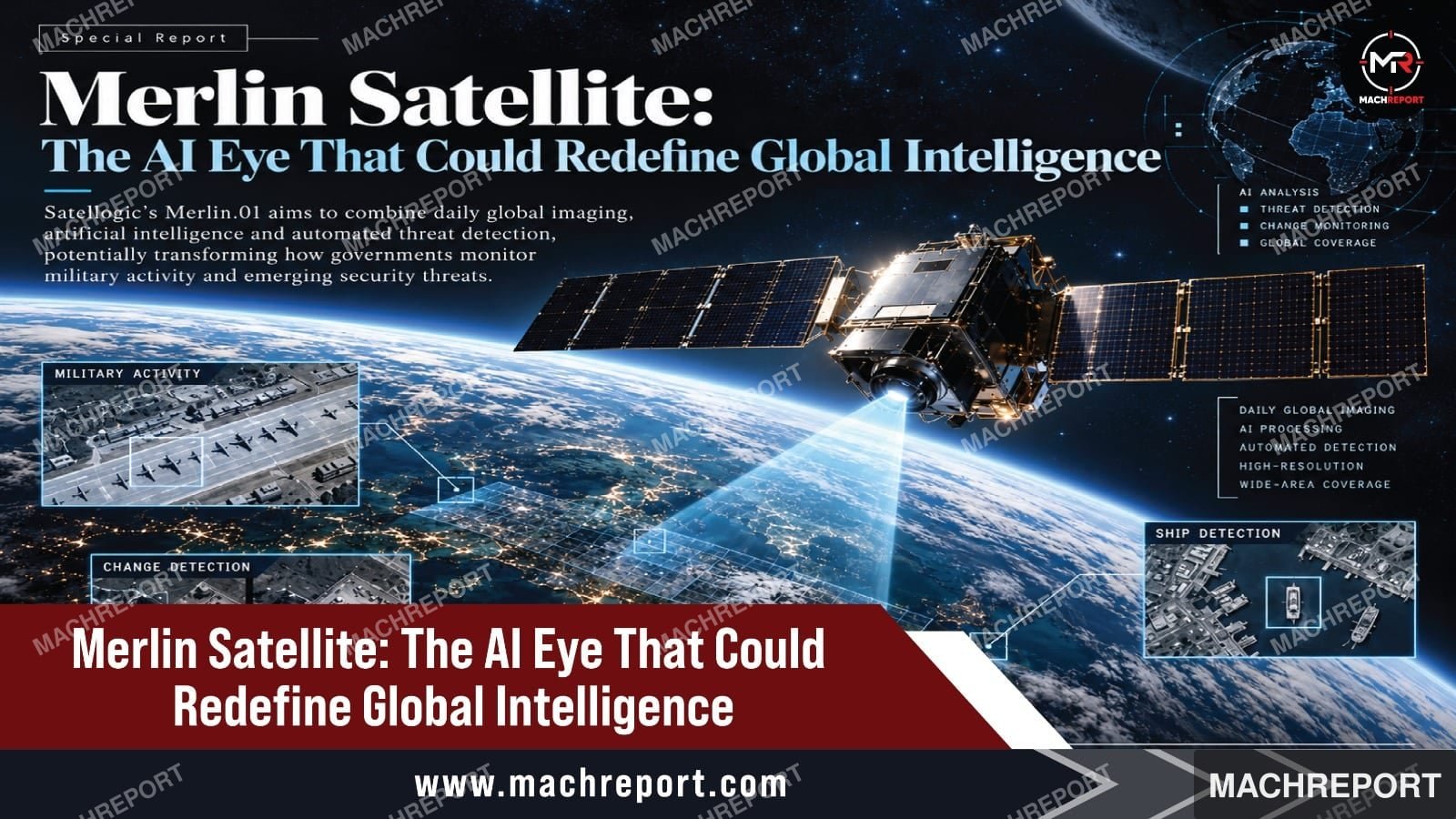
Merlin satellite combines AI, Earth imaging and automated alerts to advance military intelligence, satellite surveillance and geospatial analysis.
On October 1, 2026, US-based Satellogic launched Merlin.01 aboard a SpaceX Falcon 9 rocket from Vandenberg Space Force Base in California. Deployed into sun-synchronous low Earth orbit alongside two NewSat Mark VI satellites and one NewSat Mark V, it marks the first step towards a network designed to scan the planet daily and identify developments requiring closer attention.
The Merlin satellite forms part of Satellogic's Persistent Global Intelligence (PGI) initiative, which seeks to move satellite surveillance beyond periodic image collection towards AI-assisted monitoring. Rather than requiring analysts to identify every location of interest beforehand, the system is designed to detect changes across entire regions and trigger additional observations.
How the Merlin Satellite Turns Images into Intelligence
According to Satellogic's official launch announcement, the planned constellation is designed for daily global imaging at approximately one-metre resolution. Its sensors combine a 170-kilometre imaging swath with 10 spectral bands aligned with Europe's Sentinel-2 programme, allowing changes in infrastructure, land use and surface activity to be tracked over time. Its defining feature is onboard artificial intelligence. Satellogic says the AI-powered satellite network aims to generate change-detection alerts within 30 minutes. Processing imagery in orbit could reduce the need to transmit every image for initial ground analysis, enabling faster identification of potential threats.
The next stage uses a method called tip-and-cue. When Merlin detects significant activity, inter-satellite communication links are intended to direct NewSat Mark VI spacecraft to capture approximately 50-centimetre imagery for closer examination, without initially relying on ground-based tasking. Combined with the Aleph Observer platform, this could establish an integrated system for detection, verification and continued monitoring.
How Merlin Could Transform Military Intelligence
For military intelligence, the biggest advantage could be discovering activity in locations that analysts were not already monitoring. Repeated observations of airbases, naval installations, border regions and logistics networks could reveal unusual aircraft deployments, vehicle concentrations, construction projects and changes in military infrastructure. For example, an unexpected build-up at a remote airfield might be detected through comparisons with earlier imagery. Higher-resolution follow-up could help determine whether it reflects routine training, infrastructure development or activity requiring further investigation.
Such capabilities could improve early warning during regional crises, strengthen intelligence assessments and accelerate surveillance decisions. However, detected changes alone would not establish hostile intent.
Merlin could also enhance maritime domain awareness. In September 2026, Satellogic announced an agreement with SynMax to distribute Merlin-derived maritime intelligence through its Theia platform. Combined with vessel tracking information, satellite imagery could support the identification of ships operating without conventional tracking signals, suspected sanctions evasion and unusual maritime movements. Beyond defence, the same geospatial intelligence capabilities could support disaster assessment, deforestation monitoring and critical infrastructure protection, expanding the commercial applications of AI-enabled Earth observation.
Operational Challenges: What Merlin Cannot Yet Deliver
Despite its potential, Merlin.01 remains an emerging capability rather than a fully operational global surveillance network. On October 13, Satellogic and HEO released images captured on October 4 showing Merlin.01's deployed solar arrays. The company also reported healthy spacecraft power and thermal systems, although payload testing and commissioning remained outstanding. Satellogic currently targets full operational capability in the second half of 2027, subject to further satellite deployments and successful system integration. Its proposed 30-minute alerts, daily global imaging and automated high-resolution follow-up therefore remain performance objectives rather than fully demonstrated operational capabilities.
Important technical limitations also remain. Optical sensors are affected by cloud cover, darkness and atmospheric conditions, while orbital positioning influences how quickly additional imagery can be acquired. AI algorithms may also mistake routine construction, seasonal changes or civilian movements for significant security developments.
Consequently, satellite surveillance cannot replace human judgement. Reliable assessments will still require historical comparisons, complementary intelligence sources and verification before operational decisions are made.
The Future of AI-Powered Satellite Surveillance
Merlin represents a broader transformation in the space industry, as commercial operators increasingly seek to deliver actionable intelligence rather than individual satellite images. For countries without extensive national reconnaissance constellations, such services could expand access to sophisticated geospatial intelligence and strengthen independent situational awareness. However, dependence on commercial providers raises concerns about data security, operational reliability and access to sensitive information during crises.
The strategic value of an AI-powered satellite will ultimately depend on its ability to distinguish meaningful developments from routine activity and deliver verified information quickly enough to support decisions. Merlin.01 has reached orbit, but its greatest challenge lies ahead: proving that AI-enabled satellites can reliably transform planetary-scale observation into timely intelligence. If successful, the next breakthrough in global surveillance may not simply be seeing more of Earth, but knowing what has changed, where it matters and when decision-makers need to act.
Comments
Login to comment
No comments yet. Start the conversation.