Pentagon Expands AI Access to 3 Million Personnel With ChatGPT and Grok
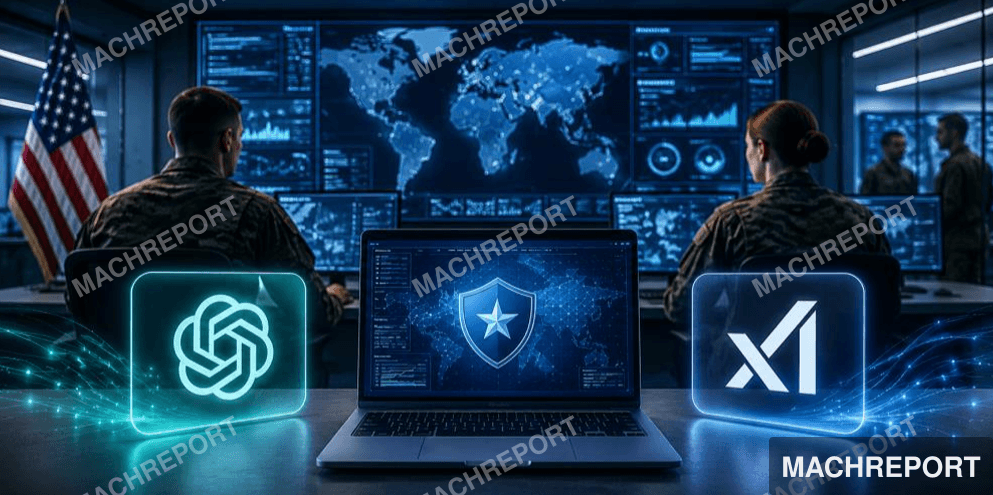
The Pentagon is expanding its use of artificial intelligence by giving up to 3 million military and civilian personnel access to customised versions of OpenAI’s ChatGPT and xAI’s Grok through the secure GenAI.mil platform, aiming to improve productivity, logistics, planning and military operations while protecting government data.
The US Department of Defense is significantly expanding its use of commercial artificial intelligence, rolling out customised versions of OpenAI’s ChatGPT and xAI’s Grok to military and civilian personnel through a secure government platform. The move gives potentially millions of Pentagon employees access to advanced generative AI systems while attempting to address the security and data-protection concerns associated with conventional consumer AI services. The customised tools, known as ChatGPT Mil and Grok for Government, are being made available through GenAI.mil, a centralised artificial intelligence platform created by the Department of Defense to provide personnel with access to commercial frontier AI models in a more controlled government environment.
According to the Pentagon, approximately 3 million military and civilian personnel could ultimately use the platform. More than 1.7 million unique users have already been onboarded, meaning well over half of the department’s workforce has gained access to GenAI.mil. The development represents another major step in the Pentagon’s broader effort to incorporate artificial intelligence into everyday government operations, military planning and logistical activities. A Secure Gateway for Government AI GenAI.mil was launched last year as a dedicated environment through which Defense Department personnel could use commercial AI models without relying on ordinary consumer-facing services. The platform initially provided access to Google Gemini and was designed to give government employees a familiar way of interacting with powerful AI systems while providing additional safeguards for government information. One of the key distinctions between GenAI.mil and consumer AI services is its approach to data.
The Defense Department says the official military environment is designed with protections intended to prevent government information from being subjected to the types of data-collection practices that can accompany consumer technology platforms. The Pentagon's decision to place ChatGPT and Grok inside this controlled environment reflects the growing importance of generative AI to federal agencies. Rather than developing every AI capability internally, the department is increasingly working with leading commercial technology companies and adapting their systems for government requirements.
The result is an expanding ecosystem of AI tools intended to support personnel while keeping their work within more secure systems. ChatGPT Mil Targets Everyday Defense Work ChatGPT Mil is being developed through OpenAI’s OpenAI for Government initiative and is intended to provide Defense Department employees with an experience similar to the widely used commercial version of ChatGPT. The system includes capabilities such as conversational assistance, file handling, projects and custom GPTs. Initially, the Pentagon expects the platform to be particularly useful for unclassified, document-intensive and routine activities.
Potential applications include administrative work, policy development, planning, logistics and the analysis of large amounts of written material. For government employees who routinely spend hours reviewing documents, preparing reports, organising information or producing written drafts, generative AI could substantially reduce the time required for those tasks. The Pentagon also expects the system’s capabilities to expand as the technology develops and as officials identify additional applications across the department. The emphasis on routine and unclassified work is significant. It indicates that the Pentagon’s immediate objective is not simply to place AI at the centre of sensitive military decision-making, but also to use the technology to improve the efficiency of ordinary government operations.
Grok Brings a More Operational Focus The Pentagon has also introduced Grok for Government, a customised version of xAI’s artificial intelligence technology. The system is being provided through Starshield AI, SpaceX’s secure governmentfocused technology infrastructure. Starshield builds on technologies associated with the company’s Starlink satellite network and is designed for government and defence applications. The Defense Department has described Grok in terms that extend beyond administrative productivity. Officials say the technology could provide personnel with faster access to information, improve knowledge continuity and support more secure and efficient collaboration.
The department has also suggested that AI could help military personnel perform missions more quickly and precisely in a variety of operational environments. Potential applications are not limited to battlefield activities. For example, acquisition professionals could use AI for market research and analysis, while logisticians could employ the technology to assist with supply-chain management. Such applications demonstrate how the Pentagon views artificial intelligence as a tool that can potentially influence nearly every layer of its organisation, from back-office administration to operational support.
Anthropic Dispute Shapes the AI Strategy The Pentagon’s latest AI expansion comes amid an ongoing dispute with Anthropic, the company behind the Claude AI model. Anthropic has been notably absent from the latest rollout. The Trump administration previously designated the company a supply-chain risk after Anthropic declined to provide the Pentagon with unrestricted access to its AI technology and maintained certain safety restrictions on how its systems could be used. Anthropic is challenging that designation in court.
The dispute illustrates a larger tension between government demands for unrestricted access to advanced AI and technology companies’ efforts to impose safeguards on how their systems are deployed. At the same time, the Pentagon’s agreements with other major technology companies indicate that it is determined to avoid relying on a single AI provider. The department has expanded relationships with companies including Amazon Web Services, Microsoft, Nvidia and Reflection AI as part of its broader effort to strengthen its artificial intelligence infrastructure.
AI Becomes a Pentagon Priority The deployment of ChatGPT Mil and Grok for Government reflects a fundamental change in how the Defense Department approaches artificial intelligence. For years, AI in defence was frequently associated with specialised research programmes, autonomous systems and experimental battlefield technologies. Generative AI is now bringing the technology into much more ordinary areas of military and civilian work. Personnel can potentially use AI to summarise documents, organise information, analyse data, prepare written material and assist with complex research. At scale, these seemingly small productivity improvements could have a significant effect on the efficiency of a department employing millions of people.
The Pentagon’s strategy also suggests that commercial AI development is becoming increasingly important to national security. Instead of waiting for government-built systems to reach the same level of sophistication as commercial frontier models, the department is seeking ways to adapt commercially developed technologies to military requirements. However, widespread adoption also brings challenges. Security, accuracy, reliability, privacy and appropriate human oversight remain critical considerations when AI is introduced into government and defence environments. An AI system that produces an incorrect summary or misleading recommendation may be inconvenient in an ordinary workplace. In military or national-security settings, the consequences can potentially be much more serious.
For that reason, the Pentagon’s controlled approach through GenAI.mil is designed to balance accessibility with security. A New Era for Military AI With more than 1.7 million personnel already onboarded to GenAI.mil, artificial intelligence is rapidly becoming part of the Pentagon’s institutional infrastructure rather than remaining a technology limited to specialist teams. The introduction of ChatGPT Mil and Grok for Government expands that effort by giving personnel access to two of the most prominent commercial AI platforms in customised government environments.
The immediate applications may centre on administrative work, logistics, research, planning and other unclassified activities. Over time, however, the Pentagon’s continued investment suggests that AI could play a much broader role across the US defence establishment. The latest rollout therefore represents more than the introduction of two new software tools. It is another indication that the Department of Defense views artificial intelligence as a strategic capability and is moving rapidly to integrate commercially developed AI into the way its military and civilian workforce operates.
As GenAI.mil continues to expand, the Pentagon will face the challenge of ensuring that the benefits of increasingly capable AI systems are matched by appropriate safeguards, accountability and human oversight. For now, the direction is clear: artificial intelligence is moving from the margins of Pentagon experimentation toward the centre of its effort to modernise defence operations and government work.
Comments
Login to comment
No comments yet. Start the conversation.