Quantum Warfare: The Next Defence Technology Race
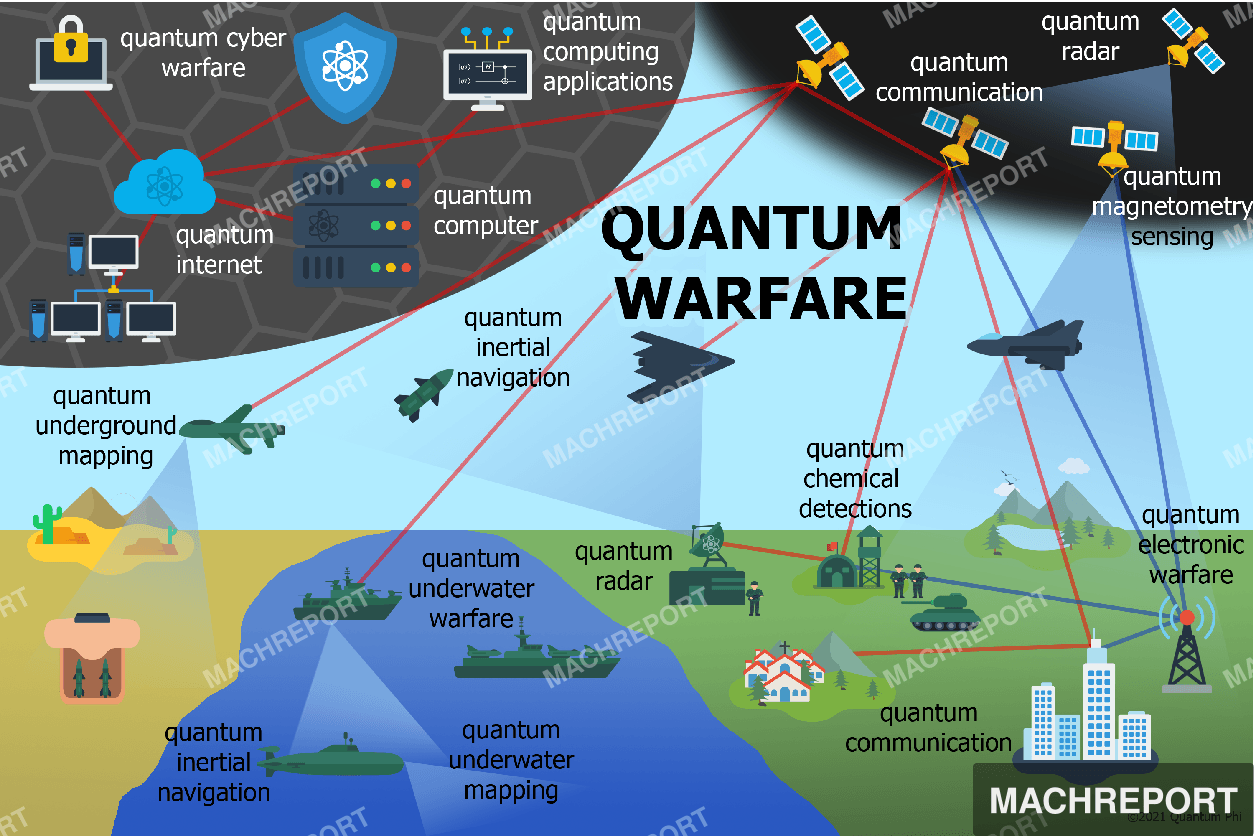
Quantum warfare is emerging as a critical domain of military competition. Unlike conventional computing, quantum technology in defence offers major advantages in the field of military operations it enables detection, navigation, communications and complex data processing. At its core, quantum computing uses superposition and entanglement to process information in ways conventional computers cannot, offering advantages in complex problem-solving. These capabilities strengthen military Command and Control (C2), intelligence and decision-making while reducing dependence on vulnerable systems such as GPS.
The relevance is visible in conflicts such as Ukraine and the Middle East, where GPS jamming has created demand for GPS-denied navigation. In the modern tech-race, US and China are treating quantum technology as a strategic priority, both are investing heavily in quantum computing, sensors and secure communications.
The competition is advancing beyond R&D as states seek to transform from quantum research to quantum defence technology for military operations. Beyond navigation, quantum sensing improves ISR by detecting magnetic, gravitational and electromagnetic signatures, while quantum computing support complex logistics and operational planning.
Quantum Sensors: Detecting the Hidden
Quantum sensors adds a new layer to military ISR by detecting the weak magnetic, gravitational and electromagnetic signatures that conventional systems might miss. When deployed from aircraft or satellites, they are able to detect submarines, buried structures and concealed activity while reducing detection timelines for earlier battlefield warning. This makes quantum sensing in defence particularly valuable where traditional ISR is limited. The same technology can also enable quantum navigation in GPS-denied environments, allowing military platforms to maintain positioning without relying solely on external satellite signals.
Quantum Computing in Cyber Domain and securing C4ISTAR
C4ISTAR refers to the integrated military systems that helps commanders to analyze battlespace information, make strategic decision-making and coordinate forces. The biggest concern in military networks is encryption to protect secure communications across command centers to maintain operational security. The transformation to quantum enabled C4ISTAR involves post-quantum cryptography that integrates Quantum Key Distribution (QKD) for command networks against quantum decryption securing the tactical data links.
A large-scale quantum computer, is able to breach widely using encryption schemes along with aid physicists performing physical simulations. Information scientists believe that quantum computing can perform extremely rapid processing for complex applications like cyber security, C4ISR, electronic warfare (EW), and multisensor processing.
US-China Quantum race
According to US, the emergence of quantum supercomputing might act as an existential threat to U.S. national security and global military dominance. The quantum warfare also characterizes US-China race as China advances in quantum supercomputing leading in secure quantum communications threatening the US military encryptions.
The major threat featured by this quantum race is that if China acquires quantum supremacy first; that would enable China to decrypt US military data while keeping its own data unhackable. Additionally, China is developing quantum radar ad magnetometers that can detect stealth fighter jets and silent US submarines.
To leverage quantum leadership, US relies on a competitive decentralized system to against China, in which federal agencies and private sector innovation support market driven experimentation and quantum research. Whereas China on the other hand, is backed by strong State funding with an integrated ecosystem linking government ministries providing China an edge to have early breakthroughs in quantum race.
US–China Quantum Defence Race: Computing, Sensing and Secure Communications
The US and China are applying quantum technology across communications, sensing and computing, but their defence ecosystems follow different models. China has prioritized Quantum Key Distribution (QKD) through Micius satellite and long-distance fibre networks, while US is advancing Post-Quantum Cryptography (PQC) to protect military networks against future quantum decryption. Both are advancing in quantum navigation for GPS-denied environments, while China is pursuing magnetic sensing for submarine detection and the US is exploring advanced quantum sensing.
In quantum computing, the US combines DoD programmes with private firms such as IBM Quantum and IonQ, while Australia-based Q-CTRL is developing quantum software and GPS-denied navigation technologies for defence applications. China relies more heavily on state-backed research institutions to advance military applications. The competition is therefore expanding from laboratories into real defence systems, with quantum technology increasingly linked to secure communications, navigation, ISR, C2 and battlefield decision-making.
Quantum Warfare: From Promise to Battlefield
Despite rapid advancements, quantum defence technology still faces major challenges before battlefield deployment. Quantum sensors are highly sensitive, but same sensitivity makes them vulnerable to vibration, temperature shifts, electromagnetic interference and platform noise. This makes deployment on aircraft, ships and mobile military systems difficult. Quantum communications also confront hardware vulnerabilities, high infrastructure costs and limitations in long-distant networks. Similarly, claims surrounding quantum radar and anti-stealth capabilities remain experimental. The near-term path is therefore likely to involve hybrid quantum-conventional systems, with quantum sensing, navigation and computing gradually integrated into existing military networks as engineers improve reliability, size, cost and battlefield resilience.
Conclusion
The transformation of quantum warfare does not mean conventional military technology will immediately expire. Instead, quantum technology probably will add a new layer to existing defence systems. Quantum computing could improve military planning and C4ISTAR, quantum sensors could strengthen ISR and navigation, while quantum communications and PQC could protect critical military networks.
The growing US–China quantum race shows that the competition is already advancing towards strategic military applications. For future forces, the advantage may come not from quantum technology alone, but from integration with AI, cyber, electronic warfare, satellites and existing C2 networks. The next defence technology race will therefore be less about who develops quantum technology first and more about who can turn it into deployable and operational military capability.
defence technologyquantumquantum computingquantum racequantum warfare
Comments
Login to comment
No comments yet. Start the conversation.