Rashid Minhas: The Boy Who Would Not Land
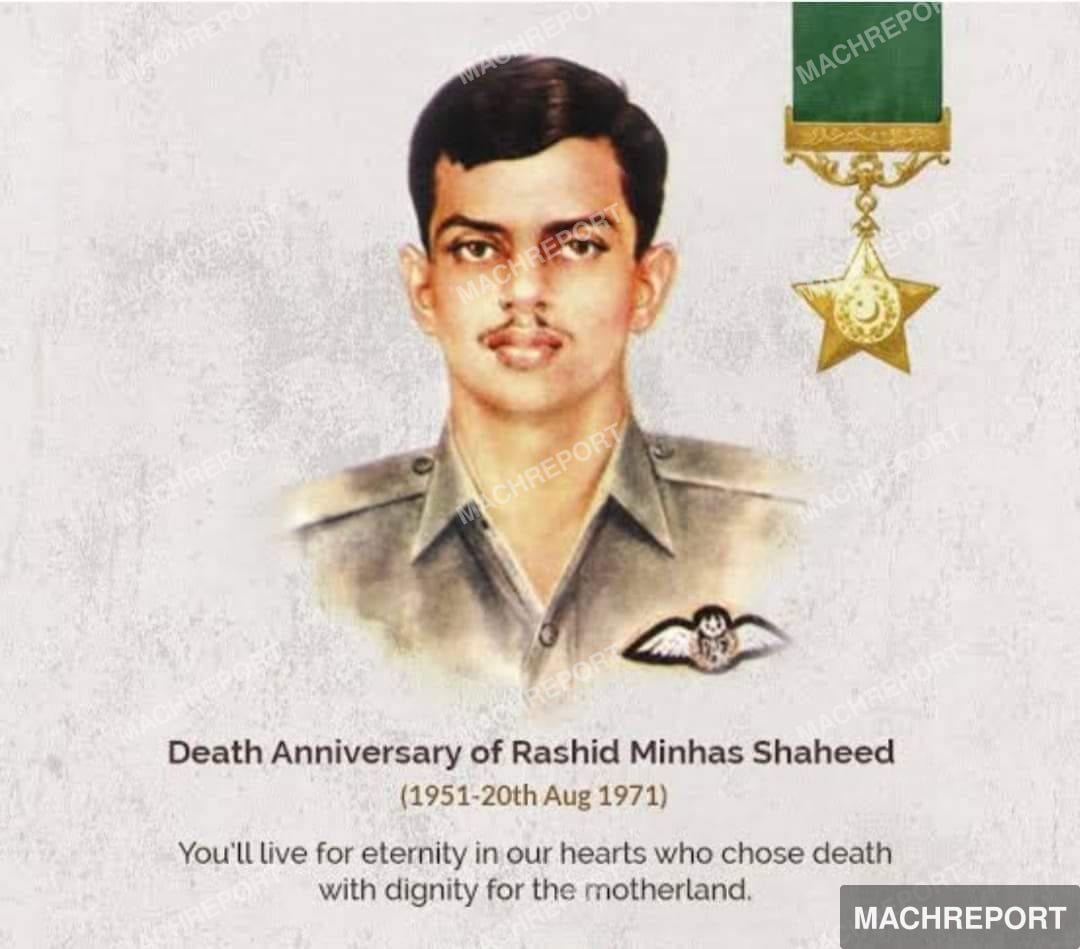
Rashid Minhas was just 20 when his T-33 jet crashed in 1971. Discover the story behind Pakistan's youngest Nishan-e-Haider recipient.
There is a particular kind of Pakistani hero who is permitted to exist only in the past tense: safely dead, conveniently young, and therefore endlessly available for recruitment into whatever cause needs a martyr that month. Rashid Minhas belongs, unfairly, to this category. He has been drafted into ISPR documentaries, PTV specials, and the kind of Independence Day segment that plays between soap commercials, which is a shame, because the myth, for once, undersells the story.
Here is what happened, stripped of the trumpets.
Rashid Minhas and the Final Flight of August 1971
On the morning of 20 August 1971, a twenty-year-old pilot officer, barely five months into his commission and preparing for his second solo flight, was taxiing a T-33 jet trainer at PAF Base Masroor when another officer approached the aircraft. Flight Lieutenant Matiur Rahman, a Bengali officer serving in an air force belonging to a country that was already coming apart at its eastern seam, entered the rear cockpit and attempted to take the aircraft towards India. This was August of the year Pakistan was already fracturing, months before Dhaka fell, when a defecting officer with a military aircraft was not merely a rumour but a genuine possibility.
What followed has been rendered, over five decades, into something almost too clean for belief: the young pilot struggling with a more experienced officer for control of the aircraft, reportedly radioing Masroor that the jet was being hijacked, and the T-33 eventually crashing near Thatta, short of the Indian border. Both men died.
Pakistan's official account maintains that the young officer deliberately brought the aircraft down rather than allow it to cross into India. Bangladeshi accounts, while recognising the struggle inside the cockpit, differ on the circumstances and cause of the final crash. One man became a national hero in Pakistan, with a road, an airbase and the country's highest gallantry decoration associated with his name. The other was honoured in Bangladesh with the Bir Sreshtho, the new nation's highest gallantry award, for attempting to join its independence struggle.
History handed out medals to both men. One was honoured by Islamabad, the other by the state that emerged from the war later that year.
Nishan-e-Haider and the Making of a National Hero
It is worth sitting with the arithmetic of the thing. He was twenty. He had been commissioned as a pilot officer on 14 March 1971, barely enough time to learn the rhythms of military life, let alone to have manufactured the kind of ideological granite that hagiography likes to install in its heroes from birth. He studied at St Patrick's in Karachi, the sort of school that produces cricket commentators and chartered accountants rather than men who crash aircraft on principle.
He had, by accounts of his early life, wanted to fly from a young age. His ambition took him towards the Pakistan Air Force, pursuing the same sky that M.M. Alam had already made legendary. There is no widely established diary entry or letter home showing that he had rehearsed the calculus of his own death. He simply found himself in a situation where the choice, if the official account is accepted, had to be made in moments rather than hours. And he made it.
This is the part the plaques leave out, because plaques have no room for physics. A T-33 does not idle patiently while two men fight over its controls. It is a machine that punishes indecision as readily as it punishes wrong decisions. Whatever happened inside that cockpit unfolded at speed, under intense physical and psychological pressure, and without the luxury of prolonged deliberation.
Rahman had rank and experience. According to accounts of the incident, he had also prepared for the attempt. The younger officer had a training aircraft, a recent commission, and apparently no intention of allowing it to be taken without resistance. Courage, in the textbook sense, usually has time to compose itself. His did not. It arrived as reflex, which may be the truest kind there is, precisely because there was so little time to manufacture it.
How the Pakistan Air Force Preserved His Legacy
The state, naturally, has since done what states do to reflexes: it has turned his into doctrine. Every cadet at the Academy encounters his story as an example of sacrifice and duty, a standard rather than a person, an exhibit rather than a boy who liked flying and had a family that worried about him.
PAF Base Kamra was renamed Minhas in his honour. A major Karachi road carries his name past traffic that may have little idea whose memory it preserves. A postage stamp placed his portrait into the ordinary circulation of national life. He became the youngest recipient of Nishan-e-Haider and remains the only member of the Pakistan Air Force to have received the decoration.
It is a fact repeated so often in official prose that it has calcified into a statistic, which is its own small tragedy. Statistics do not panic. Statistics do not struggle for control of a jet trainer. Statistics do not radio a control tower to report that something has gone terribly wrong.
Remembering the Man Beyond the 1971 War
More than fifty years later, the country that keeps his name on its air bases, roads and commemorative tributes might do him the smaller courtesy of remembering him as he actually was in the final moments of his life. Not a Nishan-e-Haider in waiting, not a lesson plan, not merely another familiar portrait in the annual calendar of national remembrance, but a very young man, recently commissioned, caught in an extraordinary situation against an officer more experienced than himself.
The precise sequence of events inside the cockpit remains contested, but the human reality is not: two officers entered that aircraft, struggled over its fate, and never returned. The story does not become less significant when its uncertainties are acknowledged. If anything, removing the polished certainty of official commemoration brings the young pilot back into view.
That may be the more meaningful way to remember him. Not as someone born already prepared to become a monument, but as a twenty-year-old whose final flight became inseparable from the history of a country at war with itself.
Comments
Login to comment
No comments yet. Start the conversation.