Rethinking Security After 9/11
This article examines the post-9/11 War on Terror's 25-year legacy, its global security impact, human costs, and sustainable counterterrorism approaches.
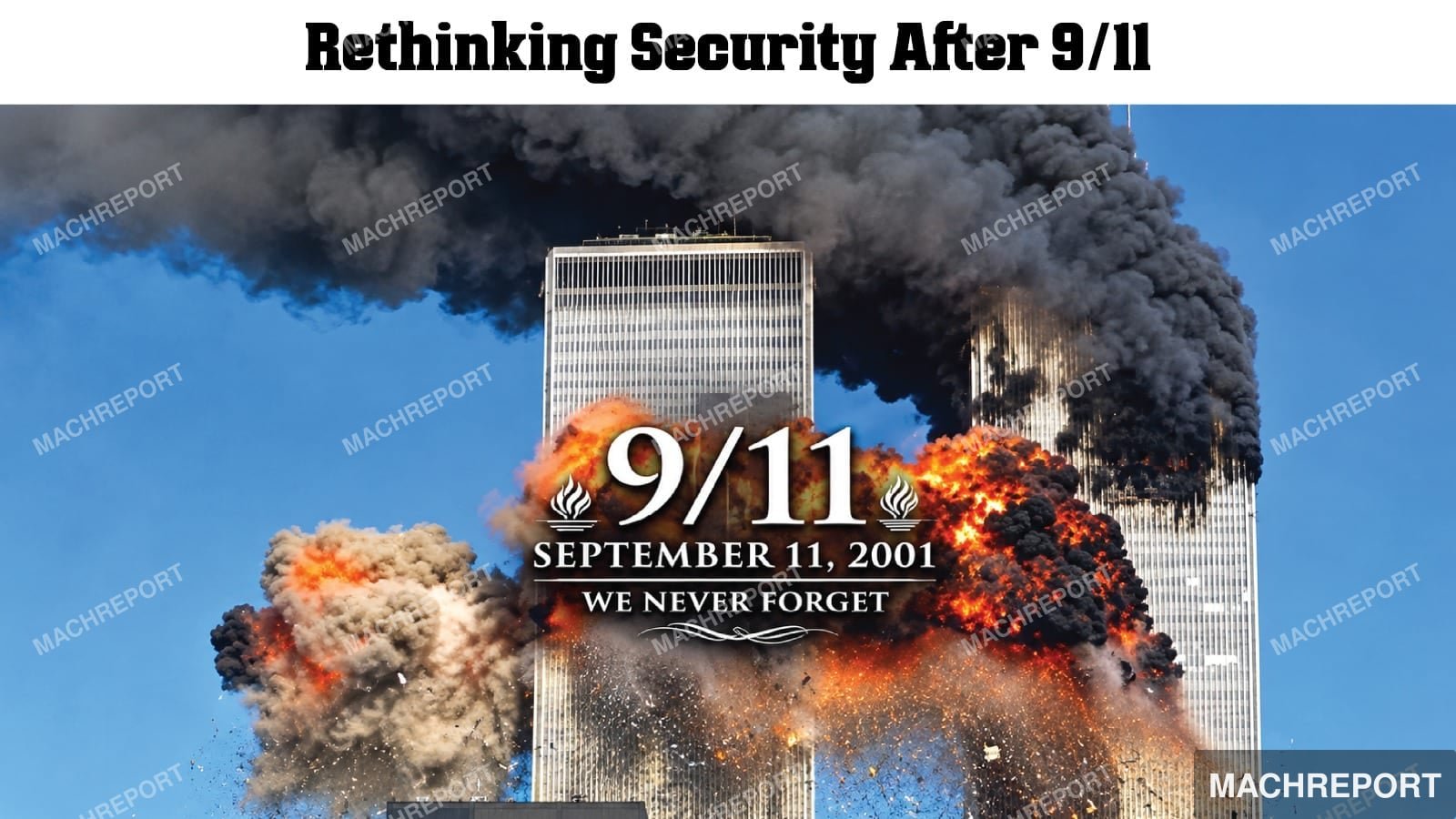
Twenty-five years after the attacks of September 11, 2001, the world continues to live with their consequences. For those who remember that day, the images remain deeply familiar: collapsing towers, smoke rising over New York, and a nation suddenly confronted with a form of violence it had not anticipated. For younger generations, however, September 11 is increasingly a historical event rather than a personal memory. Yet the political world they have inherited was profoundly shaped by what followed.
The attacks transformed the meaning of national security. Counterterrorism became a central priority of governments, military alliances were redefined, airport security expanded, surveillance technologies grew more sophisticated, and military interventions became central to Western foreign policy. The resulting period became known as the War on Terror.
After twenty-five years, however, an uncomfortable question remains: did the War on Terror make the world significantly safer, or did it create new forms of instability that continue to influence global politics?
From Retaliation to a Global War
The initial response to September 11 was focused and understandable. The United States sought to destroy al-Qaeda, prevent further attacks, and hold those responsible accountable. Afghanistan became the first major battlefield after the Taliban government refused to surrender Osama bin Laden and continued to provide sanctuary to al-Qaeda.
What followed, however, expanded far beyond the original counterterrorism mission. Military operations gradually became intertwined with nation-building, democratic reform, counterinsurgency, and attempts to reconstruct political institutions.
The 2003 invasion of Iraq represented an even greater expansion of the War on Terror. The removal of Saddam Hussein was expected by its architects to contribute to a more secure and democratic Middle East. Instead, the collapse of state institutions was followed by insurgency, sectarian conflict, and prolonged instability. The resulting environment eventually contributed to the rise of the Islamic State. The experience of Afghanistan and Iraq revealed a fundamental problem: military victory and political stability are not the same thing.
The Limits of Military Power
Terrorism presents a unique challenge because it is not a conventional enemy. Terrorist organisations do not necessarily require territory, conventional armies, or permanent institutions to survive. They can operate through small cells, online networks, ideological movements, and decentralised organisations.
Military force can destroy training camps, eliminate leaders, and disrupt operational capabilities. It cannot, by itself, eliminate the political and social conditions that allow extremist movements to emerge.
In conflict-affected societies, factors such as political exclusion, corruption, weak institutions, economic hardship, sectarian divisions, and foreign occupation can generate grievances that extremist organisations exploit. Consequently, an operation that eliminates one organisation may leave behind conditions in which another can develop.
This became increasingly evident as extremist movements emerged or expanded across parts of the Middle East, Africa, and South Asia. Terrorism did not disappear after the major interventions. Instead, it adapted to changing circumstances. The lesson is not that military action is never justified. Rather, military force is most effective when it serves a clearly defined political strategy rather than becoming a substitute for one.
Afghanistan and the Failure of Nation-Building
Afghanistan provides perhaps the clearest example of the limits of prolonged external intervention. For two decades, the United States and its allies invested enormous resources in military operations, development programmes, infrastructure, and the training of Afghan security forces. Yet when international forces withdrew in 2021, the Afghan government collapsed with remarkable speed and the Taliban returned to power. The episode demonstrated that military superiority cannot automatically produce political legitimacy.
A state may possess trained security forces and formal democratic institutions, but if those institutions lack public confidence or remain heavily dependent on foreign assistance, their long-term survival is uncertain. The Afghan experience therefore raises a broader question about intervention: how effectively can an outside power construct a sustainable political order in a society whose internal political dynamics it cannot fully control?
The answer provided by the past two decades is sobering.
The Cost Beyond the Battlefield
The consequences of the War on Terror extended far beyond military objectives. Millions of civilians experienced displacement, violence, destroyed infrastructure, economic insecurity, and prolonged political instability. Refugee movements generated by conflicts in the broader post-9/11 environment also reshaped political debates in Europe and other regions. The human cost was not limited to civilians. Military families endured repeated deployments, while veterans returned with physical injuries and psychological consequences that could persist for years.
There was also a significant moral and legal cost. Controversies surrounding indefinite detention, torture allegations, civilian casualties, and drone warfare raised fundamental questions about how democratic states should respond to extraordinary threats.
Security measures may be necessary, but when governments compromise human rights or international law in the name of security, they risk undermining the values they claim to protect.
A Mixed Record of Success
It would nevertheless be unfair to describe the War on Terror as an absolute failure. Counterterrorism capabilities improved significantly after 2001. International intelligence-sharing expanded, terrorist financing became a major focus of governments, and numerous terrorist leaders and networks were successfully targeted. The United States also avoided another attack on the scale of September 11. These are important achievements.
The problem lies in the broader definition of success. If the goal was simply to prevent another September 11 and disrupt specific terrorist organisations, the strategy achieved meaningful results. If the objective was to create a more stable international environment and eliminate the conditions that sustain extremism, the record is considerably less convincing. The distinction matters because tactical victories do not necessarily produce strategic success.
Rethinking Security for the Future
The central lesson of the past twenty-five years is that counterterrorism requires a broader strategy. Military action may sometimes be unavoidable, particularly when governments face immediate threats. However, long-term security should rely more heavily on intelligence cooperation, targeted law enforcement, financial monitoring, diplomacy, regional partnerships, and efforts to strengthen legitimate institutions. Prevention must also become a greater priority. Extremist organisations often exploit political grievances and institutional weakness. Addressing corruption, exclusion, inequality, state fragility, and unresolved conflicts can reduce the environments in which radicalisation becomes attractive.
This approach requires patience because political and social change rarely occurs as quickly as military operations. Yet sustainable security cannot be built through force alone.
The Legacy of September 11
The most enduring legacy of September 11 may ultimately be the transformation of the concept of security itself. The attacks demonstrated the vulnerability of even the world's most powerful states. The response demonstrated something else: security policies can themselves reshape societies, international relationships, and political institutions for generations.
Twenty-five years later, the challenge is not simply to determine whether the War on Terror was a success or failure. It is to understand what its history teaches about the use and limits of power. The fight against terrorism remains necessary. But it should not become an open-ended justification for war, surveillance, or the erosion of fundamental rights.
True security requires more than preventing attacks. It requires stable institutions, political legitimacy, international cooperation, respect for law, and societies in which violence has fewer opportunities to take root.
The generation that grew up after September 11 now has the opportunity to rethink the assumptions that shaped the post-9/11 world. Its task is not to forget the threats that produced the War on Terror, but to learn from its successes, failures, and unintended consequences. The ultimate lesson is simple but difficult: lasting security cannot be achieved through military power alone. It must be built through a combination of strength, restraint, diplomacy, justice, and political wisdom.
Comments
Login to comment
No comments yet. Start the conversation.