Russia- Ukraine war: Expanding Front Beyond the Battlefield
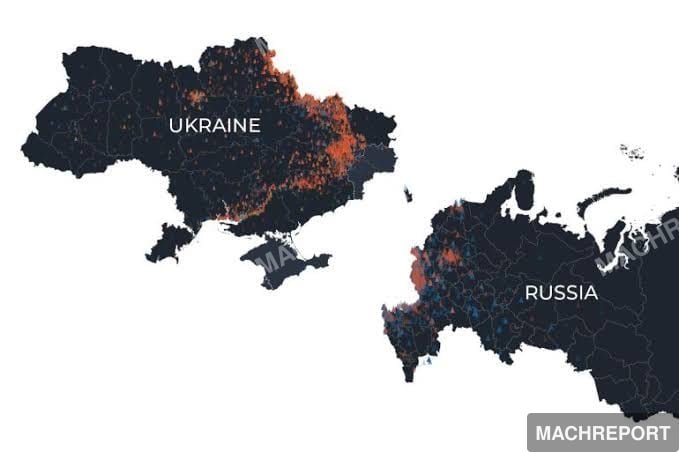
The war in Ukraine is entering a more dangerous phase as Russia confronts Ukraine’s expanding long-range strike capabilities and NATO’s protected strategic depth. This analysis examines Moscow’s incentives for escalation, the growing shadow conflict across Europe, nuclear deterrence, inadvertent escalation, and the risks created by competitive risk-taking between Russia and the West.
After nearly five years of attritional conflict, the war in Ukraine may be entering a phase in which the greatest danger lies not necessarily in a dramatic breakthrough on the battlefield, but in the widening gap between what Russia can attack and what Ukraine can reach.
Moscow has compelling reasons to consider escalation. Russia has failed to translate years of fighting into the political outcome it originally sought, while Ukraine has acquired an increasingly sophisticated ability to strike military, energy, and strategic targets far inside Russian territory. At the same time, much of the infrastructure that enables Ukraine to sustain the war is located outside Ukraine, particularly in NATO and European countries. This creates a fundamental strategic imbalance.
Ukraine increasingly operates with a protected rear. European and NATO countries provide Kyiv with weapons, financial assistance, intelligence, training, maintenance, logistical support, repair facilities, and other forms of military infrastructure. Russia can attack targets inside Ukraine, including those close to the borders of NATO members, but directly attacking the broader European network that sustains Ukraine would carry the risk of a confrontation with the Alliance. Russia has no comparable strategic sanctuary.
Its military infrastructure, energy networks, industrial facilities, command systems, and other strategic assets are increasingly vulnerable to Ukrainian long-range attacks. As Ukraine's strike capabilities expand, Moscow faces a battlefield in which the conventional military rear of one side is considerably more exposed than that of the other.
That imbalance is likely to become increasingly important as the war continues. Russia effectively has three choices. It can accept the existence of a European sanctuary from which Ukraine is continuously supplied; it can attempt to attack that sanctuary directly and risk a war with NATO; or it can find ways to impose costs on Europe's ability to support Ukraine without crossing the threshold of open conventional conflict. The third option is potentially the most attractive—and the most difficult to manage.
From Battlefield Escalation to Shadow Conflict
Russian escalation is therefore likely to operate along two interconnected tracks: greater intensity inside Ukraine and greater pressure beyond Ukraine. The first can be described as vertical escalation. Russia could increase the scale and frequency of missile and drone attacks, expand the range of targets, and place greater emphasis on Ukraine's energy system, defense industry, command-and-control infrastructure, and transportation networks connecting the country to Europe.
Attacks near the borders of Poland and Romania illustrate the strategic logic. Russia can strike the arteries through which Western assistance reaches Ukraine without directly crossing NATO's territorial frontier. The closer such attacks come to Alliance territory, the more they test NATO's tolerance while preserving a degree of geographic separation. The second track is horizontal escalation. Instead of directly attacking NATO territory, Russia can seek to weaken the infrastructure that sustains European support through covert and deniable measures. Sabotage, cyber operations, electronic warfare, espionage, interference with communications, and attacks against transportation or energy infrastructure could impose costs without immediately producing the political conditions for a conventional military response.
This creates a zone of confrontation in which attribution, proportionality, and deterrence become much harder to manage. The vulnerabilities extend beyond land-based infrastructure. Europe's dependence on ports, pipelines, shipping routes, and undersea cables creates opportunities for disruption at sea. Western dependence on commercial and military space systems creates another potential pressure point. Communications, navigation, surveillance, intelligence, and precision targeting increasingly depend upon space-based infrastructure and its associated ground systems.
Russia does not necessarily need to destroy these capabilities physically. Jamming, spoofing, cyberattacks, electronic interference, and attacks against supporting infrastructure could all generate effects while remaining below a more obvious military threshold. Physical attacks against satellites would represent a substantially more dangerous step and could therefore remain higher on the escalation ladder.
Expanding the Geography of Confrontation
Russia also possesses another means of broadening the conflict: geographic diversification. Moscow does not necessarily need to respond to Western pressure exclusively within the European theater. Expanding military and technological cooperation with countries such as Iran can create additional pressure points for Western governments. The logic is straightforward. If Russia can assist states or non-state actors capable of threatening Western interests in other regions, it can increase the costs of confrontation without directly attacking NATO members. The result is a conflict that becomes broader without necessarily becoming formally larger.
Russia could therefore pursue a strategy of simultaneous vertical and horizontal escalation: increasing the intensity of the war in Ukraine while expanding confrontation into cyber, maritime, space, covert-action, and third-country domains. The objective would be to pressure the wider system supporting Ukraine without triggering a direct NATO–Russia war.
Nuclear Deterrence and the Space for Risk
Nuclear weapons complicate this dynamic considerably. The stability–instability paradox suggests that nuclear deterrence can have two apparently contradictory effects. At the highest level, mutual vulnerability discourages deliberate war between nuclear powers because the consequences are potentially catastrophic. Yet precisely because a general nuclear confrontation is so dangerous, both sides may feel greater freedom to take risks at lower levels of conflict.
This helps explain why Russia can contemplate increasingly aggressive activity against European interests while assuming that NATO will attempt to prevent such incidents from developing into direct military confrontation. But the same logic applies to Western governments.
Russia has repeatedly issued warnings over increasingly sophisticated Western weapons, longer-range strikes, and attacks against targets deeper inside Russian territory. Yet Moscow has generally stopped short of launching a conventional attack against NATO territory.
Every time a declared red line is crossed without a dramatic Russian response, Western policymakers may become more confident that another incremental step will also remain manageable. This produces a dangerous feedback loop.
Russia interprets Western actions as evidence that its deterrent threats are losing effectiveness. The West interprets Russian restraint as evidence that Moscow's threats have limits. Both conclusions can encourage further risk-taking.
The most dangerous outcome is therefore not necessarily a deliberate decision to start a NATO–Russia war or use nuclear weapons. It is the accumulation of smaller decisions warning is issued and ignored. Another operation is conducted closer.
One side tests a red line. The other decides not to respond decisively. A new threshold is crossed. Another warning is issued and ignored. Another operation is conducted closer to strategically sensitive territory. Eventually, the distance between conventional competition and strategic confrontation may become dangerously small. The central problem is thus not that either Russia or NATO necessarily wants a wider war. It is that both sides have incentives to believe they can approach the edge without crossing it. History's most dangerous crises often begin precisely where confidence in that assumption starts to fail.
Comments
Login to comment
No comments yet. Start the conversation.