Russia’s Jet-Powered Drones Testing Next Generation of Air Defense
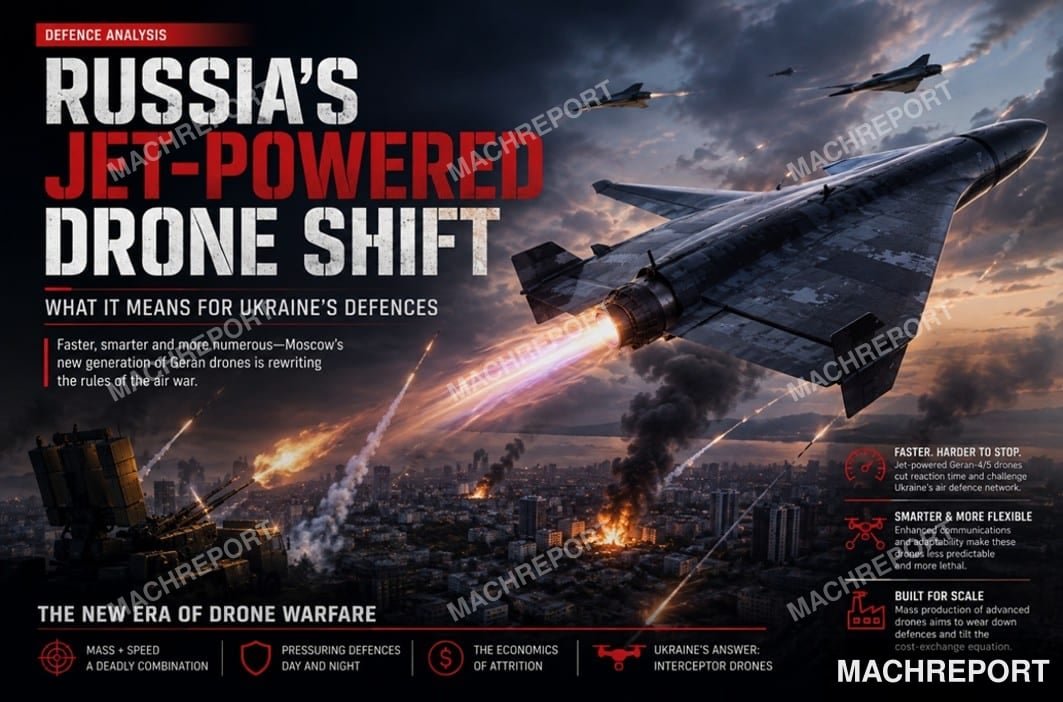
Russia’s growing use of jet-powered drones is introducing a new challenge for Ukraine’s evolving air-defence architecture. By combining greater speed with mass-employment model of conventional Shahed-type UAVs, Moscow is reducing the reaction time available to Ukrainian defenders and testing the economics of low-cost interception. The development is also accelerating Ukraine’s shift towards faster interceptor UAVs and layered Counter-UAS capabilities. The emerging competition highlights a broader transformation in Russia-Ukraine War, where speed, production scale, cost and defensive sustainability are becoming central to next phase of drone warfare.
For years, Ukraine's answer to Russian Shahed drone campaign was becoming increasingly clear: do not fight every drone with a missile. Instead, Ukraine built layers. EWcould disrupt some UAVs. Mobile fire teams and anti-aircraft guns could handle others. Searchlights and machine guns provided another layer. And increasingly, Ukrainian forces turned to interceptor drones, a cheaper answer to a weapon designed to win through quantity.
That model is now facing a new test. Russia is increasingly sending jet-powered variants of its Geran one-way attack drones into Ukrainian airspace. This change is significant not simply because these UAVs are faster, but because their speed attacks very adaptation Ukraine developed to make mass Russian drone attacks more manageable.
The result is a new phase of Russia Ukraine War in which contest is becoming less about whether a drone can be detected and more about whether defender can react quickly enough and at an affordable cost. That distinction could shape next generation of drone warfare far beyond Ukraine.
Russia Has Changed the Problem
The original Shahed-type campaign was built around a simple military proposition. Use a relatively inexpensive long-range UAV, launch it in large numbers and force defender to spend substantially more resources detecting and destroying it. The weapon did not have to be exceptionally fast. In fact, its relative simplicity was part of its strength. Ukraine gradually adapted.
The development of interceptor UAVs was particularly important because it offered possibility of restoring cost balance. Instead of firing a high-value surface-to-air missile at a comparatively inexpensive one-way attack drone, Ukraine could potentially use a cheaper drone to destroy it. That solution, however, depends on time.
A defensive drone must detect or receive target's location, launch, accelerate and reach the engagement area before the incoming UAV reaches its target. Russia's jet-powered Gerans change that calculation.
Ukrainian intelligence assessments and specialist reporting have identified several turbojet-powered variants, including Geran-3, Geran-4 and Geran-5. Janes has reported that Geran-4 can reach speeds of up to around 500 km/h, while other Ukrainian assessments have placed the Geran-5 at around 600 km/h. The precise performance of individual variants remains difficult to independently verify, but operational trend is clear: Russia is introducing substantially faster one-way attack UAVs.
The important number, however, is not 500 or 600. It is time remaining for defender.
Recent reporting from Kyiv described jet-powered drones as flying several times faster than conventional Shahed-type systems and highlighted Ukrainian President Zelenskyy's assessment that these are currently most difficult UAVs for Ukraine to intercept. Ukraine's air-defence challenge is no longer simply one of coverage. It is increasingly one of reaction time. A defensive network may have sufficient sensors and weapons on paper, yet still struggle if target's speed leaves too little time to bring right layer into action.
Russia Is Combining Mass with Speed
The most significant development may be that Russia is not replacing its slower Gerans with jet-powered drones. It is adding them to the mix that creates a more complicated attack problem. Slower UAVs remain useful because they are suited to mass employment. Faster systems can then introduce a different challenge for defender. Rather than presenting a uniform stream of identical targets, Russian strike packages can increasingly contain UAVs with different speeds and characteristics.
The effect is cumulative.
A large raid forces Ukraine to activate sensors, electronic-warfare systems and interceptors. Faster drones reduce the time available to deal with them. Decoys and missiles can complicate the picture further.
The objective is therefore not necessarily to achieve a dramatic breakthrough in every attack. It can be enough to keep defensive network under continuous pressure. That appears increasingly relevant to the latest Russian campaign. During last week of August, Russia subjected Kyiv and surrounding areas to repeated attacks over several consecutive days. Ukrainian President Zelenskyy said roughly 1,500 drones had been launched over four days, including around 800 jet-powered systems. These figures are Ukrainian estimates, but the scale is consistent with the broader reporting that Russia is increasing the use of faster UAVs. That points to a broader Russian objective. Drone is becoming a tool for imposing persistent operational pressure, not merely delivering a warhead.
The Real Target: Defensive Capacity
This is where economics of campaign become important. A successful air-defence system is not necessarily one that destroys every incoming drone. It is one that can do so without exhausting itself. Russia's one-way attack UAV campaign has always exploited this problem. A relatively inexpensive attacking system can force defender to employ a more expensive interceptor. Jet propulsion potentially makes that exchange even more difficult. A conventional interceptor UAV that can comfortably catch a slower Shahed may struggle against a faster Geran. The defender is then pushed toward a more capable interceptor, a fighter aircraft or a surface-to-air missile. That can increase the cost of defence.
Ukraine's Response
Ukrainian response is already moving beyond traditional air defense. It has tested multiple interceptor concepts against jet-powered Shahed-type drones. Kyiv Independent reported in late August that four potential interceptor systems were being tested as Russia expanded use of Geran-4 and Geran-5.
Ukraine has also introduced a domestically developed jet-powered interceptor known as Alexa Spatium, according to reporting on the system. The platform is intended to provide a relatively compact and deployable means of engaging faster aerial threats.
Objective is clear: create a defensive layer that occupies space between traditional gun-based counter-UAS systems and expensive surface-to-air missiles. If successful, this approach could help restore a favorable cost relationship between attacker and defender. But it also presents challenges.
Interceptor drones themselves require sensors, communications, launch infrastructure, trained operators or autonomous guidance, and sufficient production capacity. They must also operate in an environment increasingly affected by electronic warfare.
The solution to one generation of drones therefore creates requirements for another generation of counter-drone technology.
Beyond Russia and Ukraine
What is unfolding over Ukraine is likely to shape air-defence thinking well beyond this war. The conflict is showing that future of unmanned warfare will not be defined by drone alone, but by contest between attack, defence and adaptation. Russia’s move toward faster Gerans is already forcing Ukraine to rethink how it detects and intercepts low-cost threats. Ukraine’s response, in turn, is pushing development of faster and cheaper Counter-UAS systems. This cycle is unlikely to stop. As drones become faster and more capable, defenses will have to become faster, smarter and more affordable.
The lasting lesson from Ukraine may therefore be simple: in the next era of air warfare, the advantage will belong to side that can adapt faster and sustain that advantage longer.
Comments
Login to comment
No comments yet. Start the conversation.