The Boy Who Would Not Land
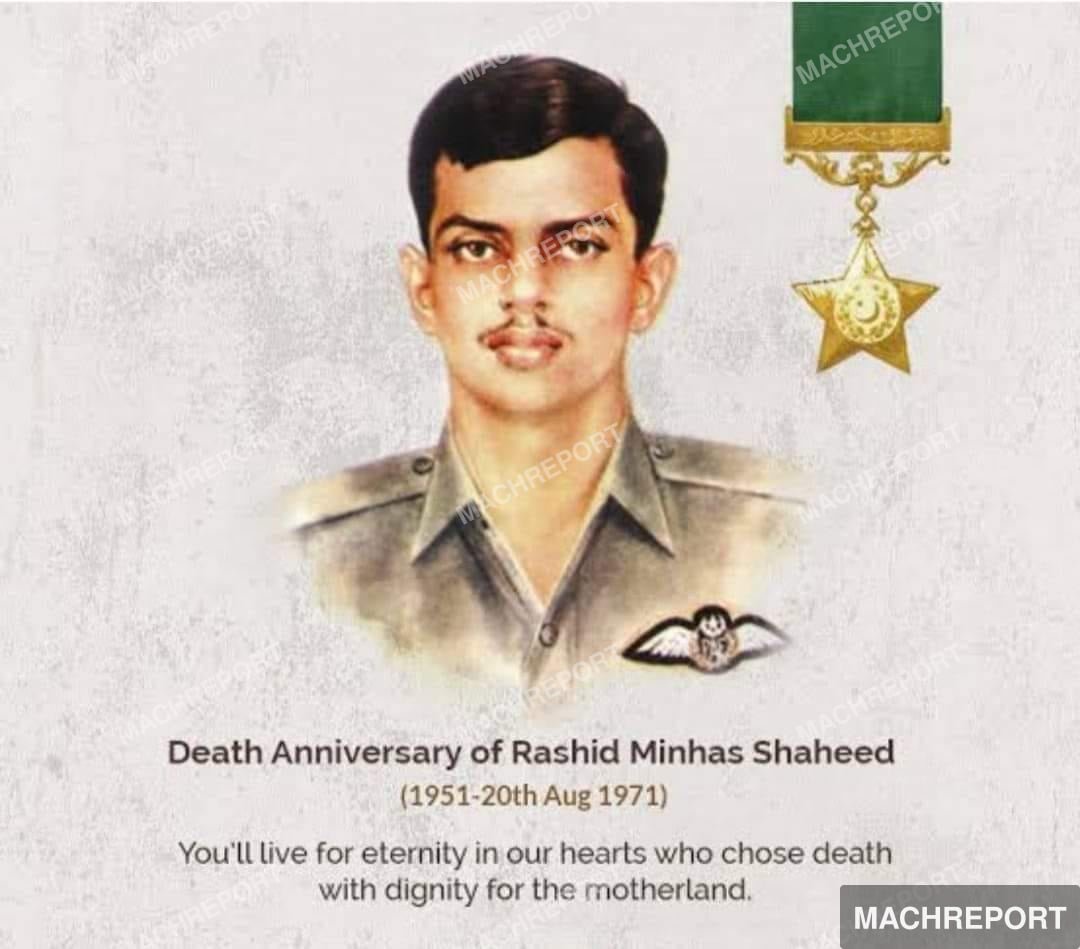
The Boy Who Would Not Land” recounts the extraordinary final moments of Pilot Officer Rashid Minhas, a 20-year-old Pakistani Air Force pilot who died in 1971 while preventing his aircraft from being taken to India by his instructor, Flight Lieutenant Matiur Rahman. The article looks beyond official heroic narratives and portrays Minhas as a very young, inexperienced pilot who faced an impossible decision in a matter of seconds. Rather than simply presenting him as a national symbol, it remembers him as an ordinary young man whose instinctive courage turned him into one of Pakistan’s most enduring military heroes.
There is a particular kind of Pakistani hero who is permitted to exist only in the past tense safely dead, conveniently young, and therefore endlessly available for recruitment into whatever cause needs a martyr that month. Rashid Minhas belongs, unfairly, to this category. He has been drafted into ISPR documentaries, PTV specials, and the kind of Independence Day segment that plays between soap commercials, which is a shame, because the myth, for once, undersells the story. Here is what actually happened, stripped of the trumpets.
On the morning of 20 August 1971, a twenty-year-old pilot officer barely five months into the uniform, barely out of his second solo flight took a T-33 jet trainer up from PAF Base Masroor and found, mid-taxi, that the man beside him had other plans. Flight Lieutenant Matiur Rahman, his instructor, a Bengali officer flying a country that had, by then, stopped quite being his, forced his way into the cockpit and tried to fly the aircraft to India. This was August of the year Pakistan was already coming apart at its Bengali seam, months before Dhaka fell, when a defecting officer with a jet was not a rumour but a live possibility, and Rahman meant to make good of it.
What Rashid Minhas did next has been rendered, over five decades, into something almost too clean for belief: the boy pilot wrestling the controls from a senior officer twice his flying hours, radioing Masroor that he was being hijacked, being told to repeat himself because no one could quite credit what he was saying, and then rather than let the aircraft, and whatever it carried in its instruments and manuals, cross into Indian hands putting T-33 into the ground near Thatta, a few reluctant kilometres short of the border. Both men died. One of them is a national hero with a road, an airbase, and a Nishan-e-Haider named for him. The other was garlanded on the opposite side of a border that hadn't even hardened into its final shape yet, awarded the Bir Sreshtho by a country called Bangladesh that did not exist when he took off that morning. History handed out medals to both men that year. One got his from Islamabad, the other from a Dhaka that didn't exist yet when the plane went down.
It is worth sitting with the arithmetic of the thing. Minhas was twenty. He had been commissioned as a pilot officer on 13 March 1971 barely enough time to learn where the mess hall was, let alone to have manufactured the kind of ideological granite that hagiography likes to install in its heroes from birth. He went to St Patrick's in Karachi, the sort of school that produces cricket commentators and chartered accountants rather than men who crash planes on principle. He had, by every account, wanted this had gone against his father's preference and enrolled at PAF School in Lower Topa in 1968, chasing the same sky that M.M. Alam had already made legend of. There is no diary entry, no letter home, that tells us he had rehearsed the calculus of his own death. He simply had about ninety seconds in which to do it, and he did.
This is the part the plaques leave out, because plaques have no room for physics. A T-33 does not idle patiently while two men fight over its controls; it is a machine that punishes indecision as readily as it punishes wrong decisions. Whatever happened in that cockpit happened at altitude, at speed, in the time it takes to read this sentence twice. Rahman had rank, experience, and if the accounts are to be believed a head start on the plan. Minhas had a training aircraft, a very recent commission, and apparently no capacity whatsoever for letting the thing be taken from him. Courage, in the textbook sense, usually has time to compose itself. His didn't. It arrived as reflex which may be the truest kind there is, precisely because there was no time to fake it.
The state, naturally, has since done what states do to reflexes: it has turned his into doctrine. Every cadet at the Academy is introduced to him early, the way Catholic schoolchildren are introduced to their patron saints as a standard, not a person, an exhibit rather than a boy who liked flying and had a father who didn't want him to. PAF Base Kamra was renamed Minhas in his honour; a Karachi road carries his name past traffic that has no idea whose it is; a two-rupee stamp put his face into pockets in 2003. He became, at twenty, the youngest recipient of Nishan-e-Haider and remains, to date, the only Pakistan Air Force officer to hold it a fact repeated so often in official prose that it has calcified into a statistic, which is its own small tragedy. Statistics don't panic. Statistics don't radio a control tower twice, insisting they aren't imagining it.
Fifty-odd years on, the country that keeps his name on its air bases and its stamps might do him the smaller courtesy of remembering him as he actually was for the four hundred-odd seconds he had left to be anything at all: not a Nishan-e-Haider in waiting, not a lesson plan, but a very young man, recently commissioned, doing the one unbearable thing asked of him, quickly, before he had the chance to decide he couldn't.
Comments
Login to comment
No comments yet. Start the conversation.