The Houthi Threat to Saudi Arabia
Yemen Becomes a Wider War Front
The renewed Saudi-Houthi confrontation is no longer an isolated Yemen conflict. It has become one of secondary fronts of wider war involving Iran, United States and Israel, with consequences extending across Gulf, Red Sea and global energy markets. Saudi Arabia has intensified air operations against Houthi positions in Yemen, while the have expanded missile and drone attacks against Saudi military, urban and energy-related targets. Reuters reported that Saudi aircraft were striking Yemen as Houthi forces continued attacks against locations including the Red Sea oil port of Yanbu and the Khamis Mushait airbase. Houthis are no longer operating only as a missile threat from Yemen’s interior. Their recent territorial advances along the western coastline, including reported control of Mocha and Mayun Island near Bab el-Mandeb, have created a more direct strategic relationship between ground war in Yemen and security of Red Sea shipping.
Riyadh Strikes Back
Saudi Arabia’s immediate response has centered on air power. Fighter aircraft have been conducting strikes against Houthi positions across several Yemeni governorates, with Saudi officials warning of further action following attacks on the kingdom. Houthi sources have reported extensive Saudi air activity, although individual strike claims and damage assessments remain difficult to independently verify.
The underlying Saudi calculation is straightforward: prevent Houthis from consolidating their new positions, suppress their missile and UAV infrastructure, and reduce their ability to threaten Saudi territory and maritime routes. The problem is that airstrikes alone do not necessarily reverse territorial gains. The Houthis have demonstrated an ability to disperse, absorb punishment and continue operating from difficult terrain, while the collapse or withdrawal of some Saudi-backed Yemeni forces has reduced Riyadh’s ability to apply pressure through local ground partners. Reuters has linked the latest Houthi advance to weakening of Saudi-backed forces on Yemen’s Red Sea coast.
This creates a familiar strategic dilemma: Saudi Arabia can increase intensity of air operations, but sustaining a prolonged campaign risks increasing expenditure, interceptor consumption and escalation without guaranteeing the restoration of the previous military balance.
The Air-Defence Problem
One of the most important developments is therefore not another strike, but Saudi Arabia’s reported shortage of missile interceptors. Riyadh approached France, Britain, Pakistan and Egypt for air-defence assistance as its stocks of interceptors came under pressure. The report also linked the shortage to the wider Iran war, which has placed substantial demands on U.S. missile-defence inventories. According to reports, no country had publicly committed forces at the time of reporting, while Washington was providing intelligence assistance rather than directly intervening in the Saudi-Houthi confrontation.
This exposes an important distinction between possessing sophisticated air-defence systems and sustaining them during a high-volume missile and drone campaign. Saudi Arabia operates a layered network incorporating US-supplied systems, but each interception consumes a relatively expensive interceptor against a threat that can involve comparatively inexpensive UAVs or missiles. A prolonged exchange can therefore become an economic and logistical contest as much as a technological one. For Riyadh, requirement is consequently not simply additional launchers. It is a broader reinforcement package involving interceptor stocks, sensor coverage, command-and-control, battle-management capacity and potentially allied personnel.
The Makkah Factor
The most politically sensitive incident came on 15 September, when Saudi authorities said air defenses intercepted a Houthi drone south of Makkah before it entered the city’s prohibited airspace. Saudi officials described security of holy sites as a red line. Houthis rejected the allegation and described Saudi account as misinformation. The significance goes beyond military value of a single UAV. Any perceived threat to Makkah or Madinah carries an exceptional political and religious dimension across the Muslim world. The incident has therefore increased pressure on Saudi Arabia to demonstrate that its air-defence architecture can protect the holy cities even while the kingdom is engaged on multiple fronts.
It also raises political stakes for Saudi partners. Pakistan and Türkiye have strengthened defence cooperation with Riyadh through the new trilateral security framework, but Pakistan has separately stated that no military response under the agreement had been discussed following the Houthi attacks. A defence agreement can provide a framework for consultation, deterrence and military cooperation without automatically translating into the deployment of combat forces in Yemen.
The F-15 Claim
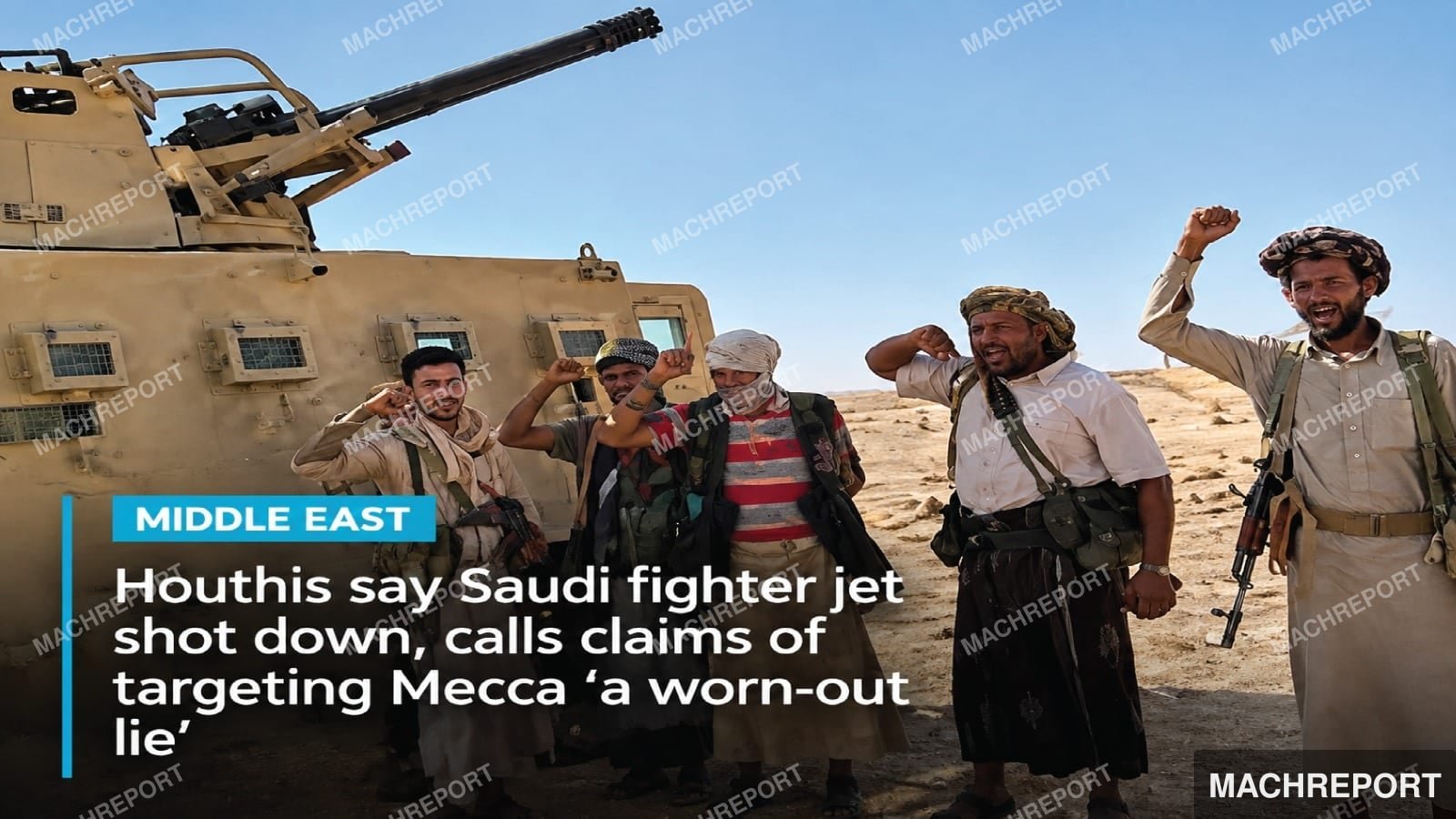
The information environment surrounding conflict is also becoming increasingly contested. Houthis have claimed that they shot down a Saudi F-15 over Marib using a locally produced surface-to-air missile and released imagery purporting to show aircraft wreckage. Saudi authorities have not confirmed the loss, and AP reported that the claim remained unverified. It should therefore be treated as a Houthi battlefield claim rather than an established aircraft loss. If independently confirmed, an F-15 loss would be operationally significant because it could indicate an increased threat to manned Saudi strike aircraft operating over Yemen. At present, however, the available evidence does not support treating the reported shootdown as confirmed.
Oil Routes Become the Strategic Centre
The most consequential aspect of escalation may ultimately be energy security. Saudi Arabia has traditionally relied heavily on the Strait of Hormuz for its maritime oil exports, while its East-West pipeline provides an alternative route to the Red Sea. The Iran war has already placed Hormuz under severe pressure. At the same time, Houthi control of positions around the Bab el-Mandeb threatens the alternative route that becomes more important when Gulf shipping is disrupted.
Importantly, recent shutdown of East-West pipeline followed drone attacks attributed by Saudi Arabia to Iraqi factions, rather than an attack publicly established as Houthi-operated. Nevertheless, the simultaneous Houthi advance toward Bab el-Mandeb means that Saudi Arabia is facing pressure across multiple components of its energy-export architecture. This produces a strategic squeeze: Hormuz is vulnerable because of the wider Iran war, while the Red Sea alternative is increasingly exposed because of the Houthi advance.
A More Difficult Saudi Calculation
Saudi Arabia therefore faces a problem larger than the immediate exchange of airstrikes and missile attacks. Riyadh must contain the Houthi military advance, protect critical infrastructure, preserve access to maritime export routes and replenish an air-defence inventory being consumed during a wider regional war.
For Houthis, objective appears broader than simply inflicting damage on Saudi territory. Their territorial expansion toward Bab el-Mandeb gives the group greater leverage over maritime security, while continued missile and UAV attacks force Saudi Arabia to divide resources between offensive operations in Yemen and defensive coverage of its own territory.
The result is a conflict in which geography has become as important as firepower. Saudi Arabia sits between two strategic chokepoints—the Strait of Hormuz and Bab el-Mandeb, while the Houthis have moved closer to controlling one of them. The longer the wider Iran war continues, the more difficult it becomes for Riyadh to treat the Yemen front as a contained security problem rather than part of a broader regional contest.
Comments
Login to comment
No comments yet. Start the conversation.