The Sixth-Generation Fighter Race: Who Will Control the Skies of the Future?
Evolution of Fighter-Jets till fifth-generation
For more than a decade, the evolution of fighter aircraft has followed the changing technology of war. The first-generation fighter jets changed the speed of war after that era introduced a jet engine along with a transformed aerial combat from propeller-driven aircraft to jet-powered fighters such as Me 262 and F-86 Sabre. The second generation then pushed into supersonic flight, improving radars and early guided missiles, while the third generation, displayed aircrafts such as F-4 Phantom II and MiG-21, manufacturing radar-guided weapons and beyond-visual-range (BVR) combat capability increasingly as per its growing strategic advantage. The fourth-generation era, shifted the strategic advantage towards high manoeuvrability that featured shoot-down radar and advanced avionics, representing an era remarked by F-15 Eagle, F-16 Fighting Falcon, MiG-29 and Su-27. The inception of F-22 Raptors and F-35 Lightning II transformed the race by combining stealth, advanced sensors, data fusion and integrated network operations into the fifth generation era.
What is sixth generation fighter program likely to be?
The sixth-generation evolution is likely to feature an unprecedented strategic advantage. Sixth-generation era will not merely depend on greater speed, manoeuvrability or stealth; rather it will rely on how effectively they can integrate and control the entire air-combat ecosystem. This era is going to be defined by the following parameters: AI-integration, advanced sensors, directed-energy weapons (lasers) electronic warfare (EW), secure data networks, autonomous drones and long-range weapons to function alongside the crewed aircraft.
The sixth-generation fighter jets will not just be the instruments of war, rather they will act as a command node that shall integrate man-power, machines and sensors across the battlespace. The development is already visible in the U.S. planned sixth generation Boeing F-47 under the Next Generation Air Dominance (NGAD) program. Meanwhile, China is advancing its classified sixth-generation efforts, with Chengdu J-36 and Shenyang J-50 reportedly emerging as key programs, supported by rapid prototyping to counter Western sixth-generation program.
US-China race for sixth-generation fighter programs
China is actively accelerating its development of sixth-generation program unofficially named as Chengdu J-36 incorporating several technologies associated with air combat. According to visuals observed from open-sources, the design of Chengdu J-36 under development have tailless design that might help them reduce the radar cross-section from all directions and carries three-engines with massive amount of fuel to fly incredibly long-distances. Moreover, Chengdu J-36 features system-level AI-integration and drones, where the software architecture would enable AI co-piloting and the human-pilot would control the flying combat-drones right from his cockpit screen.
On the other side, US NGAD program features Boeing F-47, which US Air Force’s officially selected for sixth-generation program initiative. The US project Boeing F-47 leans on twin-engine under Next Generation Adaptive Propulsion (NGAP) program. The core objective behind the twin-engine is a practical safety requirement to fly over vast stretches during carrier operations in the Indo-Pacific Region. The twin engine propulsion systems also preserve a calculated balance between reliability, raw performance, and AI integration. Currently, the contract awarded to Being F-47 is scheduled for its first flight by 2028.
Sixth-Generation race extending all across the World:
The sixth-generation program race extends beyond US-China under a Global Combat Air Program (GCAP) framework that integrates United Kingdom, Japan, and Italy. The joint-venture operates under a singular sixth-generation program entity called Edgewing, that has secured a $6.1 billion contract to accelerate into its next high-velocity design phase. Edgewing’s design features a twin-engine, low-observable stealth fighter with an expansive wing area for high-altitude range capability and massive weapons bays.
Recently, a major counter-weight to GCAP was Europe's Future Combat Air System (FCAS) framework, integrated by France, Germany, and Spain. However, the program was confronted by intense industrial disputes between aerospace giants French Dassault Aviation and Airbus that represented Germany/Spain over intellectual property rights and who would be authorized over the design.
Russian targets for sixth-generation warfare aims to upgrade existing fighter jets instead of building a brand-new plane, known as Su-57D Prototype. According to open-sources, the Russian ambition faces a massive technical and financial setback due to economic strains amid ongoing conflicts with Ukraine. This shall also create a strategic dilemma for India in the South-Asian regional environment being a closest ally of Russian platforms as the immediate backbone of its fleets.
What Strategic Advantages does sixth-generation carries?
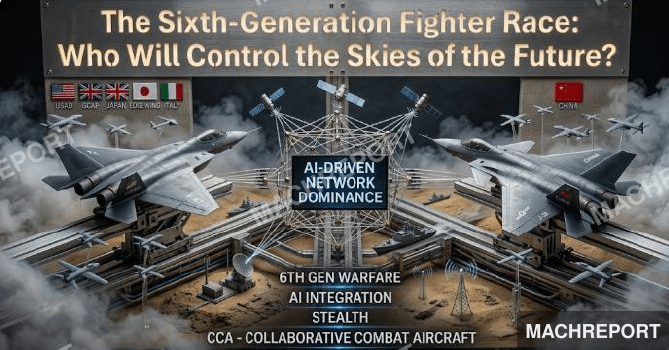
The countries investing in sixth-generation fighter program are aiming to seek a major strategic advantage through shared resources, operational reach and industrial independence. The core objective of these states focused on sixth-generation capability is to establish integrated network warfare rather than strengthening individual platforms.
The following are core strategic advantages offered by the sixth-generation fighter program to the states aiming it:
a) Collaborative Combat Aircraft (CCA):
Sixth-generation jets are expected to operate as autonomous collaborative aircraft also known as the "loyal wingmen". This integrates the human pilot with a team of uncrewed drones that extend the sixth-generation fighter's reach and combat capacity. It enables the fighter pilot to control the team of autonomous, uncrewed drones.
b) Network Dominance:
This defines that the victory is transformed from jet-versus-jet dogfights, to network-versus-network warfare. Sixth-generation platforms fuse real-time data from land, space, cyber , sea, and other air assets. This establishes an integrated network which is a core requirement for the modern air-combat.
c) AI-Integration:
The volume of information by electronic systems would overwhelm a human pilot. AI therefore, plays a significant role in filtering, prioritizing threats, and automating decision-making and threat analysis. In this framework fighter-pilot acts as a mission manager rather in the combat environment.
d) Extreme Range and Propulsion Efficiency:
These advanced fighter jets are expected to use adaptive jet engine cycles. This feature shall provide them a greater range, allowing aircraft to operate across vast threat regions such as the Indo-Pacific while reducing dependence on refuelling assets.
The Sixth-Generation Race Is Becoming an Indo-Pacific Contest
The sixth-generation fighter competition is significant for the Indo-Pacific region, that composes vast distances, disintegrated bases and growing Chinese influence, reshaping the requirements for air superiority. The US NGAP program targets around greater range, advanced stealth and integration with uncrewed drone systems. China, meanwhile, advances its own next-generation aircraft, increasing pressure on US and its regional allies to enhance capabilities during 2030s.
The competition also pushes U.S. allies: Australia and Japan toward a deeper industrial integration. The UK-Japan-Italy GCAP seeks next-generation combat-air system for the 2030s, indicating a broader shift to maintain advanced air-power capabilities without depending on U.S. platforms. At the same time, the recent breakdown of the French-German FCAS programme could reshape Europe's contribution to the sixth-generation race and potentially encourage Germany to move closer to GCAP.
South Asia: China’s Advantage forces India to Look Beyond Fifth Generation
The implications are particularly significant for South Asian environment, where China's sixth-generation development can influence India's long-term fighter planning. India is pursuing the fifth-generation AMCA while evaluating partnerships with the GCAP’s sixth-generation program, recently. Henceforth, South Asian air- balance could be shaped by technologies originally developed for wider Indo-Pacific competition. For Pakistan, pursuing an indigenous sixth-generation fighter, would face a changing threat environment in which the decisive advantage may come from sensor networks, EW, unmanned teaming and long-range engagement rather than numerous fighter strengths this time. Ultimately, the question is no longer simply who will control the skies rather decisive question will be which country builds the strongest integrated combat network.
The sixth-generation fighter evolution reflects a common design objective focused on extended range, AI integration, EW, sensor fusion, resilient networking and the ability to operate alongside Collaborative Combat Aircraft. The future fighter jets will therefore function less as weapons platform and more as a command node that integrates fighter pilots with drones, sensors, satellites and weapons across the battlespace. The sixth-generation era, therefore defines network-centric war that can detects faster, decide’s faster, strike’s faster and survive’s longest.
Comments
Login to comment
No comments yet. Start the conversation.