Turkey’s Indigenous Air Defense Leap: Steel Dome Explained
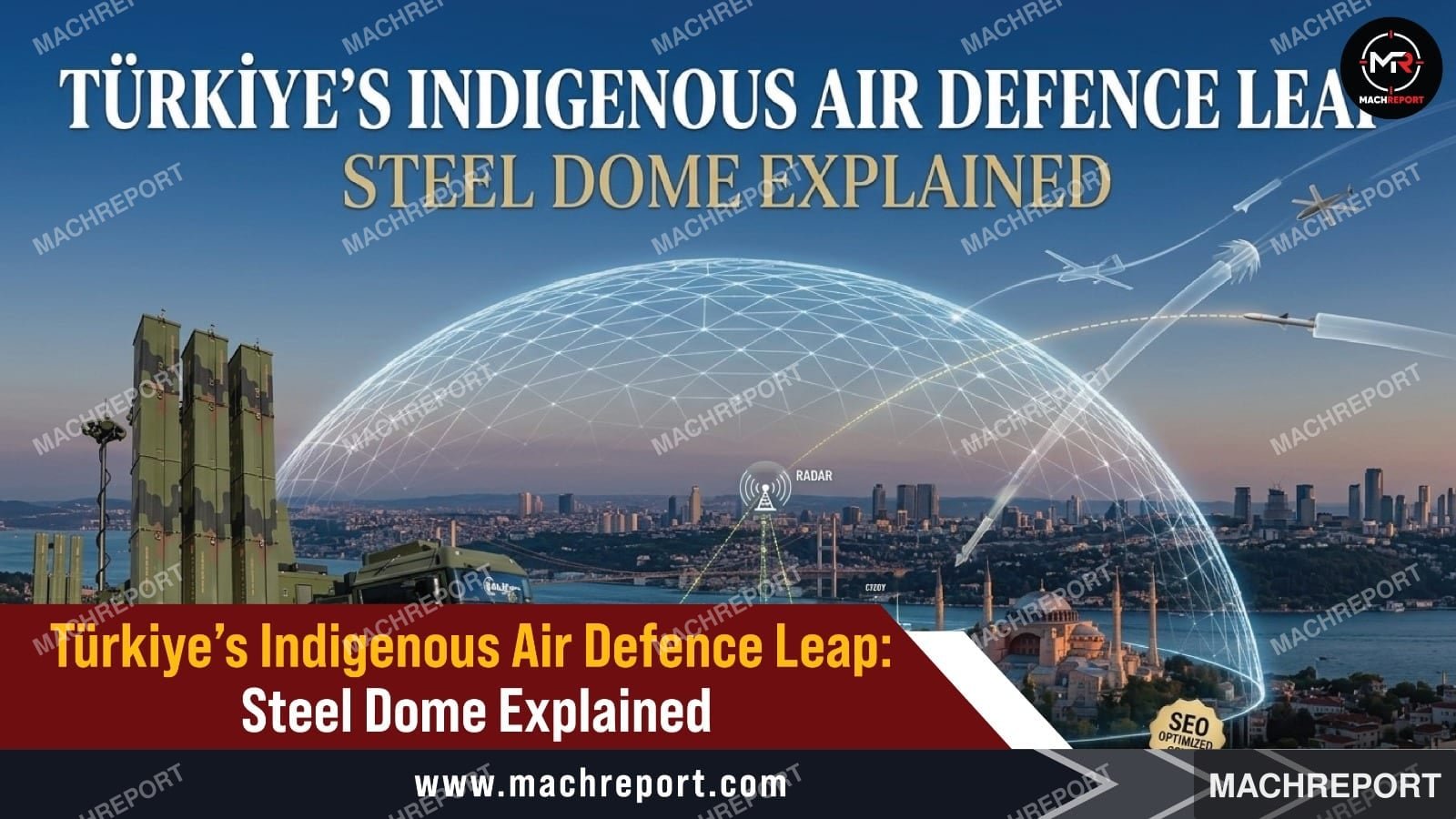
Turkey’s indigenous air defense push advances with Steel Dome, integrating AI, radar, missiles and EW systems into a layered air defence network.
Türkiye boost’s self-reliance in Air-defence system
Turkey’s indigenous air defense pursuits mark a major leap with the integration of Steel Dome in its air-defence architecture with a plan to create the most advanced air-defence systems in the world. The recent trajectory of Turkish self-reliance reflects upon its broader push to revise its air-defence strategy through largest defense market investment, at a time when networked air-defence systems are playing an increasingly important role in securing skies. Türkiye’s leading Defence Tech Company ASELSAN, has developed a range of cutting edge defence solutions to address complex threats including drones, cruise missiles and other low-altitude and high-speed aerial threats.
The core plans for the integrated ‘Steel Dome’ air-defence system were finalized in August 2024 by President Tayyip Erdogan, to combine diverse defence assets such as radar, missile and electronic warfare platforms into a unified, AI-based command and control network. Righter after finalizing Steel Dome, ASELSAN, delivered 47 domestic components, worth US$ 460 million, to Turkish Armed Forces. These critical components included advanced air defence, EW suite, and radar platforms like KORKUT, ALP, SİPER, HİSAR, and PUHU to design a multi-layered defence architecture.
What Is Türkiye’s Steel Dome?
Steel Dome is Türkiye’s smart indigenous defense shield that integrates radars, computers, and weapons to protect skies from aerial threats like drones and missiles. It acts as a giant, invisible shield over the country making all defense assets work together as a unified network.
Steel Dome’s Air-Defence Architecture
The Steel Dome network establishes a protected shield over Turkish airspace, combining hard-kill and soft-kill mechanisms across four operational layers:
(a) Close-Range: The close-range is powered by ASELSAN's Korkut self-propelled anti-aircraft guns, MANPADS, and hybrid air-and-missile defense system which combines smart ammunition and missiles against low-flying drones, helicopters, and rockets.
(b) Short to Medium Range: Powered by surface-to-air (SAM) missile platforms, defending operational troops and critical infrastructure against aircraft, helicopters, and UAVs, with hit-to-kill capability at ranges up to 40 km.
(c) Long-Range (Strategic Layer): Dominated by SİPER missile system, with range exceeding 100 km to neutralize strategic level threats.
(d) The AI Superstructure: Operating as the digital backbone of Steel Dome, that fuses real-time data from localized radar arrays to instantly detect threats and optimize weapon selection.
Together these assets are linked through National command-and-control system that enables real-time coordination and multi-target engagement against electronic attacks.
Why Türkiye Is Building ‘Steel Dome’ Air Defence Network?
The possible aspiration’s behind Steel Dome air-defence network might be due to Turkiye’s ambition to reduce foreign dependencies and accelerate the capabilities and defence partnerships of homegrown defence firms such as Aselsan, Havelsan, Roketsan, MKE and Tubitak Sage. However, it extends beyond accelerating indigenous capabilities since a strategic re-evaluation pushed Türkiye for this move, as recent conflicts such as Russia-Ukraine, US-Iran exposed critical gaps in Western-based air defence systems unable to detect Mach 7 speed precision guided-missiles and UAV’s. Additionally, the repeated denials of PATRIOT air-defence systems by the US underscored the critical requirement’s for indigenous production.
What it means for Turkey’s indigenous air defense
The Steel Dome is not merely a technological leap but it is a strategic asset for Türkiye. By creating a home-grown integrated air-defence network, the initiative aims to:
(a) Protect national airspace against emerging aerial threats
(b) Reduce foreign reliance
(c) Enhance armed forces interoperability
(d) Expand export ambitions in world defence markets
The Türkiye’s President Recep Tayyip Erdoğan describes the Steel Dome initiative as “a critical leap forward for securing Türkiye’s future and building Europe’s largest integrated air defence facility”. At present, Türkiye has become the leading exporter of unmanned aerial vehicles (UAVs) and counter drones (CUAV’s) supplying defence solutions to 40-65 countries globally. Turkish defence partnerships are expanding from Europe & NATO allies such as Ukraine, Poland, Romania and Spain to Middle East and Central Asian allies such as Azerbaijan, Qatar, and various strategic defence partners.
Moreover it sets to rival the Israel’s Iron Dome with its AI-enabled Air Defence network asserting its status as an emerging regional power. Tayyip Erdoğan is reported to have said, “If they (Israel) have an Iron Dome, we will have a Steel Dome.” From a strategic point of view, the Steel Dome boosts Türkiye’s capability to control its aerial battlespace autonomously rather than depending on NATO assets.
Steel Dome and Future of Türkiye’s Defence Market
Steel Dome can become a possible catalyst for Türkiye’s position in global air defence market. By integrating indigenous radars, missiles, EW suite and command-and-control capabilities into a multi-layered architecture, Türkiye is not only developing an indigenous air defence network but also a range of demanded technologies such as UAVs, cruise missiles and other low-altitude threats adaptable for foreign customers. It could also serve as a foundation for Türkiye to develop as the biggest supplier of integrated air defence solutions to countries seeking greater technological autonomy and lucrative defence partnerships.
Comments
Login to comment
No comments yet. Start the conversation.