Two Narratives, One Battlefield: Comparing Pakistan’s “Fizaon K Pasbaan” With India’s Military Information War
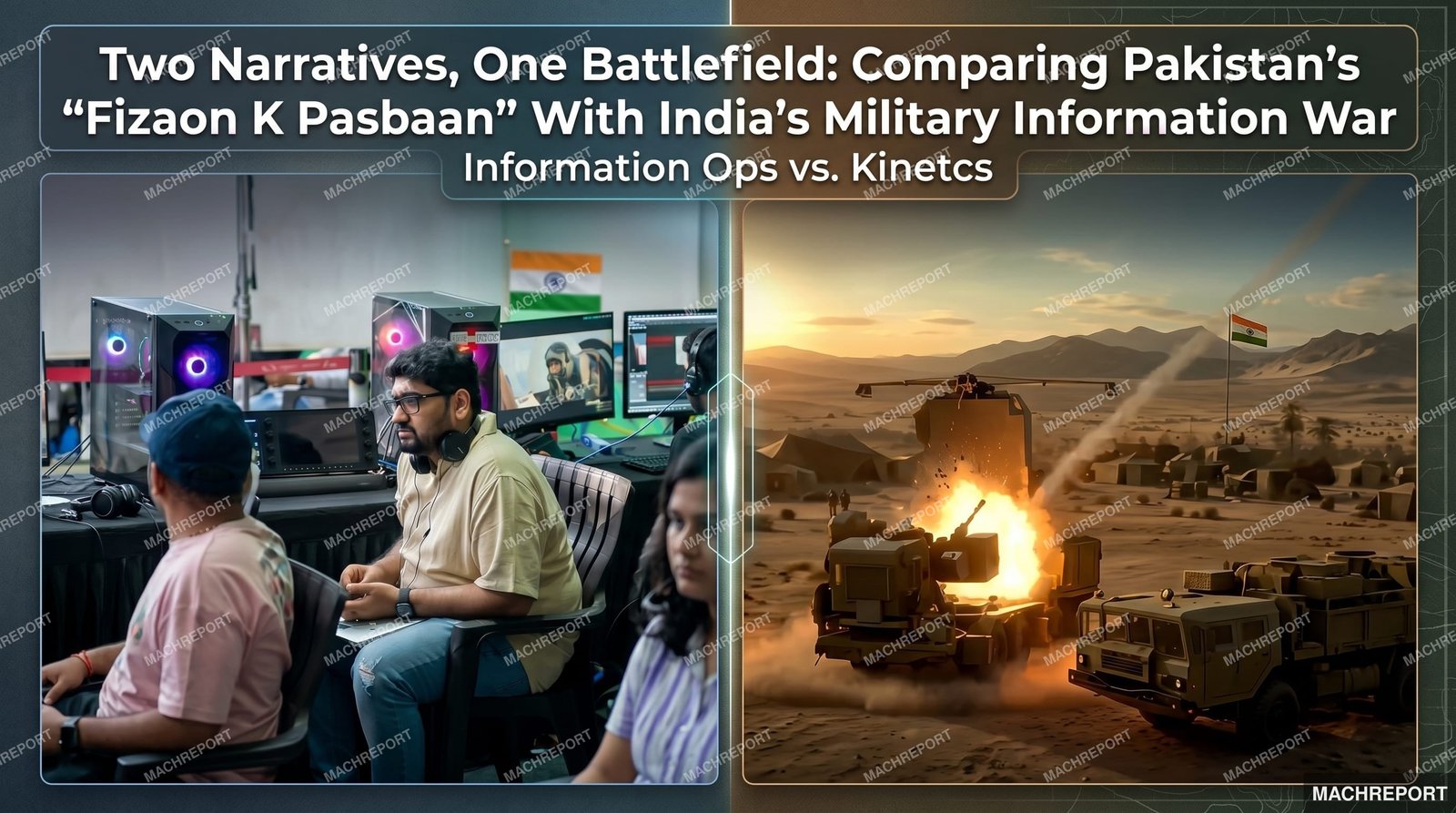
When air forces release commemorative anthems, they usually stick to a predictable script: slow-motion passes of fighter jets, stirring nationalistic choruses and pilots walking across dawn-lit tarmacs.
The Pakistan Air Force’s latest release, "Fizaon K Pasbaan," dropped the nostalgic brass band entirely. Instead, it delivered an aggressive, rapid-fire blueprint of 21st-century multi-domain warfare, spanning kinetic strikes, electronic spectrum dominance and digital sabotage. Beneath the polished veneer of a national anthem lies a calculated exercise in strategic signaling and the regional fallout reveals exactly how defense narratives are fought in the digital age.
From Keyboard to Grid: The Reality of Operation Divine Bytes
While military anthems often indulge in fantasy, the non-kinetic theater depicted here is firmly rooted in executed operations. The video highlights Operation Divine Bytes, reflecting a doctrine that treats software payloads with the same strategic consequence as precision-guided munitions.
• Targeted Interdependence:
The visual narrative zeroes in on disrupting connected civilian-military infrastructure; power distribution networks, telemetry hubs and transport corridors.
• The New Asymmetric
Playbook: Rather than merely relying on air parity, the messaging asserts that crippling an adversary's information backbone before the first sortie departs the runway is now standard operating procedure.
The AI Controversy: Digital Recreations vs. Science Fiction
Predictably, the visual treatment ignited a regional shouting match across defense forums. Indian commentators were swift to lampoon the release, pointing to the synthetic CGI and AI-generated strikes on IAF bases as a "victory in imagination."
However, this critique fundamentally misunderstands the purpose of the media. These AI sequences were not meant as hypothetical daydreams; they were utilized as digital recreations of operational claims and real-world capabilities. AI is simply the modern tool for historical reenactment; a way to visualize complex, often classified multi-domain engagements that cameras cannot capture.
There is a distinct irony in the Indian mockery when contrasted with their own history of military media and historical dramatization, particularly surrounding narratives from Operation Safed Sagar. In attempts to recreate or embellish past operations, IAF-aligned media has a track record of peddling claims that outright defy avionics, physics and basic technology:
• The Mirage 2000 "Hack": Indian narratives have unironically claimed that technicians magically "fooled" the highly sophisticated mission computers of Mirage 2000s into accepting ordinary, unguided gravity bombs as precision Laser-Guided Bombs (LGBs). This demonstrates a profound misunderstanding of how digital weapons integration actually works.
• The High-Altitude "Footprints": Even more absurd are past claims of utilizing fast-jet aerial reconnaissance to spot literal "footprints" in the snow on mountain peaks, an absolute impossibility given the speed of the aircraft, the altitude and the optical resolution limits of the targeting pods used at the time.
When viewed against a backdrop where an adversary claims to hack a fighter jet's brain to drop dumb bombs smartly, PAF's use of AI to render a 3D recreation of a targeted strike package feels significantly more grounded in reality.
A recent dissertation by Rabia Ansari, examining the crisis, identifies four major AI-enabled disinformation episodes: a fabricated Donald Trump video, an AI-manipulated video portraying Pakistan’s DG ISPR as admitting the loss of two JF-17s. The deeper problem was how quickly such material could enter the information ecosystem before verification caught up.
During the May 2025 escalation, Indian television channels reported that Pakistan’s Army Chief, General Asim Munir, had been arrested or taken into custody. Zee News and ABP News both carried the claim.
The wider coverage became so sensational that claims of Islamabad being captured, Karachi Port being destroyed and Pakistan’s leadership being forced to surrender were broadcast on live television. Even prominent anchors like Arnab Goswami were making on-air claims of severe damage in Lahore and Islamabad.
This is where the irony becomes difficult to ignore. When established television networks and prominent anchors are themselves broadcasting unverified or demonstrably false claims as breaking news during an active military crisis, it becomes difficult to take seriously the outrage directed at a clearly declared AI-generated visual simply because it depicts an operational scenario.
There is an important distinction here: an openly labelled AI reconstruction does not pretend to be real footage. A fabricated claim presented as live news does. If the information environment is already being flooded with unverified battlefield narratives, then criticising a transparent, declared visual representation while overlooking the much more consequential problem of false claims being presented to audiences as factual developments risks becoming a case of selective outrage rather than genuine concern for information integrity.
The Turkish Footprint: Beyond the Animation
Tucked beneath the digital combat simulations was a critical development grounded in physical reality: the visual debut of newly acquired Turkish air defense hardware.
Keen-eyed observers caught clear glimpses of Turkish-origin counter-UAS platforms, notably ASELSAN’s KORKUT 35mm self-propelled system and ŞAHİN 40mm automated systems, both designed to shred drone swarms and loitering munitions with programmable airburst rounds.
The inclusion quickly sparked its own narrative arc:
• The Export Validation: Turkish defense media immediately seized on the imagery, using the platform debut to showcase the expanding reach of Ankara’s domestic defense sector.
• Doctrinal Interoperability: For Turkish commentators, the footage wasn't just a nod to an allied air force; it was living proof of an evolving C4ISR and point-defense ecosystem engineered to bridge gaps exposed by recent drone-heavy modern conflicts.
The Takeaway
Modern deterrence is no longer won exclusively on the tarmac or even over contested airspace. "Fizaon K Pasbaan" illustrates that modern military capability relies on a tri-fold reality: physical hardware guarding against tactical saturation, silent digital campaigns executing in the network background and synthetic media engineered to boldly recreate and project operational realities.
Comments
Login to comment
No comments yet. Start the conversation.