Software-Defined Warfare: How AI, Drones and Cyber Technology Are Redefining Air Power
Software-Defined Warfare: How AI, Drones and Cyber Technology Are Redefining Air Power
For decades, military power was measured largely in terms of aircraft, missiles, ships, tanks and other physical platforms. Today, that equation is changing. Increasingly, the decisive advantage is not simply the machine itself but the software, data, connectivity and artificial intelligence that determine what the machine can see, understand and do.
This transformation is giving rise to what defence analysts increasingly describe as software-defined warfare, a model in which military capability can evolve through software and digital systems at a pace that traditional defence procurement was never designed to accommodate. A recent 2026 research paper argues that military capability is increasingly determined by software, while major defence platforms can take years or decades to procure and field. The implications are particularly significant for air power.
From Fighter Aircraft to Digital Combat Systems
The modern fighter is no longer an isolated aircraft. It is a node in a much larger network involving satellites, airborne early-warning aircraft, ground stations, unmanned systems, electronic-warfare platforms, command networks and intelligence databases.
Sensors generate enormous quantities of information. Data links distribute it. Software processes it. Artificial intelligence can then help identify patterns, prioritize threats and provide recommendations to operators. This means that two aircraft with broadly comparable aerodynamic and kinetic capabilities can potentially have very different battlefield effectiveness depending on their software architecture, sensors, electronic-warfare systems and ability to exchange information. The result is a gradual shift from platform-centric warfare to network-centric warfare.
AI Is Moving Into the Air Battle
Artificial intelligence is becoming one of the most important technologies in this transition. Military AI can be used for intelligence analysis, surveillance, target recognition, threat monitoring, mission planning, logistics and decision support. Research published in 2026 also highlights the growing importance of AI-enabled drone detection and real-time processing of radio-frequency signals in complex electromagnetic environments. The significance of AI is not necessarily that machines will independently replace human commanders. In many applications, the more immediate advantage is speed.
A human analyst may need to examine multiple streams of information before identifying a threat. An AI system can process large volumes of sensor data simultaneously and flag anomalies or potential targets for human review. In an air war, where seconds can determine whether an aircraft survives, that difference can become strategically important.
The Rise of Autonomous and Collaborative Aircraft
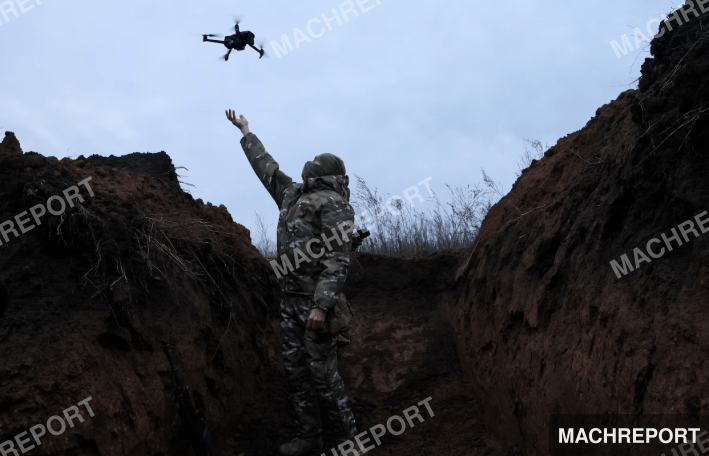
Unmanned aerial vehicles have already demonstrated that expensive aircraft are not the only way to project power through the air.
The next stage is more sophisticated: autonomous and semi-autonomous aircraft operating alongside crewed fighters. These systems can potentially perform surveillance, electronic warfare, communications relay and other missions while extending the reach of manned aircraft. Instead of viewing a fighter as a single weapons platform, future air forces may operate a team of interconnected crewed and uncrewed systems.
This concept also changes the economics of air warfare. If a mission can be performed by a relatively inexpensive unmanned platform rather than risking a highly expensive fighter and its pilot, commanders gain additional operational options.
But autonomy creates new questions. How much authority should an autonomous aircraft have? How should operators verify AI-generated recommendations? What happens when communications are disrupted? These questions make software engineering and human-machine interaction just as important as aircraft design.
Electronic Warfare Is Becoming Software-Defined
The electromagnetic spectrum is another battlefield.
Modern aircraft depend on radar, radio communications, satellite navigation, data links and other electromagnetic systems. An adversary that can disrupt, deceive or exploit those systems can potentially reduce the effectiveness of an otherwise advanced platform. Electronic warfare is therefore becoming increasingly software-driven. Modern systems can be designed to detect changing signals, classify threats and modify responses through software updates rather than relying exclusively on hardware changes. This creates an important advantage: adaptability.
A military system that can be rapidly updated can respond to new threats much faster than one requiring a completely new hardware platform. The same principle applies to cyber defence.
The Cybersecurity Problem
As aircraft become more connected, cybersecurity becomes inseparable from aviation and defence.
Military networks increasingly connect aircraft with command centres, maintenance infrastructure, intelligence systems and other platforms. Civil aviation faces similar challenges as airports, airlines, aircraft systems and third-party suppliers become increasingly digitized. The International Civil Aviation Organization identifies cybersecurity as an important component of aviation security and has developed standards and guidance addressing cyber threats to civil aviation.
A striking demonstration of the problem emerged this week when researchers disclosed a physical-access attack involving Boeing 737 avionics. The researchers demonstrated how a small wireless device could potentially interfere with signals within an aircraft's systems and manipulate functions including navigation-related data. Boeing has reviewed the findings, while the researchers have emphasized possible mitigations.
The lesson extends beyond one aircraft model. Modern aviation security cannot focus exclusively on protecting traditional IT networks. It must also consider avionics, maintenance interfaces, supply chains, firmware, data buses, connected equipment and physical access points.
The New Vulnerability: Speed
Software-defined warfare creates a paradox. Software allows militaries to evolve rapidly, but it also means vulnerabilities can evolve rapidly.
A fighter aircraft may remain operational for several decades. Its software, however, can be modified repeatedly throughout its life. That creates opportunities for continuous improvement but also creates a persistent cybersecurity challenge.
A compromised software update, malicious component, vulnerable supplier or poorly secured network could potentially affect systems long after an aircraft has entered service. This is why cybersecurity can no longer be treated as an additional layer added after a weapon system is designed. It has to be incorporated into the system from the beginning.
What This Means for Future Air Forces
The air force of the future may look very different from the air force of the past. Instead of measuring capability simply by counting fighter aircraft, analysts will increasingly examine questions such as:
- How quickly can the force process intelligence?
- How resilient are its communications?
- Can its aircraft operate in a heavily jammed environment?
- How rapidly can software be updated?
- Can manned and unmanned platforms cooperate?
Aircraft remain essential, but aircraft alone are no longer enough.
The Strategic Race Has Changed
The competition between major military powers is therefore moving beyond the traditional race to build faster aircraft or longer-range missiles.
It is increasingly becoming a race to build better algorithms, stronger networks, more resilient communications, smarter sensors, secure software and adaptable autonomous systems. This does not mean traditional military technology is becoming irrelevant. Engines, weapons, radar, airframes and pilot training remain fundamental. But their effectiveness increasingly depends on the digital architecture connecting them. Software-defined warfare is ultimately about reducing the time between detecting a threat, understanding it, making a decision and acting on it.
The air force that can complete that cycle faster and continue doing so when its networks are attacked, communications are degraded and its electromagnetic environment becomes contested could possess a decisive advantage. The future of air power may therefore not belong simply to the aircraft with the most powerful engine or the longest-range missile.
Comments
Login to comment
No comments yet. Start the conversation.