US F-35 Sale to Saudi Arabia 2026: $24.3B Deal Explained
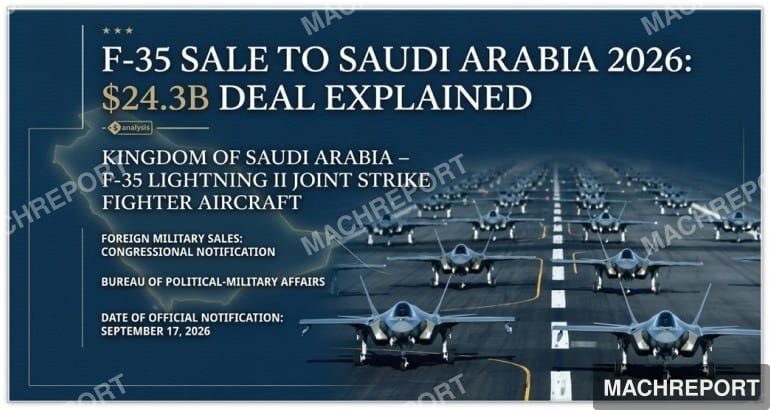
US-Saudi Arabia $24.3B F-35 deal: 48 jets, Israel’s concerns, intelligence risks, Houthi threats and its impact on Middle East air superiority.
The US cleared a potential sale of 48 F-35As to Saudi Arabia worth $24.3 billion. Congress still has 30 days. Here’s the package, the Israel and China fights, and how the Iran war’s $43.6 billion cost hangs over the deal.
The State Department announced an approval on 17 September 2026 for a possible sale of 48 F-35 Lightning II fighter aircraft to Saudi Arabia, with an estimated potential cost of $24.3 billion. The deal package includes 49 Pratt & Whitney F135-PW-100 engines and cryptographic equipment alongside electronic warfare suites and logistics support systems. In particular, the package features secure communications systems, training equipment, cryptographic equipment, software support, operational support services and a range of base support, according to the State Department.
The move has seriously concerned Israel, being the ‘only’ customer to operate the aircraft apart from America. The State Department defines the strategic rationale behind the expected sale as supporting national security objectives by guaranteeing the security of a non-NATO state that determines political stability and economic progress in the Gulf region.
Force Drivers Behind the Deal
The proposed sale comes amid Saudi Arabia confronting Houthis in Yemen, who seek to expand their control of the Bab el-Mandeb Strait, in an escalation that threatens to widen regional conflicts. Noticeably, the move also comes after some intelligence analysts warned regarding Chinese intelligence gathering to acquire F-35 technology through its partnerships with Saudi Arabia, which could also compromise Israel’s military advantage by exposing sensitive F-35 technology to China.
Israel’s Opposition: US F-35 Sale to Saudi Arabia
However, the major regional factor bearing implications for the F-35 deal remains Israel, since American law under the Arms Export Control Act only grants access to military equipment that preserves a “qualitative and competitive military edge” over regional adversaries. According to open sources, the Israeli Defence Force (IDF) General Staff submitted documents to American leadership opposing prospects regarding the sale of F-35 jets, warning that the acquisition could deter Israel’s air superiority in the region amid Chinese espionage risks. Therefore, the sale would bring a significant policy shift, potentially disrupting the balance of military power in the Middle East and testing adherence to the commitment towards its regional ally Israel to maintain a “competitive military edge”.
What the F-35 Deal Could Mean for Saudi Air Power ‘Operationally’
As a matter of strategic importance, Saudi Arabia seeks to preserve its decades-long relationship with America. The proposed plan further deepens defence cooperation between the two states while intending to modernize its air power. The F-35 fifth-generation fighter is built with stealth technology that allows it to evade enemy detection and is considered one of the world’s most advanced fighter jets. It combines advanced sensors, EW systems and secure networks to give pilots rapid awareness of threats and enable them to share combat information with other forces. The aircraft’s undetectable design could make it harder for hostile radar networks and air-defence systems to track and detect. Moreover, the stealth aircraft provides a broader picture of the combat space, increasing the potential ability to detect time-sensitive targets such as mobile missile launchers, drone-launch locations, command-and-control nodes and air-defence systems against Yemeni non-state actor groups.
Saudi F-35 Deal Prospects
As of recent news reports, the F-35 deal is undergoing a review process by congressional lawmakers, who are examining the deal within a 30-day period. The Congressional review comes amid recent controversies sparked by the possibility that Chinese intelligence could exploit Saudi access to the F-35's radar, sensor-fusion systems, software and EW architecture. This is due to Saudi Arabia’s extensive relationships with Chinese companies, including Huawei and ZTE.
Chinese access to telecommunications infrastructure and Saudi facilities could create potential collection opportunities around sensitive F-35 operations. According to credible sources, Congress would examine the intelligence warnings and decide the fate of the F-35 deal, whether to finalize the contract or block the deal.
Moreover, Israel’s status as having a qualitative military edge could be compromised, according to some analysis. However, credible news reports have confirmed that Israel has special permissions for J-35 jet modifications to modify and integrate its own weapon systems and radar-jamming systems. Despite objections, Israel is expected to receive upgrades to preserve its strategic edge, including enhanced missile defence systems and early access to sixth-generation technologies.
Strategic Assessment
Therefore, the operational value of the F-35 deal for Saudi Arabia would be prospective rather than immediate, as it would provide a survivable strike capability against Yemeni non-state actors by strengthening offensive deterrence. In regional dynamics, this would enable Saudi Arabia to safeguard frequently targeted resources such as oil reserves and critical infrastructure from potential threats by upgrading its air power. The timing is nevertheless strategic, as the agreement could redefine the balance of power in the Middle East or encounter turbulence on its path to deal approval. Above all, it would make Saudi Arabia the only Arab state to acquire the F-35, fortifying its domestic defence capabilities and improving interoperability with American forces.
Comments
Login to comment
No comments yet. Start the conversation.