When AI Enters Air-Defense Kill Chain
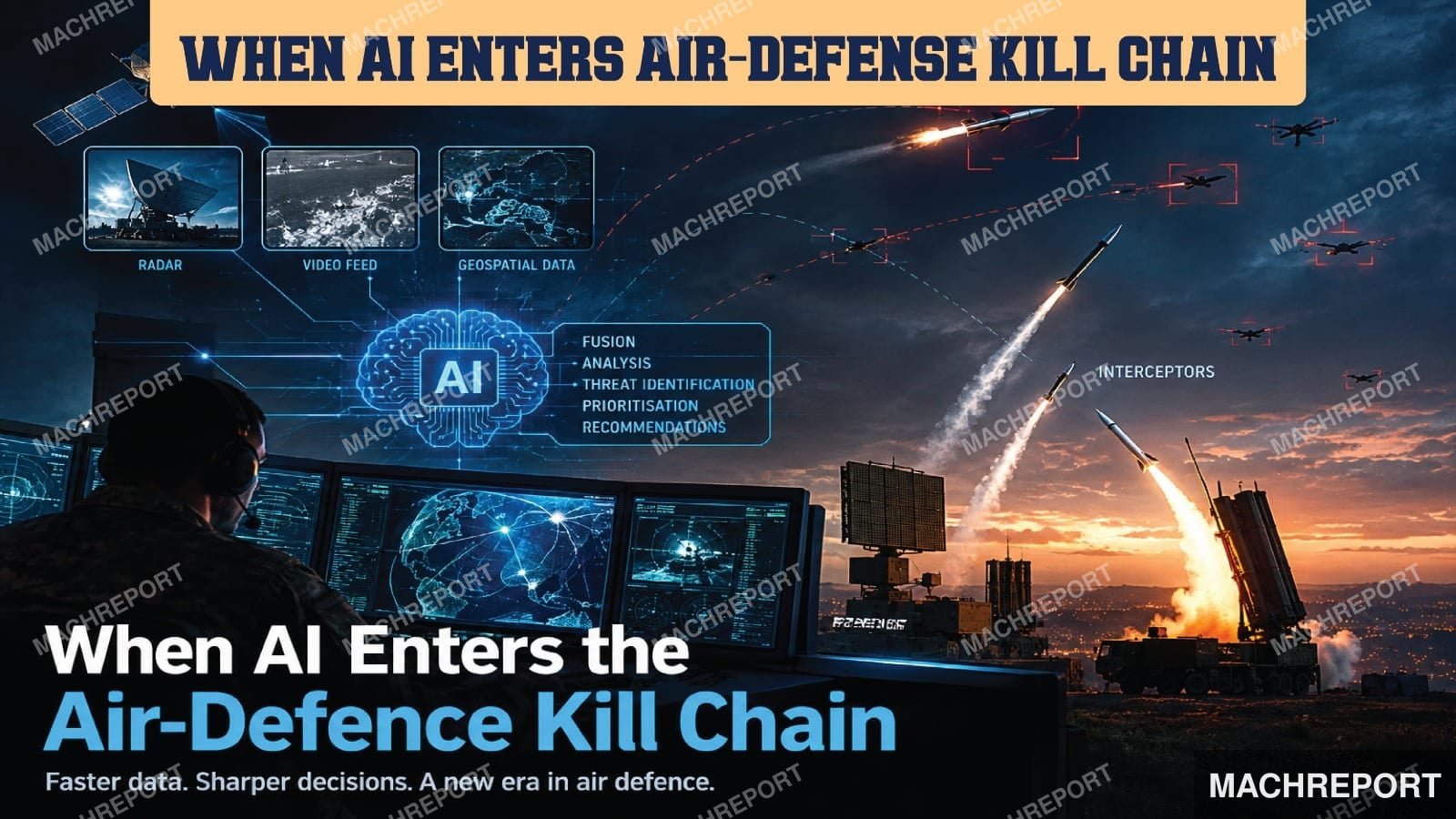
The next transformation in air defense may not come from a faster missile, but from software capable of turning thousands of fragmented signals into a usable threat picture before the window to respond closes.
Air and missile defense have always been a race against time. A radar must detect an object, operators must determine what it is, sensors must establish its track, commanders must assess threat and a weapon must then be assigned and launched. Against ballistic missiles, maneuvering weapons, aircraft and increasingly fast drones, every stage consumes part of a shrinking engagement window. Pentagon is now attempting to compress that process with artificial intelligence.
In September 2026, US Defense Innovation Unit (DIU) issued a solicitation for a “Space Threat Intelligence Synthesis Engine”, seeking AI-based software capable of converting fragmented information from radar, satellite imagery, live video, geospatial systems and classified intelligence into a continuously updated picture of space and missile threats. The proposed system is intended to generate confidence-scored alerts and provide information both to human operators and, potentially, automated command-and-control systems. The most revealing requirement is speed. DIU is seeking processing latency of no more than five seconds, with two seconds as the preferred objective, between incoming data and the presentation of the resulting information.
That requirement illustrates how role of AI in air defense is changing. The objective is not merely to replace an analyst reading a radar screen. It is to shorten the entire intelligence-to-decision cycle.
From sensor fusion to decision advantage
Modern air-defense networks already depend on multiple sensors. A radar may provide a track, an infrared sensor may provide additional confirmation, a satellite may provide contextual information and intelligence systems may contain information about a potential launch or platform.
The difficulty is making these streams useful simultaneously. DIU says existing systems can struggle to distinguish closely spaced objects, track emerging threats and keep threat models current. Its proposed architecture would use AI to correlate large volumes of information, identify relationships and patterns and continuously update threat assessments. The resulting information could be displayed to operators or supplied through low-latency machine-to-machine interfaces.
This points toward an important change in the traditional air-defense architecture. Instead of sensors feeding information into separate human-managed systems, AI increasingly becomes the layer between sensing and decision-making.
That layer could determine whether several apparently separate sensor observations represent one incoming weapon, distinguish a genuine threat from background activity, estimate the confidence of a classification and identify which targets require immediate attention.
The technology is particularly relevant as defenders confront simultaneous attacks involving drones, cruise missiles and ballistic or maneuvering weapons. The problem is not simply detecting more objects; it is determining what matters first.
The economics of seconds
Speed also has a direct relationship with the economics of air defense. A defender may possess highly capable interceptors but only limited stocks of them. During a large attack, commanders therefore have to decide which targets warrant expensive interceptors and which can be engaged by cheaper systems.
AI could assist by maintaining a continuously updated picture of incoming threats and helping operators allocate defensive resources. Defense News noted that this is particularly important where expensive interceptors such as Patriot missiles are limited. Northrop Grumman has also partnered with AI company Campaign on AI applications for integrated air and missile defense, while BAE Systems and Scale AI have pursued related work.
The potential advantage is therefore not simply faster reaction. It is better allocation of limited defensive capacity.A system that can rapidly distinguish between a decoy, a surveillance platform, a one-way attack drone and a missile could theoretically help prevent the indiscriminate expenditure of high-value interceptors. But that benefit depends on the quality of the underlying data.
The attacker is also using AI
The emerging competition is not one-sided. Anthropic's September 2026 threat-intelligence report describes a separate case involving a China-based actor who used Claude's coding and agentic capabilities to develop a software suite for electronic warfare and suppression of air defenses. Anthropic says the system contained roughly 16 modules and was iterated through 12 versions. According to the company's investigation, the software analyzed radars, surface-to-air missile sites, command posts and communications nodes, assessed radar vulnerabilities and jamming effectiveness, ranked targets and modelled engagement envelopes associated with systems including Patriot- and THAAD-class defenses.
Anthropic assessed actor as a China-based defense and military-industrial researcher, with account-level information indicating links to Chinese research institutions, including the PLA Academy of Military Sciences. However, this remains Anthropic's assessment of an observed actor; the report does not establish that the People's Liberation Army officially adopted the software or that the resulting system was operationally deployed.
The significance lies elsewhere. The case illustrates how AI can potentially compress the analytical work traditionally required to study an adversary's air-defense architecture.
Instead of manually examining radar characteristics, geographical coverage, weapon ranges and communications vulnerabilities, an AI-assisted system can rapidly organize those variables into a model of an opposing defensive network.
That creates a new dimension to the suppression-of-air-defenses problem: the attacker can use AI to understand and optimize against defender's AI-assisted network.
The emerging AI-versus-AI cycle
This creates a potentially self-reinforcing competition. The defender uses AI to fuse sensors, classify threats and accelerate decisions. The attacker uses AI to analyze the defender's sensors, identify vulnerabilities, optimize electronic attack and priorities targets. Each side then modifies its systems in response to the other's adaptations.
Electronic warfare makes this competition particularly complex. Radar emissions, communications links and navigation signals can all become part of the contest. A sophisticated defensive network must therefore be capable not only of detecting physical threats but also of recognizing attempts to deceive or degrade its information environment.
The result could be an air-defense battle in which the decisive contest occurs partly inside the data layer before a missile is launched.
Humans remain critical link
Despite rapid movement toward automation, the Pentagon's approach does not eliminate human involvement. DIU's proposed system is explicitly intended to support different levels of human participation, ranging from analyst-in-the-loop to human-on-the-loop and automated workflows.
That distinction matters. AI can process information faster than humans, but speed does not guarantee correct interpretation. Missile and air-defense environments contain deception, incomplete information, sensor errors and deliberate attempts to manipulate the information used by decision-makers. A false classification delivered in two seconds can be more dangerous than a correct classification delivered in ten.
The central challenge will therefore be determining where automation should accelerate decisions and where human judgement must remain decisive.
The new air-defence competition
Pentagon's initiative and Anthropic's reported case point toward same broader development from opposite sides of the battlefield. Air defense is becoming increasingly dependent on the ability to process enormous quantities of information under extreme time pressure. At the same time, offensive forces are acquiring AI-assisted tools capable of analyzing defensive networks, identifying vulnerabilities and accelerating targeting and electronic-warfare planning.
The result is likely to be a new contest over speed and integrity of the kill chain.
The traditional measure of an air-defense system was its radar range, missile speed or interception probability. Those characteristics remain important, but another metric is becoming increasingly consequential: how quickly can the system turn uncertain information into an actionable decision and how effectively can an adversary prevent it from doing so?
As missiles become faster, drones become more numerous and electronic warfare becomes more sophisticated, the answer may increasingly depend on algorithms operating between the sensor and the shooter. The next generation of air defense may therefore be defined not simply by better interceptors, but by which side can build the more resilient, faster and harder-to-deceive decision architecture.
Comments
Login to comment
No comments yet. Start the conversation.