When War Left the Skies and Entered the Servers: The Battle of Haq and Pakistan’s Next-Level Warfare
Then technology changed the very map of warfare.
Today, defeating an adversary does not always require bombs falling on every one of its military positions. Sometimes, severing its communications, stripping away its information advantage, disrupting its networks or unsettling its decision-making process can create an impact on the battlefield just as profound as a physical strike.
This is where the next battlefield begins: cyberspace.
The conflict of May 2025, remembered in Pakistan as Marka e Haq and Operation Bunyan-un-Marsoos, emerged as an extraordinary example of this changing face of war. Aircraft, missiles, drones and air-defense systems were all present in the physical battlespace. But alongside them, another war was being fought.
A war whose thunder could not be heard in the sky.
A war that raised no smoke.
A war that did not demand the presence of armed soldiers standing on the frontlines.
It was a war of data, networks, communications, surveillance, electronic signals and cyber systems.
In May 2026, while commemorating the first anniversary of what Pakistan described as a historic victory, Pakistan Air Force Chief Air Chief Marshal Zaheer Ahmed Babar Sidhu stated that PAF’s Cyber Force had successfully targeted Indian communication hubs, power grids and transport infrastructure, describing the operation as a new form of cyber-integrated, multi-domain warfare.
But the real story goes far beyond the question of whether a cyberattack took place.
The real story is far bigger:
How far has Pakistani military thinking already evolved in its understanding of war?
Around the world, modern militaries increasingly recognize that the cyber domain is no longer merely a matter of computer security. It has become a component of military power itself.
The more a military depends on digital technology for command and control, communications, intelligence, logistics, surveillance and weapons systems, the more its strength becomes tied to a web of interconnected networks. And this creates an entirely new question for the adversary.
Before asking how to destroy the aircraft in front of you, the more important questions become:
Who is feeding that aircraft its information?
Which network is keeping it connected?
Where is it receiving its targeting data from?
And how secure is the vast digital ecosystem behind it?
This is the transformation at the heart of modern warfare; a shift that can be described simply as “system versus system.”
A cyber expert associated with CASS explained this transformation in 2025, noting that the character of warfare is shifting from platform-versus-platform to systems-versus-systems, with cyber emerging as a critical enabler of network-centric operations. The scale of this transformation is reflected in the Pakistan Air Force’s own cyber-security architecture, which, according to the discussion, has brought approximately 25,000 assets under its cybersecurity framework.
This is where the vision of Pakistan Air Force Chief, Air Chief Marshal Zaheer Ahmed Babar Sidhu, becomes significant.
This transformation did not happen overnight.
The Air Chief himself stated that what the world witnessed in May 2025 was not something achieved within a few days. It was the result of four to five years of transformative modernization. He described the conflict as the most comprehensive full-spectrum, multi-domain operation in the history of Pakistan Air Force.
In other words:
The war had changed long before the war began.
The Pakistan Air Force had been moving toward a model in which conventional airpower was integrated with cyber, electronic warfare, space, artificial intelligence, surveillance and data as parts of a broader operational architecture.
In September 2025, the Air Chief further clarified that PAF remained committed to advancing its capabilities in space, electronic warfare, cyber technologies and other niche domains.
There is an important distinction here.
To the ordinary person, the idea of a cyber force may simply mean hacking a website.
But military-level cyber warfare is something far greater.
It can involve gathering intelligence, disrupting communication networks, interfering with command and control, affecting critical infrastructure, identifying vulnerabilities within an adversary’s digital environment and protecting one’s own forces against similar attacks.
In that sense, a cyber force can become a kind of “silent artillery”, an artillery whose shells cannot be seen, whose explosions make no sound, yet whose effects can still be felt across the battlefield.
During Operation Bunyan-un-Marsoos, Pakistani officials and state sources described several such effects.
On May 10, 2025, the Associated Press of Pakistan reported that cyber operations against Indian websites and institutions had targeted multiple platforms, including the BJP website. Claims also emerged regarding the extraction of sensitive information and access to certain databases, including those associated with the Indian Air Force. Reports also stated that PAF had gained control over more than 2,500 surveillance cameras.
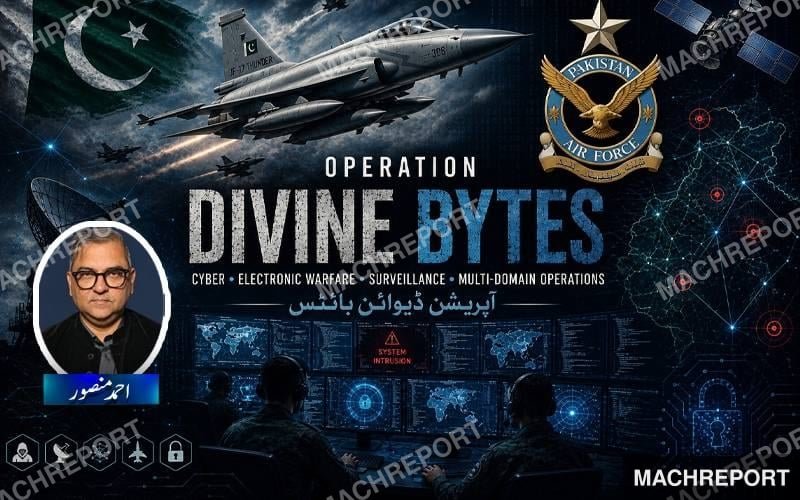
These cyber operations were given the name “Operation Divine Bytes.” According to reports, the Pakistan Air Force’s cyber force targeted multiple Indian organizations and digital infrastructure.
Reports stated that approximately 4,400 ICT elements were affected during the operation, including servers, computer systems, websites, databases, communications systems, surveillance systems and other IT components.
In this sense, Operation Divine Bytes emerged as a notable example of how cyber warfare, electronic warfare, surveillance, and conventional military power converged within a single battlespace during the May 2025 conflict.
And this is where the true significance of the digital battlefield begins to reveal itself.
Imagine a major military power possessing modern combat aircraft, advanced missiles, sophisticated radars and an extensive defense network.
Now imagine that, somewhere inside this vast machine, the flow of information begins to falter.
One command center can no longer communicate with another in time.
A surveillance system begins to lose effectiveness.
Critical data fails to reach the decision-makers when it is needed most.
The weapons may still be there. The aircraft may still be in the sky. The missiles may still be ready.
But the system that gives those weapons their full effectiveness has begun to fracture.
This is why cyber, electronic warfare and space can no longer be treated as completely separate boxes.
During the May conflict, cyber and electronic warfare operated alongside the aerial campaign, disrupting Indian military communications, coordination and critical infrastructure. According to the Air Chief, these capabilities played a significant role in impairing India’s military coordination and operational effectiveness.
This is the essence of multi-domain warfare.
An aircraft may be flying thousands of feet above the ground, yet its eyes may reach far beyond the sky into space. Its communications may depend on a network, its awareness may be shaped by a dense electromagnetic environment, and its information may be coming from another sensor, another platform, or another part of the battlespace. Behind it all lies an interconnected ecosystem—one whose protection, resilience, or disruption may ultimately extend into the cyber domain.
The battlefield, therefore, is no longer simply the image of a fighter jet or a missile.
from sensor to decision,
from decision to shooter,
and from shooter to impact.
This is why, in future warfare, stopping a missile with another missile may not be the only answer.
If a weapon’s effectiveness depends on navigation, communications, targeting or external data, then cyber and electronic warfare capabilities can potentially be used to create defensive or offensive effects against the wider system.
But there is an important caveat.
Claims that a particular missile can simply be ‘hacked’ and forced to change its course should not automatically be accepted as fact. In the real world, cyber operations, electronic warfare, jamming, spoofing and kinetic effects operate through different mechanisms and have different limitations.
The larger point is not that every weapon can be remotely ‘hacked.’
The larger point is that modern warfare increasingly demands an understanding of the entire digital ecosystem behind the weapon, rather than merely the weapon itself.
And then comes space.
Cyber and space are no longer entirely separate worlds.
Satellite communications, navigation, imagery, surveillance and precision timing are all critical to modern military systems.
A combat aircraft does not fight solely through the eyes of its pilot. It can be part of a much larger sensor network; a node within a vast web of information.
That is why a country capable of connecting its space-based assets, cyber resilience, electronic warfare and air operations can control something even more valuable than weapons: the speed and flow of information itself.
Pakistan’s stated effort to advance space, cyber and electronic warfare within a broader multi-domain framework is no longer a hidden discussion.
The full details of sensitive military satellites, their capabilities and their operational employment naturally remain undisclosed. But the larger direction is visible.
Within Pakistan’s evolving military thinking, space and cyber are no longer distant concepts belonging to some hypothetical future. They are becoming an integral part of an emerging military architecture.
Modern defense analyses have similarly described Pakistan’s multi-domain approach in terms of integrating cyber, electronic warfare, intelligence, surveillance and reconnaissance and space-based capabilities.
And the story of Operation Divine Bytes is another chapter in this larger journey.
A detailed article published in June 2026 described it as an example of the growing capabilities of the Pakistan Air Force’s cyber force and of the convergence of cyber, electronic warfare, surveillance and conventional combat power during the May 2025 conflict. According to that report, the campaign was conducted under the strategic vision of the Air Chief and connected to PAF’s broader multi-domain framework.
Now, for a moment, change the scene.
Imagine the sky filled with combat aircraft.
And somewhere else, far from the noise of engines and missiles, dozens of screens glowing inside a command room.
One screen carries radar imagery.
Another displays satellite data.
Another tracks electronic signals.
Another shows a drone feed.
Others monitor networks that may be thousands of kilometers away from the physical battlefield.
The pilot may see the enemy aircraft but before that moment, he may already have seen a part of the larger picture of the enemy’s battlespace.
And somewhere on another front, a specialist sits before a computer.
No rifle rests in his hands.
No aircraft surrounds him.
Yet, he too is in the war.
This is Next-Level Warfare.
In this war, victory will not be decided simply by who possesses more Rafales, how many J-10s, how many missiles or how many drones.
The deeper question will be:
Who can connect them all?
Who possesses better sensors?
Who can fuse data more effectively?
Who has the faster decision cycle?
Who has stronger cyber defenses?
Who possesses effective electronic warfare?
And who has the trained personnel capable of bringing all these individual capabilities together as one coherent military system?
Perhaps, for Pakistan, the greatest asset in this entire transformation is not a particular aircraft, missile, or satellite.
It is the human mind.
You can spend billions acquiring a modern combat aircraft. You can purchase advanced missiles, radars, drones, and sophisticated sensors. But no amount of money can simply buy a force that understands all these systems, connects them into a coherent whole, makes decisions under pressure, adapts to a changing battlespace and recognizes the next threat before it arrives. That is where a cyber force becomes something more than a military unit.
It becomes a factory of national human capital.
A young person learning cybersecurity, artificial intelligence, data science, networking or electronic warfare today may not simply become a computer specialist tomorrow.
He or she may become a soldier on a national-security frontier whose borders cannot even be drawn on a map.
And perhaps that is the quietest and yet the greatest lesson of Operation Marka e Haq.
The battlefield has changed.
The enemy is no longer found only across the border.
Sometimes, it exists within a network.
Sometimes, within a signal.
Sometimes, within a database.
Sometimes, within the information carried by a satellite silently orbiting above the Earth. Artillery and missiles still exist. Aircraft and tanks still exist.
But behind them all, another war has emerged. A war that cannot be seen.
And perhaps, when the world recognizes that Pakistan did not prepare for this war merely in books and doctrines but also put its capabilities to the test during Operation Divine Bytes, the real surprise will not be that Pakistan possessed combat aircraft.
The real surprise will be that Pakistan possessed minds capable of reading the next chapter of warfare.
Because throughout the history of war, the ultimate difference has never been created by weapons alone.
It has been created by the minds that wield them.
That is the treasure no foreign country can sell you.
That is the capability no arms deal can simply deliver.
And that is the force pushing Pakistan beyond conventional warfare toward multi-domain, cyber-integrated and next-generation warfare.
Marka e Haq is not the end of this journey.
Perhaps it was merely the first glimpse the world was given of where the battlefield of the next war may truly lie. Not only in the skies. Not only on the ground. But inside the invisible architecture of information, networks, signals, data and the minds capable of mastering them.
Comments
Login to comment
No comments yet. Start the conversation.