Why Electronic Warfare Could Decide the Next Air War
As air tech plateaus, future air wars may be decided by electronic warfare, AI, drones, and control of the spectrum.
Ask most people what wins an air war and you'll get the same answer: better jets, better missiles, better pilots. That's how we've measured air power for the better part of a century. But that framing is starting to look outdated. Increasingly, the side that wins isn't necessarily the one with the sharper fighter it’s the one that controls the electromagnetic spectrum the fighter has to fly through.
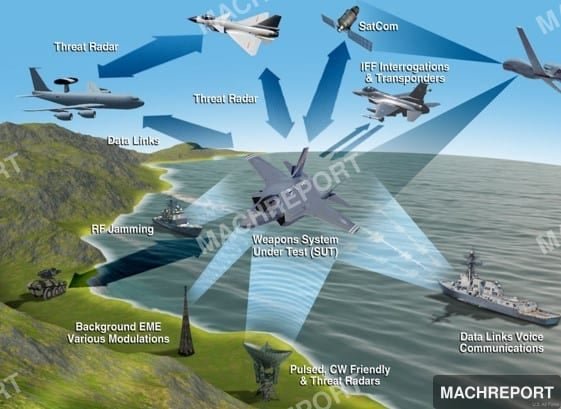
Electronic warfare used to be treated as a supporting act. Now it's closer to the main event. It touches everything radar, comms, navigation, data links, the sensors a pilot trusts to tell him what's actually out there. NATO's own definition captures this: electromagnetic warfare is about using electromagnetic energy to build situational awareness and to create effects, offensive and defensive, against an adversary's radar, communications and navigation
That matters everywhere, but it matters more in places like the India-Pakistan theatre, where two capable air forces sit close together, reaction windows are short, and there's very little room for error.
A War You Can't See
Here's the uncomfortable part for anyone who still thinks in terms of "how many jets does each side have": an aircraft doesn't need to be shot down to be useless. If you can blind its sensors, jam its comms, or scramble its navigation, you've effectively taken it out of the fight without firing a shot at it.
The Joint Air Power Competence Centre puts it plainly freedom to operate in the air increasingly depends on who controls the spectrum, because everything from communication to targeting runs through it. That's really the core of the argument here. EW doesn't go after the airframe. It goes after the information the airframe depends on to function. And that's arguably a more valuable target.
It's Not Just Jamming
People hear "electronic warfare" and picture jamming static drowning out a radio signal. That's part of it, but only part.
There's also the listening side: picking apart an adversary's emissions to figure out what's out there before they know you're looking. Analysts call this electronic support, and it's often the quieter, more valuable half of the equation you learn more by listening than by shouting.
Then there's electronic attack, which is the jamming most people picture, and electronic protection, which is the least glamorous but arguably the most important keeping your own systems working when the other side is trying to do the same thing to you.
Strip away the jargon and it comes down to this: modern air combat is a race to see the other guy before he sees you. EW is how you either win that race or sabotage the other side's ability to run it.
The Real Target Is Air Defence
This is where it gets serious. A modern integrated air-defence network isn't one radar and one missile battery it’s a web of long-range sensors, command nodes and interceptors all talking to each other. Attack one part and the rest can still function. That's the whole point of building it that way.
EW is one of the few tools that can go after the network itself rather than a single node confusing it, blinding pieces of it, feeding it bad information. RUSI has flagged this as one of the more essential functions in modern high-intensity air operations, pointing specifically to escort jamming and stand-in jamming as tools that make suppression of enemy air defences possible.
Which leads to an uncomfortable truth for anyone who puts too much faith in a jet's spec sheet: how good that aircraft actually is on a given day depends heavily on what's happening around it electronically. Send a top-tier fighter into contested airspace without EW support behind it, and it's a lot less capable than its brochure suggests.
Why This Hits Close to Home for South Asia
India and Pakistan aren't hypothetical case studies here they're a live example of exactly this dynamic playing out. Both sides have been investing in sharper aircraft, denser air-defence coverage, better surveillance platforms and growing drone fleets, all crammed into a small geographic space with very little warning time if things go wrong.
The 2025 crisis between the two countries put a spotlight on exactly this. In its aftermath, a lot of the analysis wasn't about which jet was better it was about drones, beyond-visual-range engagements, and networked systems, EW included, as the things that actually shaped how the crisis unfolded. India, for its part, has been building out its own EW capacity rather than relying purely on off-the-shelf kit. In April 2025, its Ministry of Defence signed off on a contract with Bharat Electronics for EW suites and modification kits for its Mi-17 V5 helicopters, explicitly framed around improving survivability in contested environments. That's not an isolated purchase it’s part of a broader regional shift where EW has stopped being a nice-to-have and started being treated as baseline equipment.
Drones Change the Math
Add drones into this picture and things get more interesting. Unmanned systems are cheap, they're everywhere now, and they're useful for surveillance, targeting, even strikes. But almost all of them still need a link back to someone for navigation, for control, for the mission to mean anything.
That dependency is exactly what EW is good at exploiting. You don't have to shoot down every drone that comes at you. Break its link to GPS or its operator, and it's often just as dead in the water. And there's a cost logic here that should worry anyone budgeting for drone defence purely in terms of missiles and guns: a comparatively cheap jamming effect can neutralise a platform that cost far more to build and field.
Whoever Sees Clearly, Wins
Situational awareness has always mattered in air combat, but networked warfare has raised the stakes considerably. Airborne early-warning platforms like NATO's AWACS aren't just radar in the sky anymore they’re doing surveillance, command and control, and battlespace management all at once, feeding a shared picture to everyone else in the fight.
If one side can keep that picture intact while quietly degrading the other side's ability to build theirs, that's a real advantage arguably a bigger one than showing up with a faster jet. Put simply, the next air war probably won't be decided by who spots the enemy first. It'll be decided by who manages to stop the other side from seeing clearly at all.
AI Is About to Make This Worse (or Better, Depending Who You Ask)
Here's where things get harder to predict. EW systems have to chew through enormous volumes of signal data and react to an adversary that's constantly changing frequencies and patterns just to avoid being pinned down. That's a hard problem for humans to keep pace with manually.
RUSI has pointed to exactly this the pace at which radar and EW systems are evolving is pushing forces to rely on machine learning to keep their EW mission data current, because doing it by hand is getting harder to sustain.
What that likely means in practice is an accelerating loop: smarter sensors, more adaptive jamming, defensive systems that evolve just as fast to counter them. And in that kind of contest, the advantage probably doesn't go to whoever bought the most expensive gear. It goes to whoever can learn and adjust faster than the other guy.
Don't Forget the Defensive Side. It's tempting to think of EW purely in offensive terms jam them, blind them, win. But a force that's great at attacking an adversary's systems and terrible at protecting its own isn't actually winning anything. It's just trading vulnerabilities. That means redundancy, secure comms that don't fold the moment they're contested, backup navigation that doesn't rely solely on GPS, and enough discipline about your own emissions that you're not handing the enemy a map of where you are. NATO's own air power strategy flags electronic warfare and cyber interference as major factors that will make future air operations harder to fight cleanly, and it's blunt about the need for forces to keep operating even when both are working against them.
For air forces in South Asia specifically, this might be the part that gets underweighted. Everyone wants better jamming. Fewer people want to spend the same money hardening their own systems against it.
Bottom Line: The next serious air war in this region or frankly anywhere with two capable air forces facing off won’t be won purely on fighter specs and missile range. A lot of it will be decided in a fight nobody outside the services will ever see: over the airwaves, in the data links, in whether a radar picture stays accurate or gets quietly corrupted.
For India and Pakistan specifically, that stakes feel higher than most places, simply because both sides are stacking up exactly the kind of hardware jets, drones, air defence, networked sensors that makes this contest matter. Whoever manages to control that electromagnetic space, while denying the same to the other side, is probably going to hold the advantage everywhere else too.
It's not a flashy way to win a war. But it might be the decisive one.
Comments
Login to comment
No comments yet. Start the conversation.